Mastering Charisma and Conversation
Communication Essentials
The Communication Loop
Communication isn't a one-way street; it's a dynamic, cyclical process. Think of it less like sending a letter and more like a game of catch. The goal isn't just to throw the ball, but to have it caught and thrown back. This constant exchange is what builds connections.
Every conversation involves a few key players:
- Sender: The person initiating the message.
- Receiver: The person interpreting the message.
- Message: The information being conveyed, which includes words, tone, and body language.
- Channel: The medium through which the message travels, like speech, text, or video.
The magic, or the misstep, happens in the translation. The sender encodes their thought into a message, and the receiver decodes it. Charismatic communication hinges on making this process as seamless as possible. It’s not just about what you say, but ensuring the way you say it—your word choice, tone, and gestures—is interpreted as intended. Clarity in this exchange is the foundation of influence and connection.
Crossing the Static
Even with the best intentions, messages can get distorted. In communication theory, this distortion is called noise. It's anything that interferes with the successful decoding of a message.
Noise isn't just about a loud room (physical noise). It can be psychological, like being distracted or biased. It can also be semantic noise, where words are misinterpreted. For example, telling a colleague their presentation was "fine" could be decoded as polite praise or as a sign of underwhelming performance, depending on context and relationship.
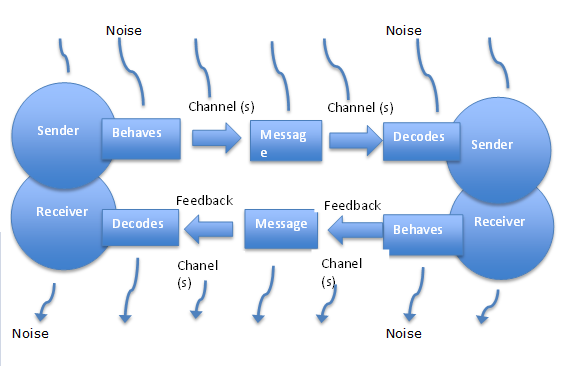
Mitigating noise is a core skill. It involves choosing the right channel for your message and, more importantly, being aware of the receiver's context. A charismatic person anticipates potential misinterpretations and adjusts their approach to ensure their message lands clearly and connects emotionally.
Closing the Loop with Feedback
Feedback is the receiver's response to the message. It's the critical final step that turns a monologue into a dialogue and completes the communication loop. Without it, the sender is just guessing if their message was received, understood, or had the desired impact.
Feedback can be verbal ("I agree," or "Can you clarify that?") or nonverbal (a nod, a confused expression, a smile). Charismatic individuals are masters of observation. They constantly scan for these cues, using them to gauge engagement and adjust their message in real-time. This practice of active listening is what makes people feel heard and understood, which is a powerful way to build rapport.
Effective feedback isn't just about correction; it's about connection. It's the proof that you're not just talking at someone, but with them.
By understanding this entire cycle—from a clear message to navigating noise and interpreting feedback—you gain control over your interactions. You can move from simply exchanging information to genuinely connecting with people, which is the heart of charisma.
Now that we've broken down the essential mechanics of communication, let's test your understanding of these core concepts.
Which analogy best describes the communication process?
In the communication model, the sender _______ their thought into a message, and the receiver _______ it.
Understanding these components is the first step. Next, we'll explore how to consciously use them to shape your interactions and build your charismatic presence.