Mastering CBSE Class 12 Physics
Electrostatics and Potentials
The Direction of Force
You already know that electric charges exert forces on each other. Coulomb's Law gives us the magnitude of this force. But force is a vector, meaning it has both magnitude and direction. To fully describe the interaction, we need to express Coulomb's Law in its vector form.
Let's consider two point charges, and , with position vectors and respectively. The force exerted on by , denoted as , is directed along the line connecting the two charges.
The unit vector is crucial. It's defined as . If and have the same sign (both positive or both negative), their product is positive, and points in the same direction as . This represents a repulsive force. If they have opposite signs, is negative, and points opposite to , indicating an attractive force. This vector form neatly encapsulates both the magnitude and the directional nature of electrostatic force.
Fields from Charge Pairs
An electric dipole consists of two equal and opposite charges, and , separated by a small distance, usually denoted by . This simple configuration is fundamental, appearing in molecules and antennas. The dipole moment, , is a vector quantity with magnitude and direction pointing from the negative to the positive charge.
Calculating the electric field around a dipole is a key application of the superposition principle. We'll examine the field at two specific locations: along the axis of the dipole and on the plane that bisects it.
An ideal or point dipole is one where the separation approaches zero while the charge approaches infinity, such that the product remains finite and constant.
Field on the Axial Line
The axial line is the line passing through both charges of the dipole. Consider a point P on this line at a distance from the midpoint O of the dipole.
The electric field at P is the vector sum of the fields due to and . The field from points away from it, while the field from points towards it. Since P is closer to , the field from the positive charge is stronger, and the net field points away from the dipole.
The magnitudes of the fields are:
The net field is their difference:
For a short dipole (), the axial field simplifies to: . The field strength decreases as the cube of the distance, which is faster than the inverse square law for a single point charge.
Field on the Equatorial Line
The equatorial line (or plane) is the perpendicular bisector of the dipole. Let's find the field at a point P at a distance from the midpoint O.
The magnitudes of the fields from both charges are equal because P is equidistant from and . The distance is . The field from points away from it, and the field from points towards it.
When we resolve these vectors, the components perpendicular to the dipole axis (the vertical components) cancel out. The components parallel to the axis (the horizontal components) add up, pointing opposite to the dipole moment vector.
The magnitude of each field is:
The net field is the sum of the horizontal components, which is .
For a short dipole (), the equatorial field is: . Notice that for the same distance , the axial field is twice the magnitude of the equatorial field.
A Shortcut for Symmetry
Calculating the electric field for continuous charge distributions by integrating over every infinitesimal charge can be mathematically intensive. Gauss's Law provides a powerful and elegant alternative, especially for charge distributions with a high degree of symmetry (planar, cylindrical, or spherical).
The law relates the net electric flux through a closed surface to the net charge enclosed by that surface. Electric flux, , is a measure of the total number of electric field lines passing through a given surface.
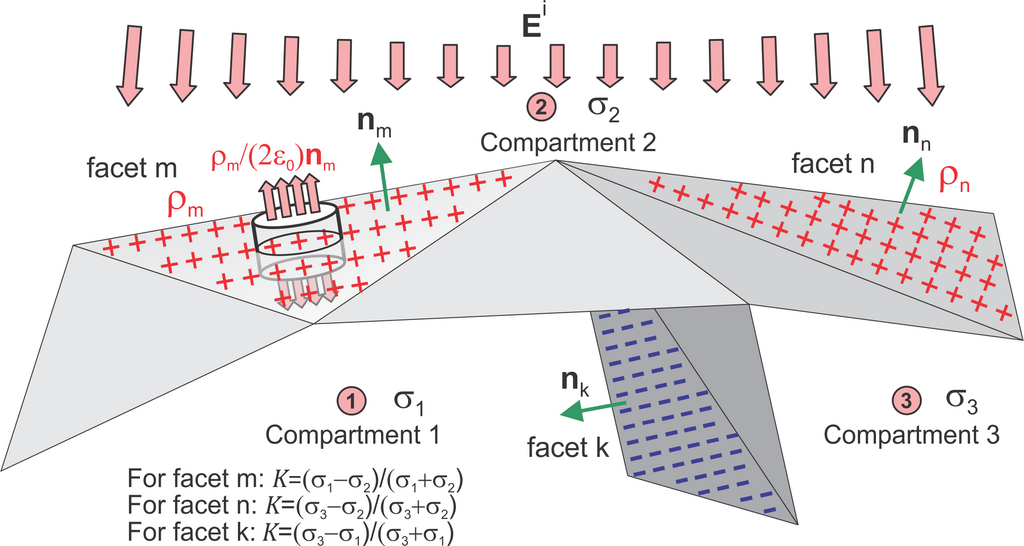
Gauss's Law states that the net electric flux through any closed surface (called a Gaussian surface) is equal to times the net electric charge enclosed within that surface.
The key is to choose a Gaussian surface that takes advantage of the problem's symmetry, so that the electric field magnitude is constant and parallel (or perpendicular) to the surface vector over parts of the surface, simplifying the integral.
Application 1: Infinitely Long Straight Wire
Consider an infinitely long, straight wire with a uniform positive linear charge density (charge per unit length).
- Symmetry: By symmetry, the electric field must point radially outwards from the wire. Its magnitude can only depend on the distance from the wire.
- Gaussian Surface: We choose a cylindrical surface of radius and length , coaxial with the wire.
- Flux Calculation: The cylinder has three surfaces: two flat end caps and one curved side. For the end caps, the electric field is perpendicular to the area vector , so . The flux through the caps is zero. For the curved surface, is parallel to everywhere. The angle between them is 0°, so . Since is constant at radius , the integral simplifies.
Applying Gauss's Law:
The charge enclosed by the cylinder is . Now we set the two sides equal:
Application 2: Infinite Plane Sheet
Consider an infinite, non-conducting plane sheet with a uniform positive surface charge density (charge per unit area).
- Symmetry: The electric field must be perpendicular to the sheet, pointing outwards on both sides.
- Gaussian Surface: We use a small cylinder or box (a "pillbox") that pierces the sheet, with its flat ends parallel to the sheet and equidistant from it.
- Flux Calculation: The field lines are parallel to the curved sides of the cylinder, so the flux through the sides is zero. The field lines are perpendicular to the two flat end caps (each of area ). The flux passes only through these caps.
Applying Gauss's Law:
Application 3: Uniformly Charged Thin Spherical Shell
Consider a thin spherical shell of radius with total charge distributed uniformly over its surface. The surface charge density is .
- Symmetry: The spherical symmetry dictates that the electric field must be radial, and its magnitude only depends on the distance from the center.
- Gaussian Surface: We choose a concentric sphere of radius .
Case 1: Outside the shell ()
The Gaussian sphere of radius encloses the entire charge . The flux is . Applying Gauss's Law:
Case 2: Inside the shell ()
Now, the Gaussian sphere is inside the charged shell. It encloses no charge, so . Applying Gauss's Law:
Potential and Energy
While the electric field describes the force on a charge, the electric potential, , describes the potential energy per unit charge at a point in space. It's a scalar quantity, making it easier to work with than the vector electric field.
An equipotential surface is a surface on which the electric potential is constant. No work is done in moving a charge along an equipotential surface, which means the electric field lines must always be perpendicular to these surfaces.
For a point charge, the equipotential surfaces are concentric spheres. For a uniform electric field, they are parallel planes.
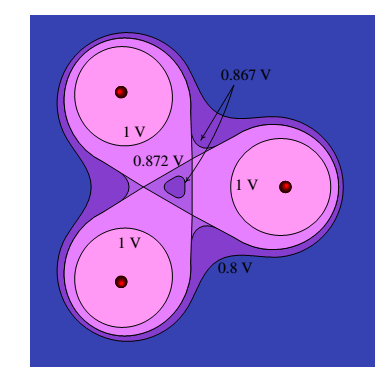
The relationship between the electric field and potential is described by the potential gradient. The electric field points in the direction of the steepest decrease in potential.
Capacitors and Dielectrics
A capacitor is a device designed to store electrical energy. It typically consists of two conductors separated by an insulator (a dielectric). The simplest form is the parallel plate capacitor.
The capacitance, , is the ratio of the charge stored on one conductor to the potential difference between the conductors.
What happens when we insert a dielectric material between the plates? A dielectric is an insulator that becomes polarized in an electric field. This creates an internal electric field that opposes the external field, reducing the net electric field between the plates. Since , a reduced electric field leads to a lower potential difference for the same charge . According to , a lower means a higher capacitance.
The effect is quantified by the dielectric constant, (kappa).
Energy Stored in a Capacitor
Charging a capacitor involves doing work to move charge from one plate to another against the electric field. This work is stored as potential energy in the electric field between the plates.
Combination of Capacitors
Capacitors can be combined in circuits in two basic ways:
-
Series: When connected in series, the charge on each capacitor is the same. The total potential difference is the sum of the individual potential differences. The equivalent capacitance is found by:
-
Parallel: When connected in parallel, the potential difference across each capacitor is the same. The total charge stored is the sum of the charges on each capacitor. The equivalent capacitance is:
In the vector form of Coulomb's Law, . If the product is negative, what is the relationship between the force vector and the unit vector ?
For an electric dipole, what is the direction of the net electric field at a point on its equatorial line?
These principles form the foundation of electrostatics, governing everything from molecular interactions to the design of high-voltage equipment.