Mastering Cat Training Fundamentals
Understanding Cat Behavior
The World Through a Cat's Eyes
To understand a cat, you have to think like one. Domestic cats may seem far removed from their wild ancestors, but they are still driven by powerful, ancient instincts. At their core, they are solitary predators. This fundamental truth shapes everything they do, from how they play to how they interact with you.
Ever see your cat stalk a toy mouse, crouch low, and pounce with perfect precision? That's not just a game. It's a deeply ingrained hunting sequence: stalk, chase, pounce, and kill. Even a well-fed housecat needs to express these behaviors to feel fulfilled. Other behaviors, like scratching, climbing to high places, and hiding in small spaces, also stem from these survival instincts. A high perch gives them a safe vantage point to survey their territory, while a good scratching post lets them mark their space and maintain their claws.
Recognizing the instinct behind the action is the first step. Your cat isn't scratching the sofa to spite you; it's fulfilling a natural need. Understanding this allows you to see their behavior not as good or bad, but simply as feline.
The Language of Cats
Cats communicate constantly, using a subtle and complex language that combines body posture, vocalizations, and scent. They don't rely on a single signal, but a combination of cues to express their feelings and intentions.
Their most expressive tool is their body. A cat's tail, ears, and eyes are like billboards for their emotional state. Learning to read these signals helps you understand what your cat is trying to tell you.
| Body Part | Signal | Meaning |
|---|---|---|
| Tail | Held high, slight curve | Confident, friendly |
| Tail | Tucked low or between legs | Fearful, insecure |
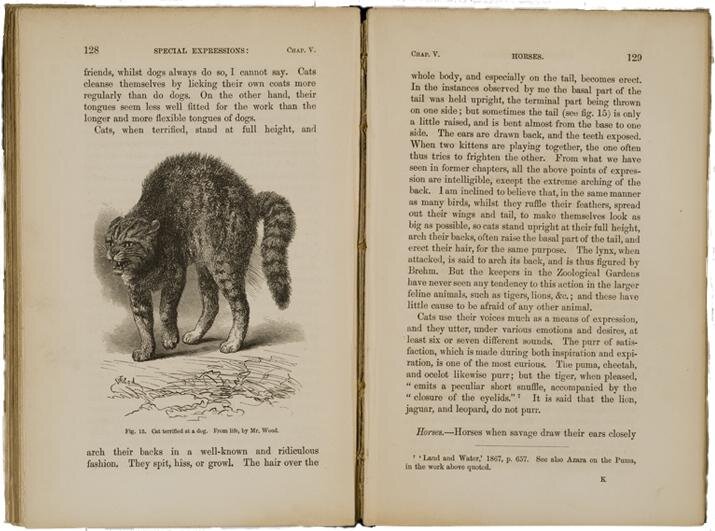
| Tail | Puffed up (like a pipe cleaner) | Very scared or angry |
| Ears | Pointed forward, relaxed | Alert, content |
| Ears | Flattened back against the head | Afraid, annoyed, aggressive |
| Eyes | Slow blink | Trust, affection (a "cat kiss") |
| Eyes | Wide with dilated pupils | Excited, fearful, or aggressive |
The slow blink is one of the clearest signs of trust a cat can offer. Returning the gesture by slowly closing and opening your own eyes can be a powerful way to communicate that you are not a threat.
Vocalizations are just as important. While kittens meow to their mothers, adult cats often reserve their meows for communicating with humans. A purr usually signals contentment, but cats also purr to comfort themselves when they're scared or in pain. Hisses, growls, and spits are unmistakable warnings to back off. Friendly chirps and trills, on the other hand, are often used as a greeting.
Territory and Social Rules
Cats are deeply territorial. Their home is their kingdom, and they need to feel secure within its borders. They mark their territory using scent glands located on their cheeks, forehead, paws, and tail. When your cat rubs its face against you or the furniture, it's not just being affectionate; it's depositing its scent and claiming you as part of its safe zone. This act, called bunting, creates a familiar scent profile that makes the cat feel secure.
Despite their reputation as loners, cats can form complex social structures, especially in multi-cat households. They establish hierarchies and routines to minimize conflict. You might notice one cat always eats first, or another claims the best spot on the sofa. This isn't necessarily a sign of dominance, but rather a way for cats to navigate shared resources and space without fighting.
Disruptions to this territory, like moving furniture, introducing a new pet, or even having guests over, can be very stressful. A cat that suddenly hides or becomes aggressive may be reacting to a perceived threat to its territory. Understanding their need for a stable environment is key to a happy cat and a harmonious home.