Mastering Calculus Integration
Introduction to Integration
The Other Side of Change
We've seen that differentiation is all about finding the rate of change. If you have a function that describes a car's position, its derivative gives you the car's velocity at any instant. It's like having a movie and pausing it to see exactly how fast something is moving at that one moment.
But what if you have the opposite problem? What if you know the car's velocity at every moment and want to figure out the total distance it has traveled? This process of adding up all the tiny changes to find the whole is called integration. It's the reverse of differentiation.
Integral
noun
A mathematical object that can be interpreted as an area or a generalization of an area. It represents the accumulation of a quantity.
Visually, one of the most common ways to think about an integral is as the area under a curve. Imagine plotting a function on a graph. The integral over a certain interval gives you the exact area of the shape bounded by the function's curve, the x-axis, and the start and end points of the interval.
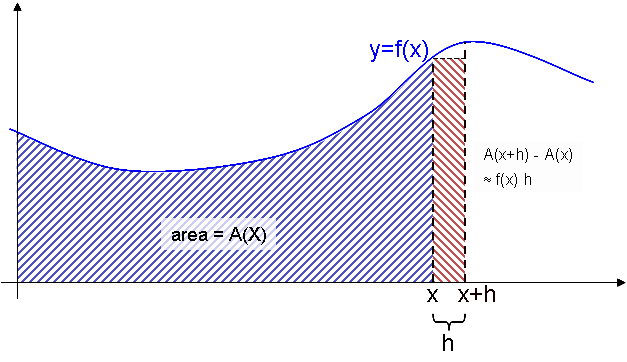
Two Kinds of Integrals
Integration comes in two main flavors: indefinite and definite.
An indefinite integral is the most general form of the reverse derivative, often called the antiderivative. When we differentiate a function, any constant term disappears. For example, the derivative of is . The derivative of is also . So, if we want to go backward from , what was the original function? We don't know the constant.
To account for this, we add a constant of integration, written as . The indefinite integral of is . The notation looks like this:
The is the integral sign, and indicates that we are integrating with respect to the variable .
A definite integral, on the other hand, calculates the accumulated value over a specific range. It gives us a concrete number representing the area under the curve between two points, say from to . Since we're calculating the change between two points, the constant cancels out and isn't needed.
This represents the area under the curve of from to .
The Fundamental Theorem
The deep connection between differentiation (finding slopes) and integration (finding areas) is spelled out by the Fundamental Theorem of Calculus. It's a cornerstone of mathematics for a reason.
The theorem has two parts, but the main idea is this: differentiation and integration are inverse operations. They undo each other. If you integrate a function and then differentiate the result, you get back the original function you started with.
The Fundamental Theorem of Calculus links derivatives and integrals in a beautiful symmetry, showing that integration and differentiation are inverse processes.
This theorem is what allows us to calculate definite integrals easily. To find the area under the curve of from to , we just need to find its antiderivative, let's call it , and then calculate . No more slicing the area into infinite tiny rectangles!
Basic Integration Rules
Just like with derivatives, there are rules to make finding integrals easier. The most basic one is the power rule, which is the reverse of the power rule for differentiation.
To find the integral of , you increase the exponent by one and then divide by the new exponent.
Let's try it with an example. To integrate , we raise the power from 3 to 4, then divide by 4.
You can check this by differentiating the result. The derivative of is indeed .
Another simple rule involves constants. You can pull a constant multiplier out of the integral, just like with derivatives.
Example: To find , we can treat it as . Using the power rule on gives . So the final answer is , or .
These basic rules are the first steps toward solving a huge range of problems that involve accumulation and summing things up.
If a function v(t) describes a car's velocity at time t, what does the integral of v(t) represent?
What does a definite integral, such as , typically represent visually on a graph?