Mastering Calculus Function Rewriting
Understanding Functions
The Idea of a Function
Think of a function as a simple machine. You put something in, it does something to it, and something new comes out. For every valid input, you get exactly one output. A coffee grinder is a good analogy. You put in coffee beans (the input), and you get coffee grounds (the output). You can't put in beans and get out tea.
A function is a rule that assigns each input value to exactly one output value.
In mathematics, we usually work with numbers. We might have a function that takes a number and doubles it. If you put in a 2, you get a 4. If you put in a 5, you get a 10. We often write this relationship using notation like . Here, is the name of the function, and is the input. The expression tells us the rule: take the input and multiply it by 2.
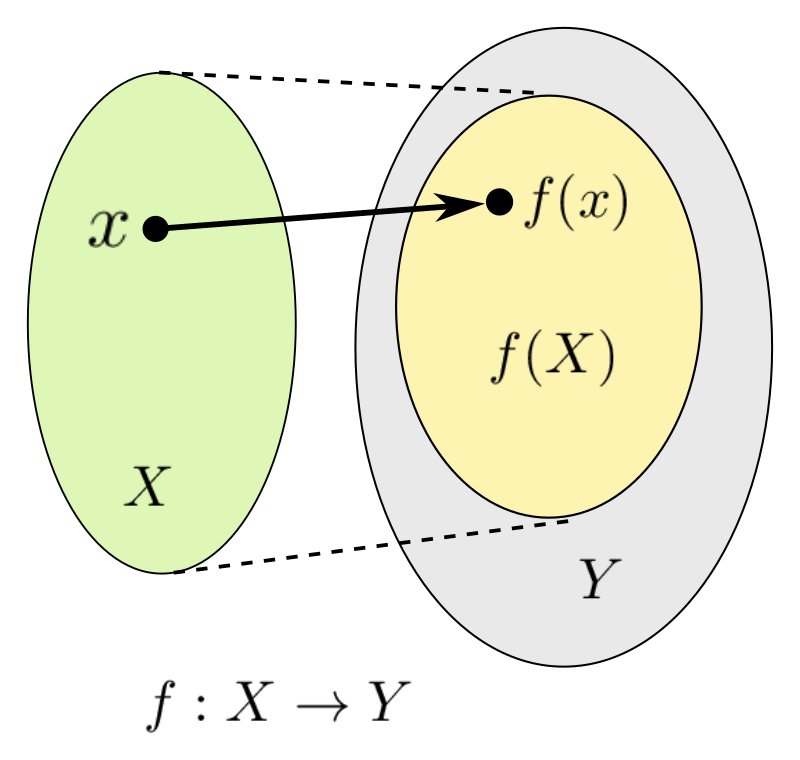
Two key terms go along with functions: domain and range. They tell us what numbers we're allowed to use.
Domain
noun
The set of all possible input values for a function.
Range
noun
The set of all possible output values for a function.
For our doubling function, , you can put in any real number. So, its domain is all real numbers. Since doubling any real number results in another real number, its range is also all real numbers.
But what about a function like ? You can put in almost any number, but you can't divide by zero. So, the domain is all real numbers except 0. It's also impossible to get 0 as an output, so the range is also all real numbers except 0.
A Family of Functions
Functions come in many varieties, each with its own characteristic shape and behavior. Getting to know them is like meeting the members of a large, interesting family.
| Function Type | General Form | Description |
|---|---|---|
| Linear | Creates a straight line graph. The 'm' is the slope and 'b' is where it crosses the y-axis. | |
| Quadratic | Creates a parabola (a U-shape). It can open upwards or downwards. | |
| Polynomial | A generalization of linear and quadratic functions with whole number exponents. Can have many curves and turns. | |
| Rational | A ratio of two polynomial functions. Often has asymptotes, which are lines the graph approaches but never touches. |
Beyond polynomials, there are other essential types of functions you'll encounter constantly in calculus.
Exponential and logarithmic functions are two sides of the same coin. One describes rapid growth or decay, while the other is its inverse.
Think of population growth or radioactive decay. The variable is in the exponent, leading to very rapid changes.
This function answers the question, "What exponent do I need to raise to in order to get ?" It's the inverse of the exponential function and grows very slowly. Notice that its domain is only positive numbers ().
Finally, we have the functions that describe repeating patterns, like waves or the swinging of a pendulum.
Trigonometric Functions
Trigonometric functions relate the angles of a right triangle to the ratios of its side lengths. The three most common are sine, cosine, and tangent. They are periodic, meaning their graphs repeat in a predictable cycle.
These functions are fundamental for modeling anything with a cyclical nature, from sound waves and light to the changing of the seasons.
Let's check your understanding of these different function types.
Which of the following relationships best describes a function?
If a function is defined as , what is ?
Grasping these fundamental function types is the first step toward understanding calculus. Each has a distinct personality, and you'll soon learn how to analyze their rates of change and the areas underneath their curves.