Mastering Buoyancy and Archimedes Principle
Buoyant Force Mechanics
Pressure's Upward Push
We know that the deeper you go in a fluid, the greater the pressure. This is because of the weight of the fluid piling up from above. But pressure doesn't just push down; it pushes in all directions. An object submerged in water feels pressure on its top, bottom, and all its sides.
Consider a simple cylinder submerged upright in water. The pressure pushing on its left side is perfectly balanced by the pressure pushing on its right side. These horizontal forces cancel each other out. But the vertical forces are a different story. The bottom of the cylinder is deeper than the top, so the pressure pushing up on its bottom surface is stronger than the pressure pushing down on its top surface.
This imbalance creates a net upward force. This is the buoyant force. It's a true force, a vector quantity with both magnitude and direction. Its direction is always upward, opposing gravity.
From Pressure to Principle
We can calculate this net force precisely. The pressure at any depth in a fluid is given by the formula , where (rho) is the fluid's density and is the acceleration due to gravity.
The downward force on the top of our cylinder is , where is the area of the cylinder's top face. The upward force on the bottom is .
The buoyant force, , is the difference between these two opposing forces.
We can simplify this by factoring out the common terms.
Notice that the term is just the formula for the cylinder's volume, . By substituting into the equation, we arrive at the classic expression for the buoyant force.
This equation reveals something crucial: the mass of the object itself doesn't determine the buoyant force acting on it. Only the density of the fluid and the volume of the object matter. This mathematical link is the core of Archimedes' Principle—the buoyant force on a submerged object is equal to the weight of the fluid it displaces. It's not magic, just physics rooted in pressure differences.
The buoyant force depends on the weight of the fluid pushed aside, not the weight of the object itself.
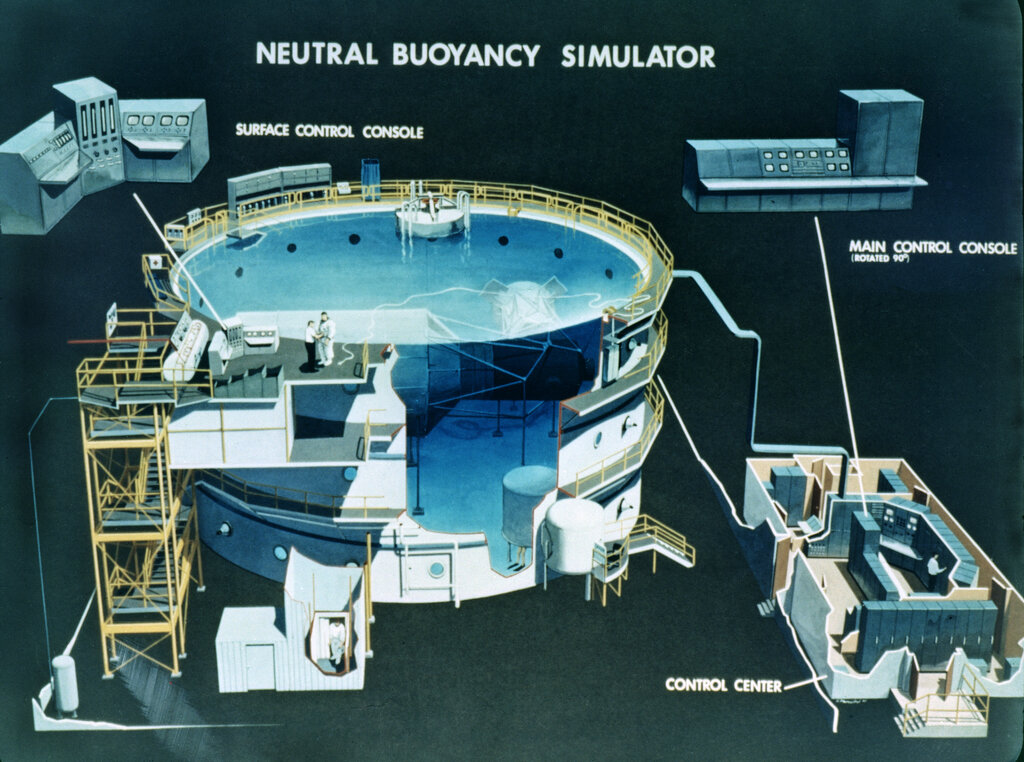
Engineers use this principle to achieve neutral buoyancy for astronaut training. By carefully balancing an astronaut's weight with the buoyant force in a massive pool, they can simulate the weightless conditions of space. The astronaut floats, neither sinking nor rising, perfectly suspended in a state of with the surrounding water.
What is the fundamental cause of the buoyant force on a submerged object?
Which formula correctly represents the buoyant force, , according to Archimedes' Principle?
Understanding how pressure differences create this upward force is the key to seeing why some things float and others sink.