Mastering Book Reading
Active Reading Strategies
Reading Isn't Just Looking at Words
Have you ever finished a page, or even a chapter, and realized you have no idea what you just read? Your eyes moved across the words, but your brain was somewhere else entirely. That’s passive reading. It’s like listening to music while you’re focused on something else; you hear it, but you're not really taking it in.
Active reading is the opposite. It’s a focused, conscious effort to understand and engage with the material. Instead of just letting the words wash over you, you enter into a conversation with the text. You question it, you connect with it, and you make it your own.
Active reading engages your brain in effective strategies that force your brain to interact with the text before, during, and after reading and that help you better gauge what you are (and aren’t) learning.
This approach transforms reading from a one-way street into a dynamic dialogue. It’s the difference between being a spectator and being a participant. Let's look at a few simple ways to become a more active reader.
Talk to the Text
The simplest way to start reading actively is to make notes directly on what you're reading. This process is called annotation. It’s your side of the conversation with the author.
Don't be afraid to mark up your books or printouts. A pristine book might look nice on a shelf, but a marked-up one is a sign of a working mind. Here are a few ideas:
- Underline or highlight key sentences or phrases. Be selective. If you highlight everything, nothing stands out.
- Circle words you don't know so you can look them up later.
- Write questions in the margins. If something confuses you or makes you curious, jot it down.
- Make short comments. A quick “aha!” or “I disagree” or “key point” helps you process your reactions.
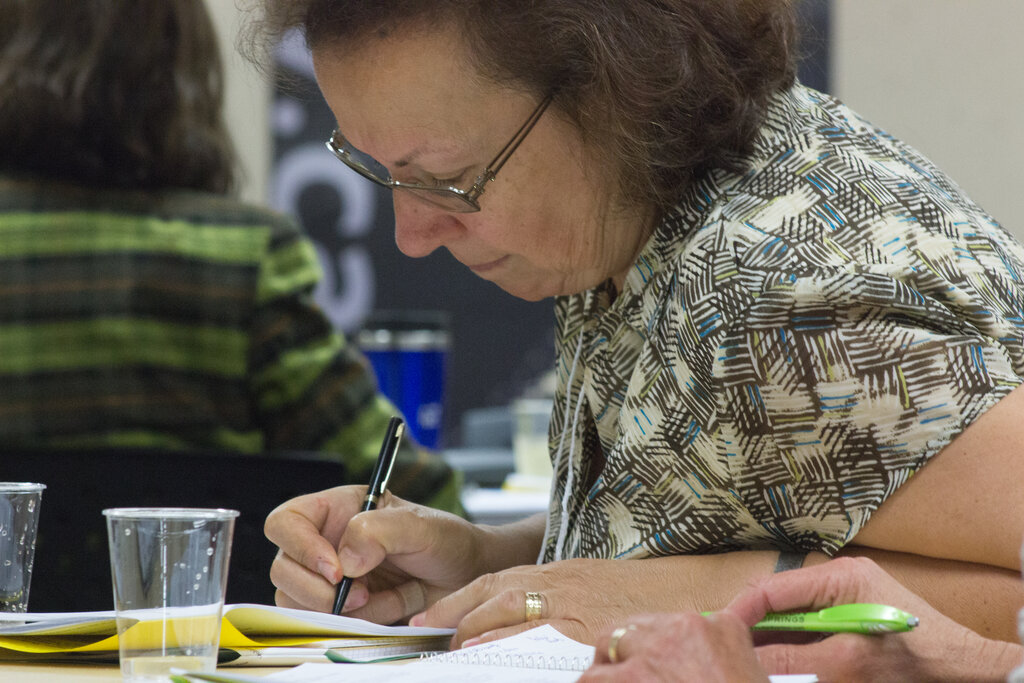
The goal isn't to create a masterpiece of marginalia. The goal is to keep your brain switched on and focused on what the text is actually saying.
Become a Questioner
Curiosity is a powerful engine for learning. Active readers are constantly asking questions before, during, and after they read. This habit turns reading into a quest for answers.
By formulating questions, you give your reading a purpose. You’re not just reading to get to the end; you’re reading to find something out.
| Reading Stage | Sample Questions |
|---|---|
| Before Reading | What does the title suggest this will be about? What do I already know about this topic? What do I want to learn? |
| During Reading | What is the main point of this paragraph? Why did the author include this example? What does this word mean in this context? |
| After Reading | What were the most important ideas? How does this connect to other things I know? What is one thing I’m still confused about? |
You don't need to write down every single question, but keeping them in mind as you read will keep you focused and help you identify the most important information.
Put It In Your Own Words
The final test of understanding is being able to explain something simply. After you read a section, pause and try to summarize its main points in your own words. You can do this out loud, in your head, or by writing a sentence or two in the margin or a notebook.
If you read a whole chapter, try writing a short paragraph that captures the core argument or story. This isn't about restating every detail. It's about distilling the essence of the text.
Forcing yourself to summarize reveals what you truly understand versus what you only think you understand. If you can't put it in your own words, you haven't quite grasped it yet.
This practice strengthens your memory of the material and builds a solid foundation for more complex ideas later on.
What is the primary difference between active and passive reading?
The process of making notes directly on the text you're reading is called _______.
These active reading strategies aren't complicated, but they require a shift in mindset. By annotating, questioning, and summarizing, you take control of your learning and get far more out of every text you read.