Mastering Blue Ocean Strategy
Introduction to Blue Ocean Strategy
Beyond the Competition
Most companies battle for market share in a crowded space. They fight over the same customers, offering similar products and services. This is a tough, often bloody, way to do business. Think of a patch of ocean crowded with sharks fighting over a limited supply of fish. The water turns red. This is a “red ocean.”
Blue Ocean Strategy offers a different path. Instead of fighting rivals in a red ocean, you create a new, uncontested market space—a “blue ocean.” Here, the competition is irrelevant because you’ve created a new frontier. You're not just trying to be better than the competition; you're making the competition obsolete by inventing a new market.
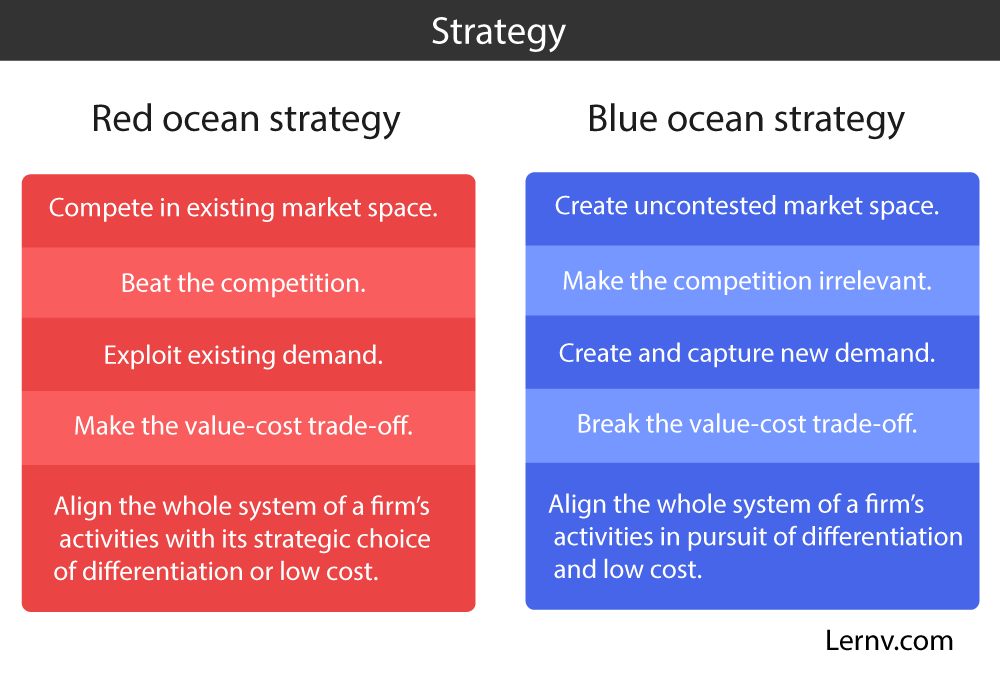
| Red Ocean Strategy | Blue Ocean Strategy |
|---|---|
| Compete in existing market space | Create uncontested market space |
| Beat the competition | Make the competition irrelevant |
| Exploit existing demand | Create and capture new demand |
| Make the value-cost trade-off | Break the value-cost trade-off |
| Align the whole system with differentiation OR low cost | Align the whole system with differentiation AND low cost |
The Heart of the Strategy
How do you create a blue ocean? The core idea is value innovation. This isn't just about technological breakthroughs or being the first to market. It’s about pursuing both differentiation and low cost at the same time.
Value innovation is the cornerstone of Blue Ocean Strategy. It's about creating a leap in value for buyers and your company, thereby opening up new and uncontested market space.
Typically, businesses assume they have to make a choice: offer a better product for a higher price, or an adequate product for a lower price. Value innovation rejects this trade-off. It seeks to lower costs by eliminating features that industries take for granted, while simultaneously raising buyer value by creating new sources of utility.
Guiding Principles
Creating a blue ocean isn't about random luck. It's a systematic process guided by a few key principles. These principles help you look at your industry and the world in a new way, spotting opportunities others miss.
Reconstruct Market Boundaries: Instead of accepting the defined limits of your market, you actively reshape them. This involves looking across different industries, customer groups, and even time to find new value.
Focus on the Big Picture, Not the Numbers: Get out of the weeds of spreadsheets and industry reports. Successful strategies are about seeing the overall strategic landscape and your place in it, not just crunching numbers based on the current state of play.
Reach Beyond Existing Demand: Red oceans are full of companies fighting over the same customer base. Blue oceans are created by looking to noncustomers—people who could be your customers but currently aren't—and understanding what would bring them into the market.
Get the Strategic Sequence Right: A brilliant idea is not enough. To be a sustainable blue ocean, a business model must be viable. This means following a specific sequence: ensuring buyer utility, setting the right price, achieving a target cost, and addressing any hurdles to adoption.
Let's test your understanding of these core concepts.
What is the primary characteristic of a "red ocean"?
What is the main goal of Blue Ocean Strategy?
By moving beyond competition, businesses can find new ways to grow and redefine their industries. It's a shift from dividing up an existing pie to baking a new, much larger one.