Mastering Bloom's Taxonomy for Effective Learning
Refining Learning Objectives
From Theory to Action
You already know the six levels of Bloom's Taxonomy, from remembering basic facts to creating new work. Now, let's translate that framework into sharp, measurable learning objectives. The goal is to move from a fuzzy idea of what learners should know to a precise statement of what they must be able to do.
The key is choosing the right verb. A well-chosen action verb sets a clear target for both the learner and the instructor. It removes ambiguity and makes assessment straightforward. Vague goals like "understand the new software" become concrete tasks like "generate a Q3 sales report using the new software."
| Bloom's Level | Action Verbs |
|---|---|
| Remember | Define, List, Recall, Name, Repeat |
| Understand | Classify, Describe, Discuss, Explain, Summarize |
| Apply | Implement, Solve, Use, Demonstrate, Execute |
| Analyze | Differentiate, Organize, Compare, Deconstruct, Attribute |
| Evaluate | Justify, Critique, Defend, Appraise, Recommend |
| Create | Design, Formulate, Assemble, Construct, Develop |
These verbs are your toolkit. When you build an objective, you're not just picking a word; you're defining the cognitive task you expect a learner to perform.
Crafting SMART Objectives
Strong learning objectives are not just actionable; they are SMART: Specific, Measurable, Achievable, Relevant, and Time-bound. This framework transforms a simple goal into a practical plan for instruction and assessment.
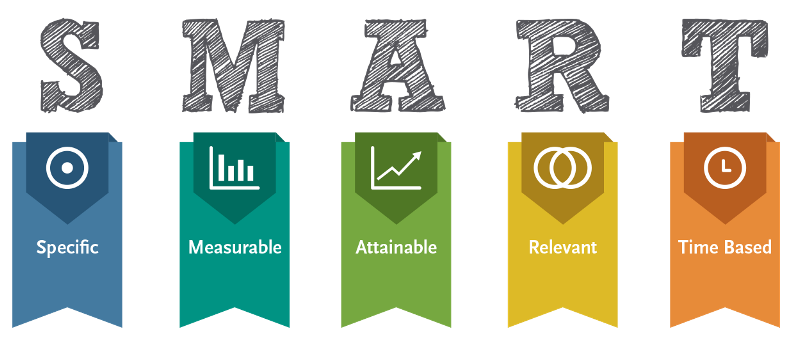
Let's break down an example. Imagine we're training new project managers.
- Vague Objective: Learn how to manage project risks.
- SMART Objective: By the end of the one-day workshop, you will be able to create a risk mitigation plan for a sample project, differentiating between high-priority and low-priority risks and justifying your resource allocation for each.
This revised objective is far more powerful. It uses verbs from the 'Create,' 'Analyze,' and 'Evaluate' levels of Bloom's Taxonomy. It specifies the conditions (one-day workshop, sample project) and the measurable outcome (a complete plan with justifications). The relevance is clear for a project manager, and it's achievable within the given time.
To be effective, LOs must focus on what students are intended to achieve, focus on specific cognitive processes, and be measurable.
Cognitive Load and Retention
When designing objectives, especially at the 'Remember' and 'Understand' levels, we have to consider two powerful forces: cognitive load and the forgetting curve. Cognitive load is the total amount of mental effort being used in the working memory. If you ask learners to remember too many unrelated facts at once, you overload their working memory, and very little gets transferred to long-term memory.
A good objective doesn't just state what needs to be remembered; it implies a structure that manages cognitive load. Instead of "Memorize all 25 new safety protocols," a better objective might be "List the 5 most critical safety protocols for handling hazardous materials." This focuses attention and makes the learning task manageable. We trade encyclopedic knowledge for practical, retainable skill.
Apply vs. Analyze in Practice
In a workplace setting, the line between 'Apply' and 'Analyze' can seem blurry. Both involve using knowledge to solve problems. The key difference lies in the nature of the task. Application is about using known procedures in concrete situations. Analysis is about breaking down information to understand its underlying structure and relationships.
Here’s a practical example for a data analyst:
-
Apply: Use a provided SQL script to extract user engagement data from the company database. This is a direct application of a known tool and procedure.
-
Analyze: Compare the user engagement data from Q1 and Q2 to identify three statistically significant trends in user behavior. This requires deconstructing the data, looking for patterns, and understanding the relationships between different data points.
Designing objectives that clearly distinguish between these two levels ensures you are building a ladder of skills, moving learners from simply following instructions to making informed, independent judgments. The 'Analyze' objective requires a deeper level of thinking and is a prerequisite for higher-level tasks like evaluating the effectiveness of a marketing campaign ('Evaluate') or designing a new feature based on the findings ('Create'). It’s not just about doing, but about understanding why you are doing it.