Mastering Blockchain Mining and Consensus Mechanics
Hashing and Nonce Mechanics
The Cryptographic Puzzle
At its core, Bitcoin mining is the process of solving a difficult mathematical puzzle. This isn't calculus or algebra; it's a brute-force guessing game on a massive scale. The goal is to be the first to find a specific number, and the tool used for this game is a cryptographic hash function.
Bitcoin uses the SHA-256 algorithm. A hash function takes any input—in this case, data from a block of transactions—and spits out a fixed-length string of characters, called a hash. It's a one-way street; you can't reverse the process to get the original input from the hash. A tiny change in the input, even a single bit, results in a completely different hash. This property is crucial for mining.
Anatomy of a Block Header
Miners aren't hashing all the transaction data at once. Instead, they work with a much smaller, 80-byte summary called the block header. Think of it as the table of contents for the block. The header contains six key pieces of information that get bundled together and hashed.
| Field | Size | Description |
|---|---|---|
| Version | 4 bytes | The block version number, indicating which block validation rules to follow. |
| Previous Block Hash | 32 bytes | The hash of the header of the previous block, linking them together in a chain. |
| Merkle Root | 32 bytes | A hash of the hashes of all transactions included in this block. |
| Timestamp | 4 bytes | The approximate time the block was created, in seconds since 1970. |
| Bits | 4 bytes | The difficulty target for this block, defining how small the block's hash must be. |
| Nonce | 4 bytes | A counter that miners change to try to find a valid hash. |
The is a clever way to summarize all the transactions in a block into a single, compact 32-byte hash. It's created by hashing each transaction, then pairing those hashes and hashing them, and repeating this process until only one hash remains. This structure allows for efficient verification of transactions without needing to download the entire block.
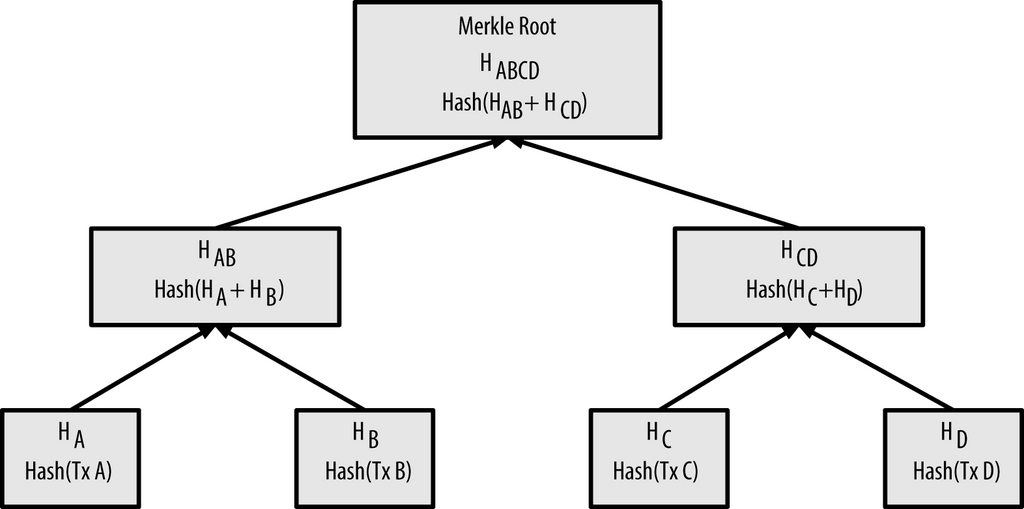
The Search for a Golden Nonce
Out of the six fields in the block header, miners can only freely change one: the Nonce. The nonce (a term meaning "number used once") is a 4-byte field, which gives miners about 4.2 billion values to try. A miner takes the other five fields, adds a nonce, and hashes the entire 80-byte header.
The puzzle is to find a nonce that, when combined with the rest of the header data, produces a hash that starts with a certain number of leading zeros. The number of zeros required is determined by the network's difficulty target.
What happens if a miner runs through all 4.2 billion nonces and doesn't find a valid hash? They can't just give up. This is where the extranonce comes in. By making a small change to the coinbase transaction (the transaction that pays the miner their reward), the miner can slightly alter the Merkle root. This change to the Merkle root gives them a completely new set of 4.2 billion nonces to try. This process repeats endlessly.
// A simplified view of the mining loop

nonce = 0
while (true) {
  // 1. Construct the block header with the current nonce
  block_header = version + prev_hash + merkle_root + timestamp + bits + nonce

  // 2. Hash the header (Bitcoin does this twice)
  hash = SHA256(SHA256(block_header))

  // 3. Check if the hash meets the difficulty target
  if (hash < difficulty_target) {
    // Found a valid block! Broadcast it to the network.
    broadcast(block)
    break // Exit the loop and start on the next block
  } else {
    // 4. If not, increment the nonce and try again
    nonce++
  }
}
Measuring the Effort
The sheer number of guesses required to find a valid hash is staggering. The total computational power dedicated to mining on the Bitcoin network is measured by the —the number of hashes being performed per second across the entire network.
A higher hash rate means more miners are competing, making the network more secure. It also means the difficulty of finding a valid block increases. The Bitcoin network automatically adjusts this difficulty roughly every two weeks (or 2,016 blocks) to ensure that, on average, a new block is found every 10 minutes, regardless of how many miners join or leave the network.
Time to check your understanding of these core mining mechanics.
What is the primary cryptographic hash function used in the Bitcoin mining process?
A Bitcoin miner has tried all approximately 4.2 billion possible values for the nonce but has not yet found a valid hash. What is the standard procedure for the miner to continue working on the same block?
Understanding how miners manipulate the block header through hashing is key to seeing how the blockchain stays secure and consistent.