Mastering Blockchain Development
Blockchain Fundamentals
A Shared Digital Notebook
At its heart, a blockchain is a special kind of database. Think of it as a digital notebook that's shared among a group of people. Instead of one person holding the notebook, everyone in the group has an identical copy. When someone wants to add a new entry, they announce it to the group. Everyone then adds the new entry to their own copy of the notebook.
At its core, blockchain technology is a digital distributed ledger that provides a strong foundation for securely recording and validating transactions without intermediaries.
This setup is powerful because it removes the need for a central authority, like a bank or a government, to keep track of things. The record is public, verified, and distributed among all the participants. This is the core idea behind a distributed ledger.
Centralized vs. Decentralized
Most systems we use today are centralized. Your bank, for example, stores all your financial records on its private servers. You have to trust the bank to maintain that ledger accurately and honestly. If their server goes down or gets hacked, your information is at risk.
A blockchain, on the other hand, is decentralized. The ledger isn't stored in one place; it's spread across a network of computers. Each computer on the network is called a node, and each node has a full copy of the entire ledger. This distribution makes the system incredibly resilient. To take down the network, you'd have to attack thousands of computers at once.
Because everyone has a copy, it's also very secure. If someone tries to cheat and alter a record on their copy, it won't match everyone else's. The network would immediately reject the fraudulent version, preserving the integrity of the ledger.
How the Chain Is Built
A blockchain stores information in groups called blocks. Each block contains a batch of transactions, a timestamp, and some other important data. Once a block is full, it's ready to be added to the chain.
Here's what makes it a "chain": each new block contains a unique, secure reference to the block that came before it. This link is created using cryptography.
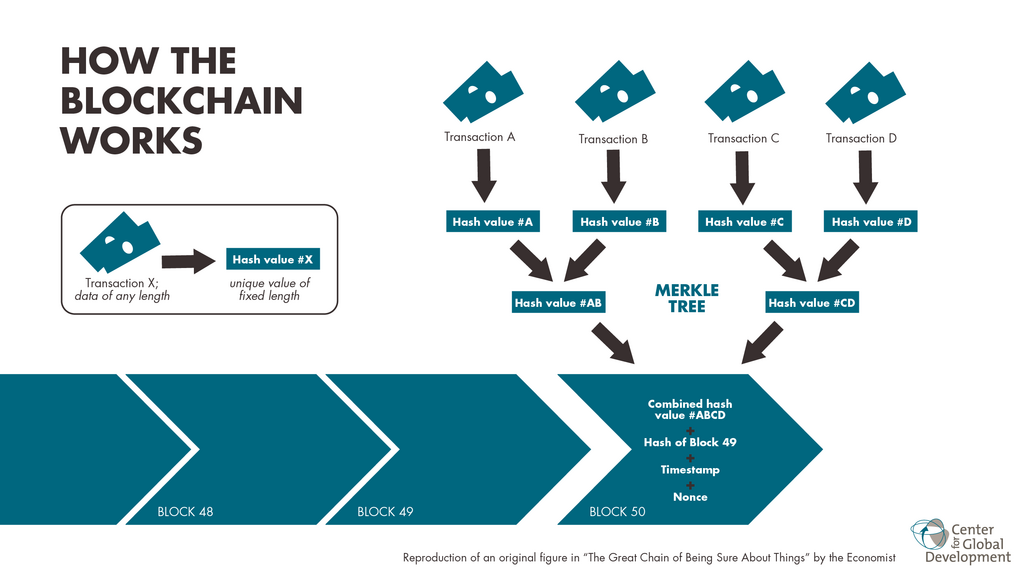
This reference is called a cryptographic hash. A hash is a unique digital fingerprint generated from the data inside the block. It's created by a special algorithm that takes the block's data as input and produces a fixed-size string of letters and numbers. For example, the data "Hello, world!" might produce a hash like this:
a591a6d40bf420404a011733cfb7b190d62c65bf0bcda32b57b277d9ad9f146e
The key property of a hash is that if you change even a single character in the input data, the output hash changes completely and unpredictably. This makes it impossible to tamper with a block's data without being noticed.
Each block contains the hash of the previous block, creating a strong, chronological link. This structure is what makes the blockchain immutable, or unchangeable.
If someone tried to alter an old transaction, they would change the hash of that block. Since the next block contains that original hash, the link would break. To successfully cheat, an attacker would have to recalculate the hash for the altered block and every single block that came after it, all while the rest of the network is adding new blocks. It's a practically impossible task.
Reaching an Agreement
Since there's no central boss, how does a decentralized network agree on which new blocks to add to the chain? This is solved by something called a consensus mechanism.
A consensus mechanism is a set of rules that all participants in the network follow to agree on the state of the ledger. It ensures that every new block added to the chain is valid and that everyone agrees on the order of the blocks.
There are different types of consensus mechanisms, but they all serve the same purpose: to allow the network to work together and maintain a single, shared source of truth without needing a central coordinator. This process is what secures the blockchain and makes it trustworthy.
Ready to test your knowledge on these core concepts?
What is the primary characteristic of a blockchain that differentiates it from a traditional database, like one used by a bank?
In a blockchain network, what is a 'node'?
These foundational ideas—a distributed ledger, cryptographic blocks, and consensus—are the building blocks for everything else in the world of blockchain.