Mastering Blackjack 21
Blackjack Basics
The Goal of Blackjack
The objective of Blackjack, also known as 21, is simple: create a hand of cards with a total value closer to 21 than the dealer's hand, without going over 21. If your hand's value exceeds 21, you "bust" and lose immediately.
It's a game of you versus the dealer. The other players at the table don't affect your outcome. Your goal is solely to beat the dealer's hand.
Card Values
Understanding how to count your hand is the first step. Each card has a specific point value.
| Card | Value |
|---|---|
| 2 through 10 | Face value (a 2 is worth 2, etc.) |
| Jack, Queen, King | 10 points each |
| Ace | 1 or 11 points (whichever is better) |
The Ace is the most flexible card. Its dual value creates two types of hands. A "soft hand" is one that includes an Ace counted as 11. For example, an Ace and a 6 is a "soft 17." It's soft because you can take another card without any risk of busting; the Ace would just switch its value from 11 to 1. A "hard hand" is any hand without an Ace, or a hand where the Ace must be counted as 1 to avoid busting.
How a Round Works
A round of Blackjack follows a clear sequence. First, you place your bet. Then, the dealer gives two cards to every player, including themselves. Your cards are usually dealt face up, while the dealer gets one card face up (the "upcard") and one card face down (the "hole card").
Starting with the player to the dealer's left, each person decides how to play their hand. Once all players have finished, the dealer reveals their hole card and plays their hand according to a strict set of rules. Finally, the dealer settles all bets.
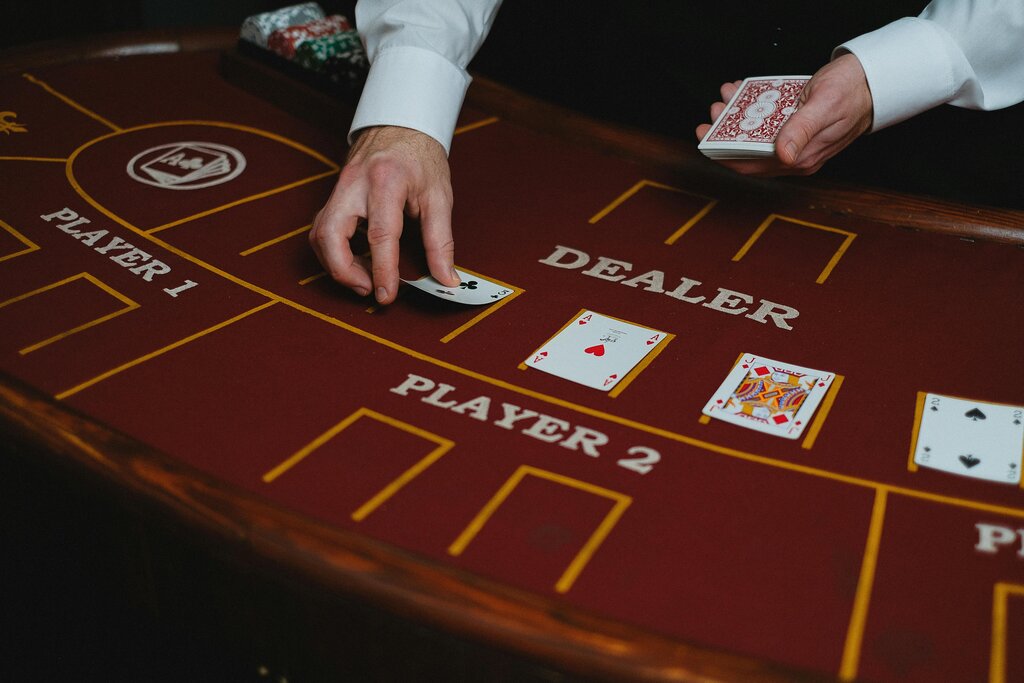
When it's your turn, you have several options.
| Action | Description |
|---|---|
| Hit | Take another card. You can hit as many times as you like until you decide to stand or you bust. |
| Stand | Take no more cards and end your turn. This is done when you're satisfied with your hand total. |
| Double Down | Double your initial bet in exchange for receiving only one more card. You must stand after receiving that single card. |
| Split | If your first two cards have the same value (like two 8s or a King and a Jack), you can split them into two separate hands. |
| Surrender | An option offered at some tables. You can give up your hand and lose half your bet, ending the round early. |
The dealer doesn't get to make strategic choices. Their actions are fixed by the casino's rules. This creates a predictable opponent.
The dealer must hit until their hand totals 17 or more. Once they reach 17, they must stand.
While the core game is consistent, you'll find small rule variations from one casino to another. One common difference is the number of decks used, which can range from one to eight. More decks make it slightly harder for the player.
Another key variation is what the dealer does on a soft 17 (an Ace and a 6). Some tables require the dealer to stand on all 17s, while others require them to hit a soft 17. The dealer hitting on soft 17 slightly increases the house's advantage.
Finally, pay attention to the payout for a "blackjack" (an Ace and a 10-value card on your first two cards). The traditional payout is 3:2. However, many tables now offer a 6:5 payout, which is significantly worse for the player.
Ready to test your knowledge?
What is the primary objective in a game of Blackjack?
Which of the following hands is considered a "soft hand"?
Now you know the fundamental rules and flow of the game. This foundation is all you need to start playing.