Mastering Bitcoin Fundamentals
Introduction to Blockchain
A Shared Digital Ledger
At its heart, a blockchain is a digital ledger. Think of it like a notebook shared among a large group of people. Instead of one person holding the notebook, everyone in the group has an identical copy. When someone wants to add a new entry, they announce it to everyone. The group then works together to verify the entry and add it to their notebooks at the same time.
At its most basic level, a blockchain is a digital ledger maintained by a decentralized network of computers.
This structure is what makes a blockchain so secure. Because everyone has a copy of the ledger, it's incredibly difficult for one person to cheat or change an entry without everyone else noticing. The main purpose of this technology is to allow people who don't know or trust each other to agree on a set of facts without needing a central authority, like a bank or government, to mediate.
Blocks in a Chain
The name "blockchain" describes exactly how it's built: from blocks of information linked together in a chain.
-
A Block: This is like a page in our shared notebook. It's a container that holds a batch of recent transactions or data, a timestamp, and a unique identifying code called a hash.
-
A Hash: Think of a hash as a digital fingerprint for the data inside the block. It's a unique string of letters and numbers generated from the block's contents. If even a single character of the data inside the block changes, its hash will change completely.
-
The Chain: Here's the clever part. Each new block also contains the hash of the block that came before it. This is what links them together, creating a chain. By including the previous block's hash, it creates a dependency. If someone tried to alter an old block, its hash would change. This would break the link to the next block, because the stored hash would no longer match. This mismatch would cascade down the entire chain, making the tampering immediately obvious to everyone on the network.
This chain structure makes the ledger immutable, which is a key feature of blockchain. It means the history of transactions is permanent and cannot be altered.
Decentralization and Consensus
A blockchain doesn't live on a single computer. Instead, it is distributed across a network of thousands of computers around the world. Each of these computers is called a node, and each one holds a full copy of the entire blockchain.
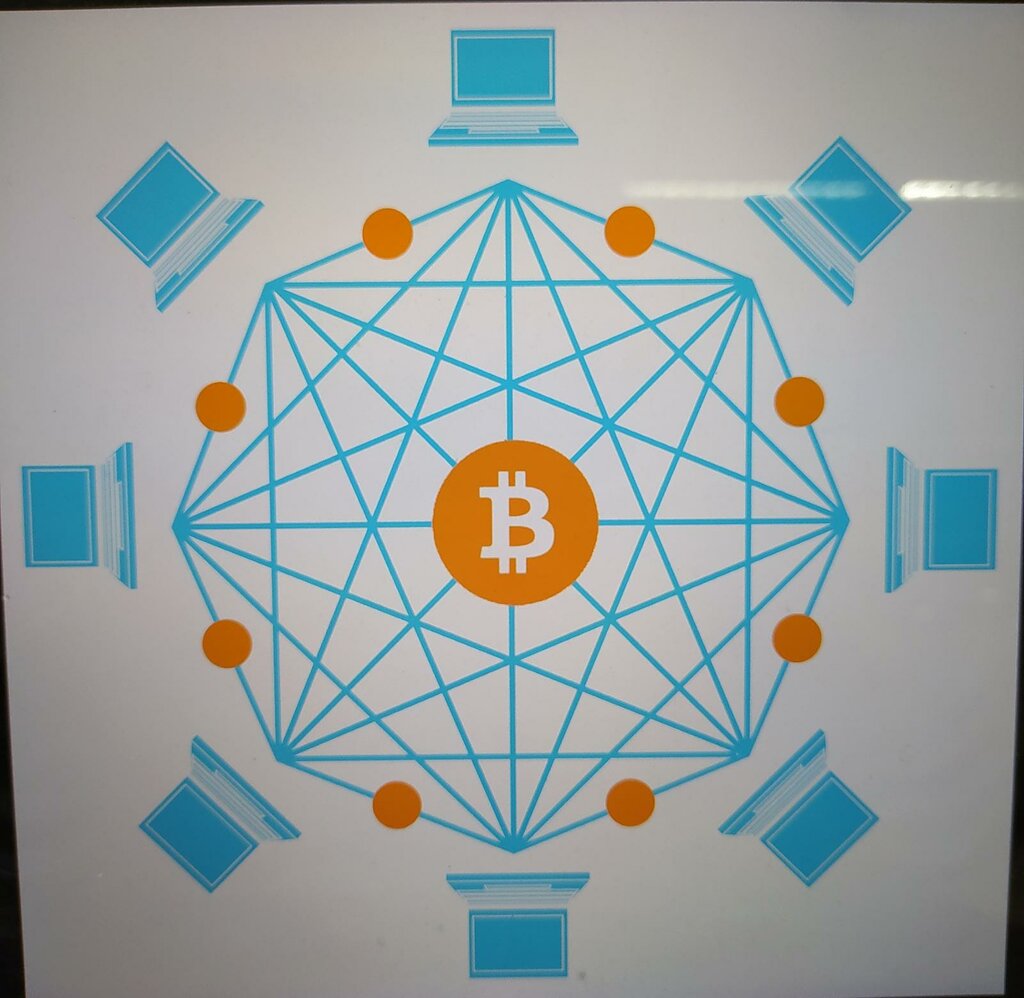
This decentralization is crucial for security and reliability. If one node goes offline or is attacked, the network continues to run without interruption. It also prevents any single person or group from controlling the ledger.
But if there's no central authority, how does the network agree on which new blocks to add? This is achieved through a consensus mechanism. It's a set of rules that all the nodes follow to validate transactions and agree on the state of the ledger.
Consensus
noun
A general agreement among the participants of a distributed network. In blockchain, it refers to the process of achieving agreement on a single data value or state of the network.
One of the first and most well-known consensus mechanisms is called Proof of Work (PoW).
In a Proof of Work system, nodes on the network compete to solve a complex mathematical puzzle. The first node to solve the puzzle gets to propose the next block to be added to the chain and is rewarded for their effort. This process is often called "mining."
The puzzle is designed to be very difficult to solve but easy for others to verify. This computational effort is the "work." It serves two purposes:
- It makes it expensive to add blocks. This prevents malicious actors from overwhelming the network with bad blocks.
- It secures the chain. To alter a past block, an attacker would have to redo the Proof of Work for that block and all subsequent blocks, all while competing with the rest of the network. This would require an immense, practically impossible amount of computing power.
What is the primary purpose of a blockchain?
In the context of a blockchain, what is a "hash"?
These core concepts—blocks linked in a chain, a decentralized network of nodes, and a consensus mechanism like Proof of Work—form the foundation of blockchain technology.