Mastering Binary Tree Traversals: BFS vs. DFS in C++
Tree Traversal Methods
How to Visit Every Node
Once you have a binary tree, you need a systematic way to visit every single node. This process is called traversal. Unlike linear data structures like arrays or linked lists, which have a clear beginning and end, trees are hierarchical. You can't just start at the first element and move to the next.
The path you take matters. Depending on the order you visit the nodes, you can get completely different results. There are two main philosophies for navigating a tree: going deep or going wide. These approaches are known as Depth-First Search (DFS) and Breadth-First Search (BFS).
Depth-First Traversals
Depth-first traversal is like exploring a maze by always taking the first path you see and following it to a dead end before backtracking to try another. This strategy prioritizes depth, going as far down a single branch as possible before exploring its neighbors. There are three common ways to perform a depth-first traversal, and the only difference between them is the order in which they visit the root node relative to its left and right subtrees.
Let's use the tree above as our example. We'll start with preorder traversal.
Preorder
noun
A traversal method where you visit the current node first, then recursively visit the entire left subtree, and finally, recursively visit the entire right subtree.
The pattern is Root -> Left -> Right. You process the current node (the root of whatever subtree you're looking at), then you move to its left child and repeat the whole process. Once that entire branch is done, you backtrack and do the same for the right side.
For our example tree, the preorder traversal is:
F → B → A → D → C → E → G → I → H
Next is inorder traversal. This time, the root is visited in the middle.
Inorder
noun
A traversal method where you recursively visit the entire left subtree, then visit the current node, and finally, recursively visit the entire right subtree.
The pattern is Left -> Root -> Right. You travel all the way down the left-most path, visit that node, then its parent, then that parent's right child (if it exists). This method is particularly useful for binary search trees, as it visits the nodes in sorted order.
A → B → C → D → E → F → G → H → I
Finally, there's postorder traversal, where the root is visited last.
Postorder
noun
A traversal method where you recursively visit the entire left subtree, then recursively visit the entire right subtree, and finally, visit the current node.
The pattern is Left -> Right -> Root. You traverse all of a node's children before visiting the node itself. This is useful in situations where you need to process the children before the parent, such as deleting nodes from a tree or evaluating an expression tree.
The postorder traversal for our tree is:
A → C → E → D → B → H → I → G → F
Breadth-First Traversal
The other main approach, Breadth-First Search (BFS), explores the tree in a completely different way. Instead of going deep, it goes wide. It visits every node on the same level before moving down to the next level.
This method is also known as a level-order traversal. Imagine scanning the tree from top to bottom, left to right, like reading a book. You start with the root, then visit all of its children, then all of their children (the grandchildren), and so on.
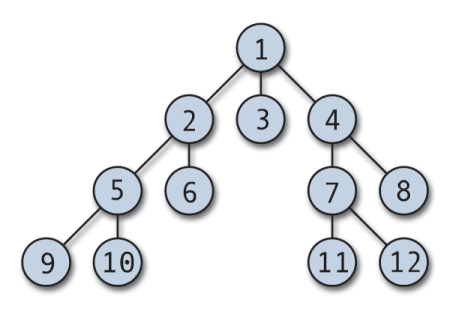
For our example tree, the level-order traversal would be:
F → B → G → A → D → I → C → E → H
BFS is excellent for finding the shortest path between two nodes in an unweighted graph or tree. Because it explores layer by layer, the first time it finds the target node, it's guaranteed to have found it via the shortest possible path.
Let's check your understanding of these traversal techniques.
Which traversal strategy explores a tree by visiting all nodes on the same level before moving to the next level?
Given a tree where node F is the root, B is the left child of F, and G is the right child of F. What is the result of a preorder traversal?
Each traversal method serves a different purpose. Understanding when to use each one is key to solving problems efficiently with trees.