Mastering Bharatnatyam Transitions and Expression
Mastering Tala and Jatis
From Steps to Rhythmic Phrases
You’ve mastered the foundational Adavus, the basic steps of Bharatanatyam. Now, we move from individual movements to the grammar that weaves them into powerful rhythmic narratives. This is where Tala, the cyclical rhythm, and Jatis, the rhythmic families, come into play. They provide the mathematical and aesthetic framework that transforms simple footwork into complex, expressive dance.
The Five Rhythmic Families
At the heart of Tala are the Jatis, which are specific groupings of beats or aksharas. Think of them as rhythmic DNA. There are five primary Jatis, each defined by a unique number of beats and a corresponding set of rhythmic syllables, known as s. These aren't just for counting; they are vocalised percussive sounds that embody the rhythm's feel and drive the dancer's movements.
| Jati | Aksharas (Beats) | Sollukattu |
|---|---|---|
| Tisra | 3 | Ta Ki Ta |
| Chatusra | 4 | Ta Ka Dhi Mi |
| Khanda | 5 | Ta Ka Ta Ki Ta |
| Misra | 7 | Ta Ki Ta Ta Ka Dhi Mi |
| Sankeerna | 9 | Ta Ka Dhi Mi Ta Ka Ta Ki Ta |
While Chatusra (4 beats) is the most common and serves as the default Jati, a dancer must achieve mastery over all five to navigate the rich rhythmic landscape of Bharatanatyam.
The Structure of Tala
A Tala is a complete rhythmic cycle, built from smaller components called angas. The three primary angas are the Anudrutam, Drutam, and Laghu. While the Anudrutam (1 beat) and Drutam (2 beats) are fixed, the Laghu is variable. Its value changes based on the Jati of the Tala. This is the key to creating rhythmic diversity. The seven foundational Talas, known as the s, combine these angas in different ways.
| Tala Name | Anga Structure |
|---|---|
| Dhruva | Laghu Drutam Laghu Laghu |
| Matya | Laghu Drutam Laghu |
| Rupaka | Drutam Laghu |
| Jhampa | Laghu Anudrutam Drutam |
| Triputa | Laghu Drutam Drutam |
| Ata | Laghu Laghu Drutam Drutam |
| Eka | Laghu |
To find the total number of beats in a specific Tala, you simply substitute the Laghu's Jati value. For example, Chatusra Jati Triputa Tala (a very common Tala also known as Adi Tala) has a Laghu of 4 beats. Its structure is Laghu (4) + Drutam (2) + Drutam (2), resulting in an 8-beat cycle. If it were Tisra Jati Triputa Tala, the cycle would be 3 + 2 + 2 = 7 beats.
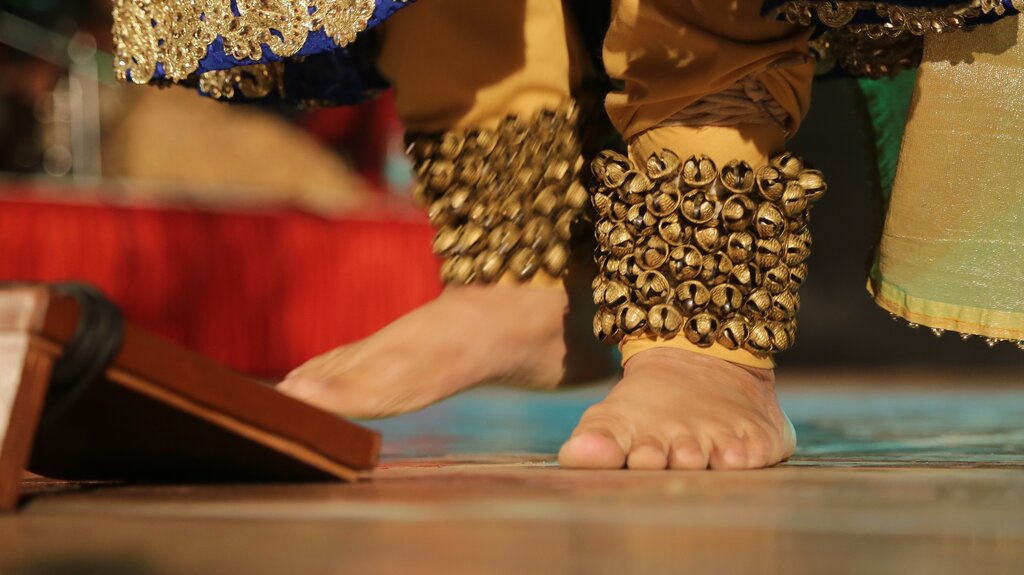
Tempo and Speed
Mastering Tala and Jati isn't just about mathematical precision; it's also about controlling the tempo, or Laya. A dancer must be able to execute Adavus perfectly across three speeds, or Kalas.
- Vilambita Laya (First Speed): This is the slow tempo. Each beat of the Tala has one syllable or movement.
- Madhya Laya (Second Speed): The medium tempo. Each beat of the Tala now contains two syllables or movements.
- Druta Laya (Third Speed): The fast tempo. Each beat of the Tala contains four syllables or movements.
Practising Adavus in all three Kalas builds stamina, clarity, and rhythmic control. It ensures that the footwork remains sharp and the form correct, no matter how fast the tempo becomes.
The transition between Kalas must be seamless, showing the dancer's effortless command over Laya.
When you see an performance, the opening piece in a traditional Bharatanatyam recital, you are witnessing these concepts in action. The Alarippu, meaning 'flowering bud,' is a pure dance piece that starts with simple, slow movements of the eyes, neck, and shoulders. It gradually builds in complexity and speed, incorporating Adavus set to a specific Tala and moving through the different Kalas. It serves as both a warm-up for the dancer and an introduction for the audience to the rhythmic vocabulary of the performance.
With this understanding of Jatis, Talas, and Kalas, you now have the tools to deconstruct and appreciate the intricate rhythmic architecture of Bharatanatyam. It's the hidden engine that powers every step.