Mastering Batting Balance and Stance Stability
Stance Biomechanics
The Athletic Foundation
A batting stance isn't just about standing still; it's a dynamic, athletic state of readiness. Think of it as the launching pad for every shot you play. The goal is to create a stable, balanced base that allows for a smooth transfer of energy from the ground, up through your body, and into the ball. This sequence is known as the —a system of linked body segments that work together to produce powerful, coordinated movement.
An effective stance engages this chain from the moment you take your guard. Your feet are the connection to the ground, your legs and core provide the stable platform, and your upper body is coiled, ready to un-leash rotational force. A breakdown in any part of this chain—like wobbly knees or a hunched back—leaks energy and compromises both power and control.
Lowering Your Centre
The key to a stable base is managing your centre of gravity. In a relaxed standing position, your centre of gravity is relatively high. By adopting your batting stance, you intentionally lower it. This is achieved through two primary adjustments: maintaining an with your spine and introducing a slight flex in your knees and hips.
A neutral, or 'athletic', spine means your back is relatively straight but not rigid, with your head balanced and eyes level. Bending at the hips rather than rounding your back keeps your core engaged and ready to rotate powerfully. The knee flexion is crucial; it acts like a suspension system, absorbing pressure and allowing you to shift your weight smoothly forward or back. This crouched position makes you harder to unbalance, transforming you from a rigid structure into a coiled spring.
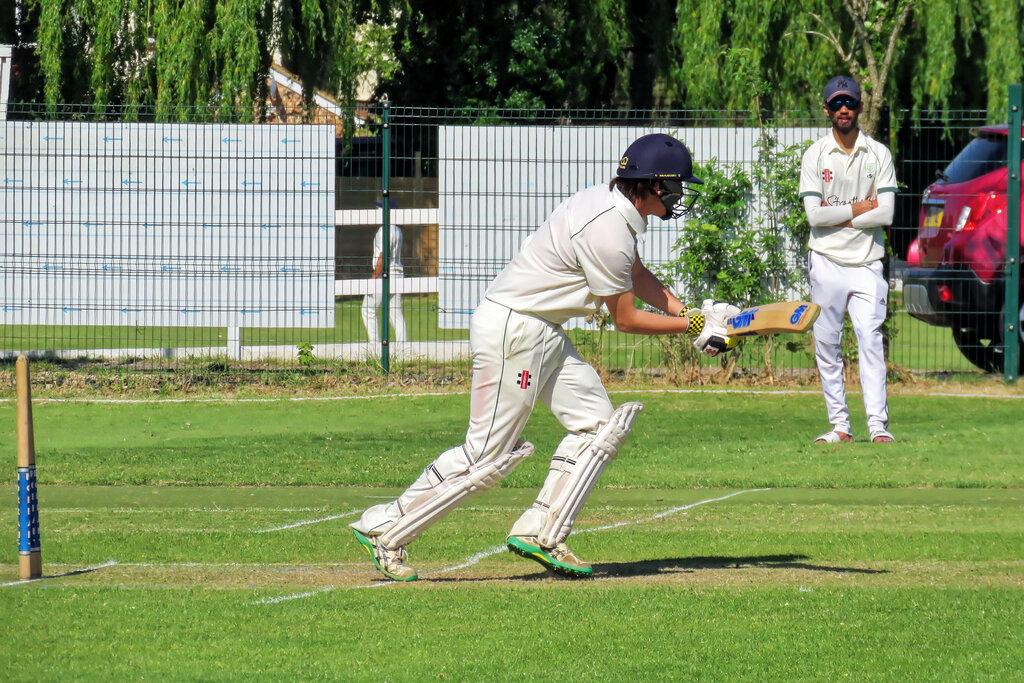
The Stance Width Trade-Off
The distance between your feet is a critical variable that dictates the trade-off between stability and mobility. There is no single correct answer; the optimal width depends on your body type, style of play, and the conditions you're facing. Understanding the pros and cons of each approach is key.
| Stance Type | Advantages | Disadvantages |
|---|---|---|
| Narrow Stance | Quicker footwork, easier to move forward or back, promotes fluid weight transfer. | Less initial balance, can feel unstable against fast bowling, smaller stable base. |
| Wide Stance | Extremely stable base, powerful foundation for shots, good for hard pitches. | Can feel 'planted', slower to adjust feet, may restrict hip rotation and reach. |
A narrow stance, roughly shoulder-width apart, facilitates rapid adjustments. Because your feet are closer together, initiating movement—whether onto the front foot to drive or back to cut—requires less effort. However, this mobility comes at the cost of initial balance. A very wide stance provides a rock-solid foundation, lowering your centre of gravity even further and improving your significantly. This makes you difficult to knock off balance, but it can also anchor you to the crease, making refined footwork more difficult.
Having the incorrect stance width is a huge power leak, so avoid being too narrow at address as this can reduce your range of motion and impact negatively on your stability.
So how do you find your ideal width? Start with your feet just wider than your shoulders. From this position, rock gently side-to-side and forwards-and-backwards. You should feel balanced and athletic, not stiff or stretched. The goal is to find the widest stance you can maintain while still feeling able to move your feet quickly and comfortably in any direction. It should feel strong, but not locked in place.
What is the primary function of the "kinetic chain" in a batting stance?
According to the text, what is the main advantage of a narrow, shoulder-width stance?