Mastering Base Editing
Introduction to Genome Editing
Editing the Code of Life
Every living organism has a genome, a complete set of genetic instructions written in the language of DNA. For a long time, we could only read this code. Now, we can edit it. Genome editing is the technology that allows scientists to change an organism's DNA, opening up incredible possibilities for research and medicine.
CRISPR is essentially a find and replace function for DNA, and in the hands of scientists, it's a super powerful molecular tool for rewriting the code of life.
While several genome editing tools exist, the most famous one is called CRISPR-Cas9. It's often shortened to just CRISPR. This system acts like a pair of molecular scissors that can be programmed to cut DNA at a very specific location. By making a precise cut, we can then remove, add, or change the genetic code.
How CRISPR-Cas9 Works
The power of CRISPR-Cas9 comes from its two main components. Think of it as a guided missile system for genes.
Cas9 Protein: This is the 'scissors' part. It's an enzyme that can cut through both strands of a DNA double helix.
Guide RNA (gRNA): This is the 'GPS'. It's a small piece of RNA designed in the lab to match the exact DNA sequence we want to target.
Together, these two parts form a complex. The guide RNA leads the Cas9 protein through the entire genome. When the gRNA finds its matching sequence, it locks on, and the Cas9 protein makes the cut. This creates what's known as a double-strand break.
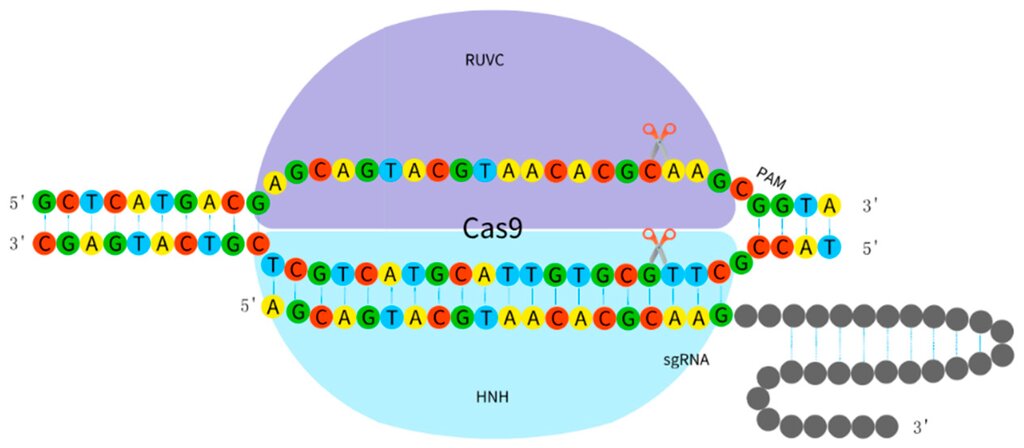
Once the DNA is broken, the cell's natural repair machinery kicks in to fix the damage. Scientists can leverage two main repair pathways.
-
Gene Disruption: The cell's default repair system is fast but error-prone. It often sticks the broken ends back together imperfectly, adding or deleting a few DNA letters. This scrambles the gene's code, effectively disabling or "knocking out" the gene.
-
Precise Editing: If scientists provide a template—a new piece of DNA with the desired sequence—the cell can use a more precise repair pathway. It uses the template to fix the break, allowing for the correction of a faulty gene or the insertion of a new one.
Putting CRISPR to Work
This ability to edit genomes with precision has transformed biology. In the lab, researchers use CRISPR to understand the fundamental roles of different genes. By knocking out a gene, they can observe the effects on a cell or organism, revealing its function. This is crucial for studying diseases and basic biological processes.
Gene therapy, which involves making targeted changes to a person's genome to treat or cure diseases, is a significant medical application of genetic engineering.
Beyond the lab, CRISPR holds enormous promise for medicine. Scientists are developing therapies to correct the genetic mutations that cause diseases like sickle cell anemia, cystic fibrosis, and Huntington's disease. The idea is to use CRISPR to edit a patient's cells to fix the faulty gene, offering a potential cure at the most fundamental level. Early clinical trials are already underway for several conditions, marking a new era in genetic medicine.
Let's review the key concepts we've covered.
What is the primary function of the Cas9 protein in the CRISPR-Cas9 system?
A scientist wants to disable, or "knock out," a gene to study its function. Which cellular process do they primarily rely on after CRISPR makes a cut?
Genome editing is a powerful technology that is rapidly evolving. While CRISPR-Cas9 provides a versatile tool for cutting DNA, scientists continue to build on this foundation to create even more precise and sophisticated editing systems.