Mastering Bach's Two-Part Inventions
Introduction to Baroque Music
The Baroque Era
The Baroque period, spanning from roughly 1600 to 1750, was a time of dramatic flair, scientific discovery, and opulent art. Think of grand palaces like Versailles, the groundbreaking astronomy of Galileo, and the laws of motion from Isaac Newton. This spirit of grandeur and intricate detail is mirrored in the music of the time.
Composers during this era were often employed by the church or royal courts, and their music served specific functions, from sacred worship to courtly entertainment. This context shaped a style that was both highly structured and emotionally expressive, designed to awe and move the listener.
What Baroque Music Sounds Like
Baroque music is distinct and full of character. One of its defining features is the use of strong contrasts. Composers would play loud sections against soft sections, a technique known as terraced dynamics. They also contrasted a small group of soloists with a larger orchestra, giving rise to the concerto.
Another hallmark is ornamentation. Melodies were rarely left plain. Instead, they were embellished with trills, turns, and other decorative figures, much like the intricate carvings on Baroque furniture. These ornaments weren't just for show; they added emotional depth and brilliance to the music.
The entire structure was built upon a powerful foundation called the basso continuo.
Basso Continuo
noun
A foundational accompaniment in Baroque music, consisting of a bass instrument (like a cello or bassoon) playing the bass line, and a chordal instrument (like a harpsichord or organ) playing the harmonies built upon that line.
The texture of the music itself also evolved. The era is famous for its complex polyphony, where multiple independent melodic lines are woven together. This is a sound most associated with J.S. Bach. At the same time, a simpler texture called homophony, featuring a single clear melody with chordal backup, gained popularity, especially in the new genre of opera.
The Instruments
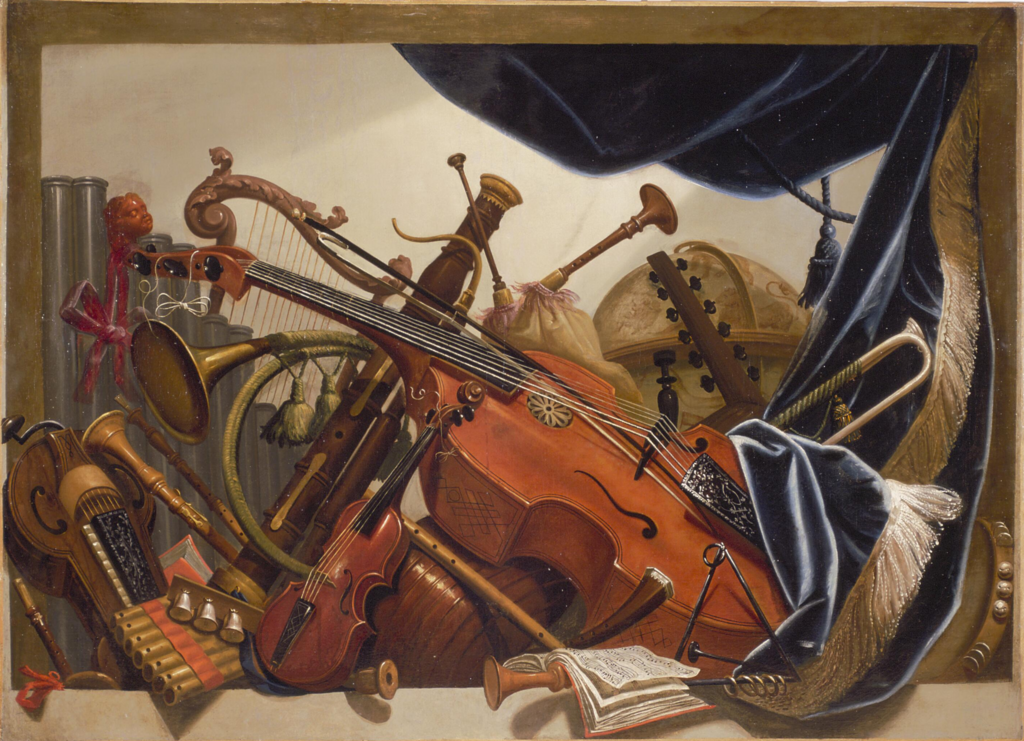
The sound of the Baroque era was shaped by its unique instruments. The harpsichord, with its plucked strings, was the quintessential keyboard instrument, long before the piano was invented. Grand pipe organs were central to church music. The string family included violins, violas, cellos, and the viola da gamba, which has a softer, more resonant tone than a modern cello. Lutes and early woodwind instruments like recorders and oboes also played crucial roles.
Key Composers
While countless composers wrote music during this 150-year span, a few figures stand out for their immense contribution and lasting influence.
| Composer | Lived | Known For |
|---|---|---|
| Johann Sebastian Bach | 1685–1750 | Master of counterpoint, fugues, cantatas, and the Brandenburg Concertos. |
| George Frideric Handel | 1685–1759 | Italian operas and English oratorios, most famously Messiah. |
| Antonio Vivaldi | 1678–1741 | Prolific composer of concertos, including the beloved The Four Seasons. |
| Claudio Monteverdi | 1567–1643 | A pioneer of opera who bridged the Renaissance and Baroque periods. |
Each of these composers brought a unique voice to the era, from Vivaldi's vibrant instrumental writing to Bach's profound and complex sacred works. Understanding their world and their musical language is the first step to appreciating the pieces they left behind.
What was the primary function of the basso continuo in Baroque music?
The Baroque compositional technique of weaving together multiple independent melodic lines simultaneously is called: