Mastering Atoms and Matter for Grade Six
Subatomic Particles and Nucleus
Inside the Atom's Engine
We know that atoms are the building blocks of everything, much like an engine is the core of a car. But what's inside that engine? If you could zoom into an atom, you'd find it's mostly empty space. At the very center, however, is a tiny, dense core called the nucleus.
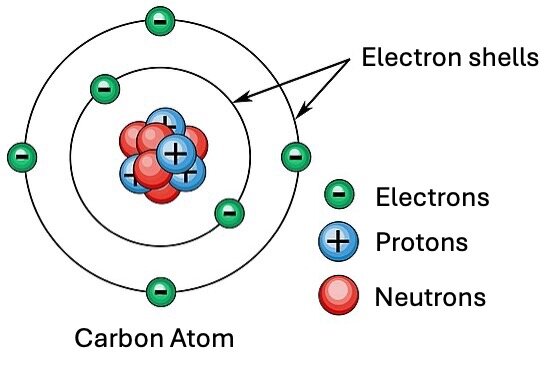
The nucleus is the atom's command center. It contains two types of particles packed tightly together. Surrounding the nucleus, whizzing around in that empty space, is a third type of particle.
The Nucleus Crew
Let's meet the particles that live inside the nucleus.
First are the protons. Protons have a positive electrical charge. Think of it like the '+' side of a battery. The number of protons in an atom is unique and defines what element it is. An atom with one proton is always hydrogen. An atom with six protons is always carbon. This crucial number is called the atom's atomic number.
The number of protons determines the element's identity.
The second resident of the nucleus is the neutron. As their name suggests, neutrons are neutral. They have no electrical charge at all. Their main job is to add mass to the atom and help hold the positively charged protons together in the nucleus. Without neutrons, the protons would repel each other and the nucleus would fly apart.
Together, protons and neutrons account for almost all of an atom's mass. They are the heavyweights of the atomic world.
Electrons on the Outside
Zipping around the nucleus are the electrons. Electrons have a negative electrical charge, the opposite of protons. Think of the '−' side of a battery. This opposite charge is what keeps them attracted to the positive nucleus, preventing them from flying away.
Electrons are incredibly lightweight, almost 2,000 times less massive than a proton or a neutron. They don't stay in one place but exist in an area around the nucleus called the electron cloud. This cloud is arranged in layers, or energy levels, like the layers of an onion. The electrons in the outermost layer are especially important because they are the ones that interact with other atoms to form chemical bonds.
subatomic
adjective
Referring to particles that are smaller than an atom.
These three particles, protons, neutrons, and electrons, are the fundamental subatomic particles that make up atoms. Here is a quick summary of their properties:
| Particle | Charge | Location | Relative Mass |
|---|---|---|---|
| Proton | Positive (+) | Nucleus | ~1 |
| Neutron | Neutral (0) | Nucleus | ~1 |
| Electron | Negative (−) | Electron Cloud | ~1/1836 |
Understanding these three particles is the first step to understanding how atoms work together to build our world. Let's see what you've learned.
What is the electrical charge of a neutron?
An atom's identity (e.g., whether it's hydrogen or carbon) is determined by its number of...
By knowing the roles of protons, neutrons, and electrons, you have the foundation to understand how different elements behave and interact.