Mastering Async and IO Fundamentals
Concurrency Paradigms
The Illusion of Doing Everything at Once
Most programs you've written likely follow a simple, predictable path. One instruction executes, then the next, and so on. This is synchronous execution. It’s like a person making a sandwich: you get the bread, then the filling, then you put it together. Each step must wait for the previous one to finish.
But modern applications are rarely that simple. They juggle database queries, network requests, and user interactions all at once. If a web server handled requests one by one, users would face frustrating delays. The server needs to handle multiple tasks concurrently. Asynchronous execution makes this possible. It's like a chef in a busy kitchen who starts cooking the pasta, then chops vegetables while it boils, and puts the sauce on to simmer. The tasks progress independently, without waiting for others to complete.
Concurrency is about dealing with many things at once. Parallelism is about doing many things at once.
This distinction is key. Concurrency is a design principle for structuring a program to handle multiple tasks over a period. Parallelism is the simultaneous execution of those tasks, which requires multiple CPU cores. A program can be concurrent without being parallel, like a chef working alone in the kitchen, but it can't be parallel without being concurrent.
Two Paths to Concurrency
How do we build concurrent applications? Two dominant models have emerged: multi-threading and the event-driven architecture.
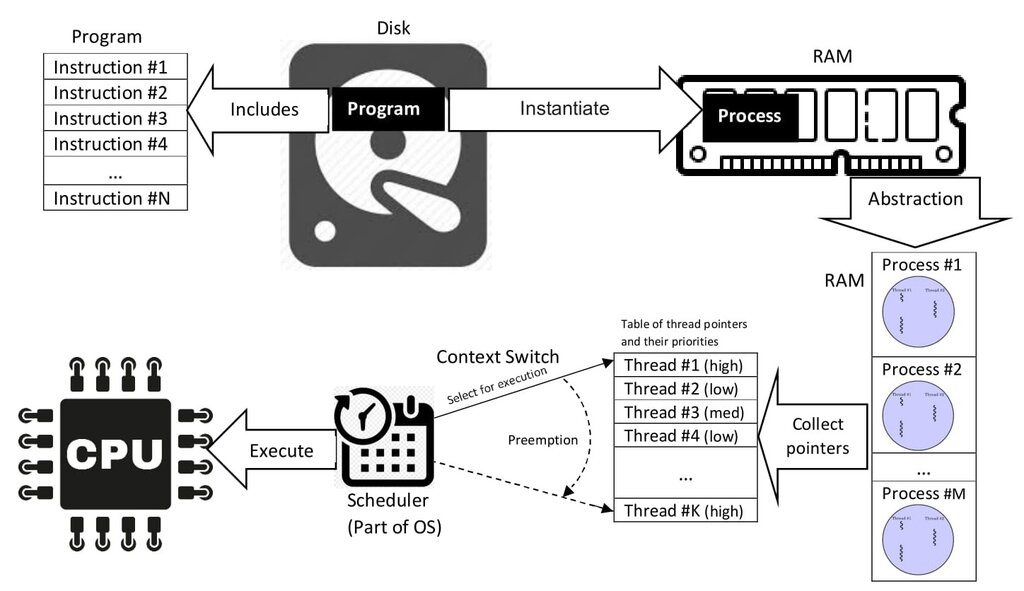
Multi-threading is like hiring more chefs. Each new task (or user connection) gets its own thread, which is a lightweight process managed by the operating system. These threads can run in parallel on multiple CPU cores. It's an intuitive model: one thread, one task.
However, threads aren't free. Each one consumes memory and CPU time. The operating system must perform a context switch to pause one thread and resume another, which has overhead. If you have thousands of connections, creating a thread for each one becomes inefficient and can exhaust system resources.
An event-driven architecture is like having one incredibly fast and organized chef. This model uses a single thread and an event loop. Instead of waiting for a slow operation to complete, the thread delegates it to the system (like putting the pasta on the stove) and immediately moves on to the next task. When the slow operation finishes, the system sends an event, and the loop processes the result when it gets a chance.
Blocking vs. Non-Blocking I/O
The magic behind the event-driven model is non-blocking I/O (Input/Output). I/O operations, like reading a file from a disk or fetching data from a network API, are anciently slow compared to the CPU's speed.
A blocking I/O call forces the program to wait. If a thread asks for a file, it sits idle until the disk provides the data. In a multi-threaded server, this is acceptable because other threads can run on the CPU. But if you only have one thread, the entire application freezes.
A non-blocking I/O call is different. The thread requests the file and immediately gets back a response, either with the data if it was ready instantly, or a confirmation that the request is in progress. The thread is free to do other work. This is the cornerstone of event-driven systems like Node.js.
This leads to a critical question: when should you use each model? The answer depends on the type of work your application does.
| Task Type | Description | Best Concurrency Model |
|---|---|---|
| CPU-bound | A task that spends most of its time doing computations, like video encoding or complex math. | Multi-threading, to leverage multiple CPU cores for parallel processing. |
| I/O-bound | A task that spends most of its time waiting for I/O operations, like a web server handling requests. | Event-driven, to handle many connections efficiently without the overhead of threads. |
An event-driven, single-threaded architecture excels at I/O-bound tasks because it avoids the overhead of creating and managing thousands of threads. It keeps the CPU busy with useful work instead of waiting. For heavy computation, the raw power of parallel processing across multiple cores with threads is unbeatable.
Asynchronous programming, on the other hand, allows multiple operations to progress concurrently.
By understanding the trade-offs between threads and event loops, and identifying whether your tasks are CPU-bound or I/O-bound, you can choose the right architectural pattern. This decision is fundamental to building software that is both scalable and performant, efficiently using the resources available to it.
Time to check your understanding of these core concurrency concepts.
Which of the following scenarios best describes synchronous execution?
What is the key difference between concurrency and parallelism?
Choosing the right concurrency model is a foundational step in designing scalable systems. It's about matching the tool to the task at hand.