Mastering Artificial Intelligence
Introduction to Artificial Intelligence
What Is Artificial Intelligence?
Artificial intelligence, or AI, is a field of computer science focused on creating machines that can perform tasks that typically require human intelligence. Think of it as teaching a computer to learn, reason, and solve problems on its own. Instead of being explicitly programmed for every single task, an AI system learns from experience, identifies patterns in data, and can even correct its own mistakes over time.
The core goal of AI is to simulate human intelligence in machines. This can range from understanding a spoken command to driving a car or diagnosing a disease.
This ability to mimic human cognitive functions is what makes AI so powerful. It's not just about following a rigid set of instructions; it's about adapting and making decisions in new situations.
A Brief History
The idea of intelligent machines has been around for centuries, but the formal field of AI research began in the 1950s. A pivotal moment was the Dartmouth Workshop in 1956, where the term "artificial intelligence" was coined and the field was established as a distinct area of study.
The early years were filled with optimism. Researchers developed programs that could solve algebra problems, prove theorems, and speak simple English. However, progress was slower than expected. The complexity of creating true intelligence led to periods known as "AI winters," when funding and interest dwindled.
Things began to change dramatically in the late 20th and early 21st centuries. The explosion of the internet generated vast amounts of data, and significant increases in computing power made it possible to process that data. These two factors fueled a resurgence in AI, leading to the rapid advancements we see today.

The Building Blocks of AI
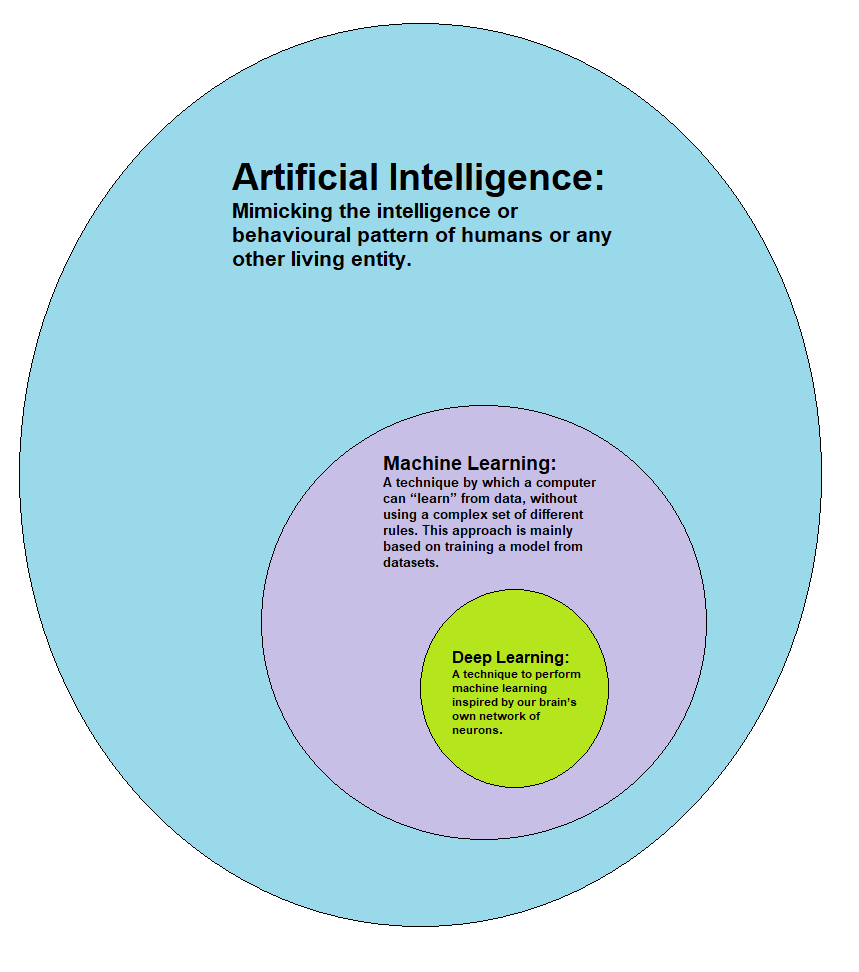
AI is a broad field with several specialized subfields. Understanding these branches is key to grasping how AI works. The three most important ones are Machine Learning, Deep Learning, and Natural Language Processing.
Machine Learning
noun
A subset of AI where systems learn from data to identify patterns and make decisions without being explicitly programmed.
Machine Learning (ML) is the engine that powers most modern AI. Instead of writing rules, developers feed an ML model large amounts of data and let it figure out the patterns on its own. For example, to teach a model to recognize cats, you'd show it thousands of cat pictures. Eventually, it learns the features that define a cat and can identify one in a new photo it has never seen before.
Deep Learning (DL) is a more advanced type of machine learning. It uses complex structures called neural networks, which are inspired by the human brain. These networks have many layers that allow them to learn very intricate patterns from massive datasets. Deep learning is behind some of the most impressive AI achievements, like voice recognition on your phone and facial recognition systems.
Natural Language Processing (NLP) is the branch of AI that deals with language. Its goal is to enable computers to understand, interpret, and generate human language. Every time you use a translation app, talk to a chatbot, or see your email client suggest a reply, you're interacting with NLP.
AI in the Real World
AI is no longer just a concept from science fiction; it's a technology that has practical applications across many industries. Its ability to analyze huge volumes of data and automate complex tasks is transforming the way we work and live.
In healthcare, AI helps doctors diagnose diseases like cancer from medical scans with greater accuracy. In finance, it analyzes transaction data in real-time to detect and prevent fraud. Streaming services use AI to analyze your viewing habits and recommend movies and TV shows you might like.
Transportation is another area undergoing an AI-driven revolution. Self-driving cars use a combination of computer vision, sensor data, and machine learning to navigate roads safely. In logistics, AI optimizes delivery routes, saving time and fuel. From customer service chatbots to personalized advertising, AI is becoming an integral part of our daily lives.
Now that you have a foundational understanding of AI, let's test your knowledge.
What is the primary focus of artificial intelligence (AI)?
At which event was the term 'artificial intelligence' officially coined, establishing it as a formal field of study?
AI is a rapidly evolving field with the potential to solve some of the world's biggest challenges. Understanding its core concepts is the first step toward navigating this exciting technology.