Mastering AP US History
Pre-Colonial America
A Land of Many Peoples
Before 1492, the Americas were home to millions of people living in thousands of distinct societies. It's a common mistake to think of a single “Native American” culture. The reality was a continent teeming with diversity, from sprawling agricultural cities to small, mobile bands of hunters.
The societies of Native American peoples before the arrival of Christopher Columbus were diverse and rich in culture, displaying sophisticated social structures, complex trade systems, and deep spiritual practices.
Estimates of the pre-contact population vary widely, ranging from 50 to 100 million people across North and South America. These societies were built on deep connections to the land, intricate kinship networks, and complex spiritual beliefs that had been developing for millennia.
A Mosaic of Cultures
Geography shaped life in profound ways, leading to a stunning variety of cultures. We can group these societies into broad cultural regions, each with its own unique adaptations and traditions.
In the Northeast, peoples like the Haudenosaunee (or Iroquois) formed powerful political confederacies. They lived in villages of longhouses and practiced sophisticated agriculture, cultivating corn, beans, and squash, known as the “Three Sisters.”
To the south, the Southeast was dominated by the Mississippian culture, famous for its large earthen mounds and fortified cities. The city of Cahokia, near modern-day St. Louis, was a major urban center with a population of over 10,000 people at its peak around 1100 CE.
In the arid Southwest, the Ancestral Puebloans built remarkable cliff dwellings and developed complex irrigation systems to farm in the desert. Meanwhile, societies on the Great Plains were largely nomadic, following vast herds of bison which provided food, clothing, and shelter.
| Region | Key Characteristics | Example Group |
|---|---|---|
| Northeast | Agriculture (Three Sisters), longhouses, political confederacies | Haudenosaunee (Iroquois) |
| Southeast | Large cities, mound building, complex chiefdoms | Mississippian Culture |
| Southwest | Cliff dwellings, irrigation farming in arid climate | Ancestral Puebloans |
| Great Plains | Nomadic hunting, reliance on bison | Lakota, Cheyenne |
| Northwest Coast | Fishing and whaling, totem poles, potlatch ceremonies | Tlingit, Haida |
Each of these societies had its own languages, spiritual traditions, and social structures. Trade networks crisscrossed the continent, moving goods like shells, obsidian, copper, and pottery over thousands of miles. This was not an empty wilderness, but a landscape shaped and managed by human hands for centuries.
First Encounters
The arrival of Europeans in the late 15th century marked a turning point. It wasn't a “discovery,” but a collision of two worlds that had developed in isolation for thousands of years. Christopher Columbus’s voyages, beginning in 1492, initiated sustained contact between Europe and the Americas.
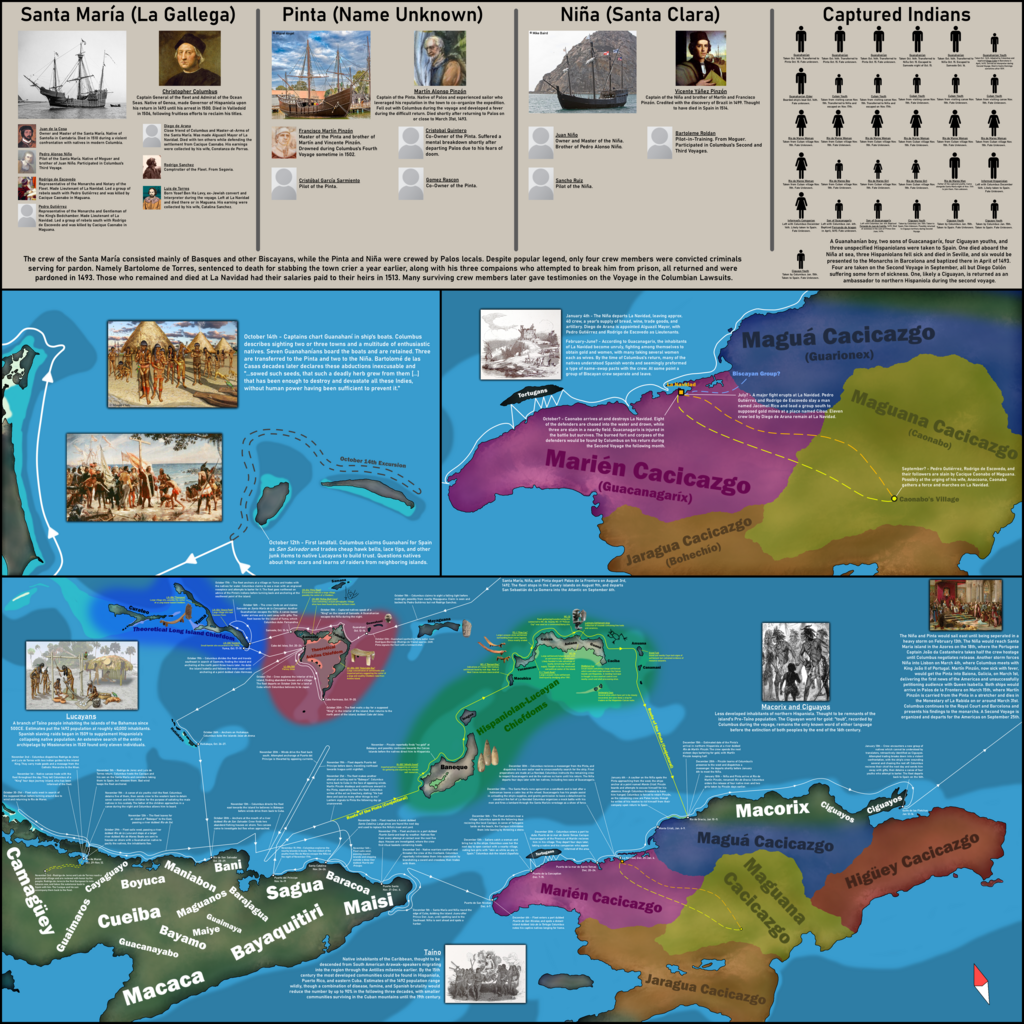
Initial interactions were often a mix of curiosity, confusion, and commerce. Europeans were amazed by new plants like corn and potatoes, while Native Americans were intrigued by metal tools, firearms, and cloth. This exchange of goods, ideas, and technologies, known as the Columbian Exchange, would fundamentally reshape both worlds.
But the Columbian Exchange was not an equal trade. Along with crops and animals, Europeans brought something else across the Atlantic, something they themselves didn't fully understand: deadly diseases.
Native Americans had no immunity to Old World diseases like smallpox, measles, and influenza. These illnesses had swept through Europe, Asia, and Africa for centuries, but they were entirely new to the Americas. When they arrived, they spread with terrifying speed and lethality.
The Great Dying
The impact of these new diseases was catastrophic. Historians refer to this period as “The Great Dying.” Epidemics raged through communities, sometimes wiping out entire villages before a European ever set foot in them. The diseases traveled faster than the explorers, spreading along the very trade routes that had connected indigenous peoples for centuries.
It is estimated that in the first 150 years after contact, the indigenous population of the Americas declined by as much as 90%. This is one of the largest demographic disasters in human history.
This massive loss of life had devastating consequences. It shattered social structures, erased cultural knowledge, and destabilized political systems. It created a power vacuum that later European colonists would exploit. The America that Europeans began to colonize in the 16th and 17th centuries was already a post-apocalyptic landscape for its original inhabitants.
Let's review some of the key ideas from this section.
Now, test your knowledge of this foundational period.
Which statement best describes the Americas before the arrival of Columbus in 1492?
The city of Cahokia, a major urban center with large earthen mounds, was a key feature of which cultural region?
Understanding this pre-colonial era is essential. It provides the context for everything that followed: the conflicts, the treaties, and the creation of the United States on lands that had been home to other peoples for millennia.