Mastering Anxiety
Understanding Anxiety
What is Anxiety?
Think about the last time you had to give a presentation, go on a first date, or interview for a job. You likely felt a knot in your stomach, a racing heart, or sweaty palms. That feeling is anxiety. It’s a natural human response to stress, an internal alarm system that alerts us to potential danger or important events on the horizon.
Anxiety
noun
An emotion characterized by feelings of tension, worried thoughts, and physical changes like increased blood pressure.
Unlike fear, which is a response to an immediate, present threat, anxiety is future-oriented. It’s the feeling of dread about something that might happen. This anticipation can be helpful. It motivates you to study for that test or prepare for that presentation. In this way, a healthy amount of anxiety is not just normal; it’s adaptive. It’s a feature, not a bug, of our nervous system.
A Helpful Signal or a Disorder?
So, where is the line between normal anxiety and an anxiety disorder? The difference comes down to three key factors: intensity, duration, and impairment.
Normal anxiety is temporary and tied to a specific situation. The nervousness you feel before a speech fades once you’re done. An anxiety disorder, however, involves excessive, persistent worry that is disproportionate to the actual situation. The feelings don't go away and can even arise for no apparent reason.
Most importantly, a disorder significantly interferes with daily life. If your fear of social situations prevents you from going to work, seeing friends, or even grocery shopping, the alarm system has gone from a helpful signal to a debilitating condition.
This spectrum helps visualize how a natural emotion can escalate into a condition that disrupts life. It’s not a simple on/off switch but a continuum.
Your Body on Alert
To understand anxiety, we have to look at the body's wiring. Our physical reactions are governed by the autonomic nervous system, which operates automatically, without our conscious control. It has two main branches: the sympathetic and the parasympathetic.
The sympathetic nervous system is our gas pedal. When your brain perceives a threat, it triggers the famous "fight-or-flight" response. It floods your body with hormones like adrenaline and cortisol, preparing you to face danger. Your heart beats faster to pump more blood to your muscles, your breathing quickens to take in more oxygen, and your senses sharpen. These are the classic physical symptoms of anxiety.
The parasympathetic nervous system is the brake pedal. It’s responsible for the "rest-and-digest" response, calming your body down once the threat has passed.
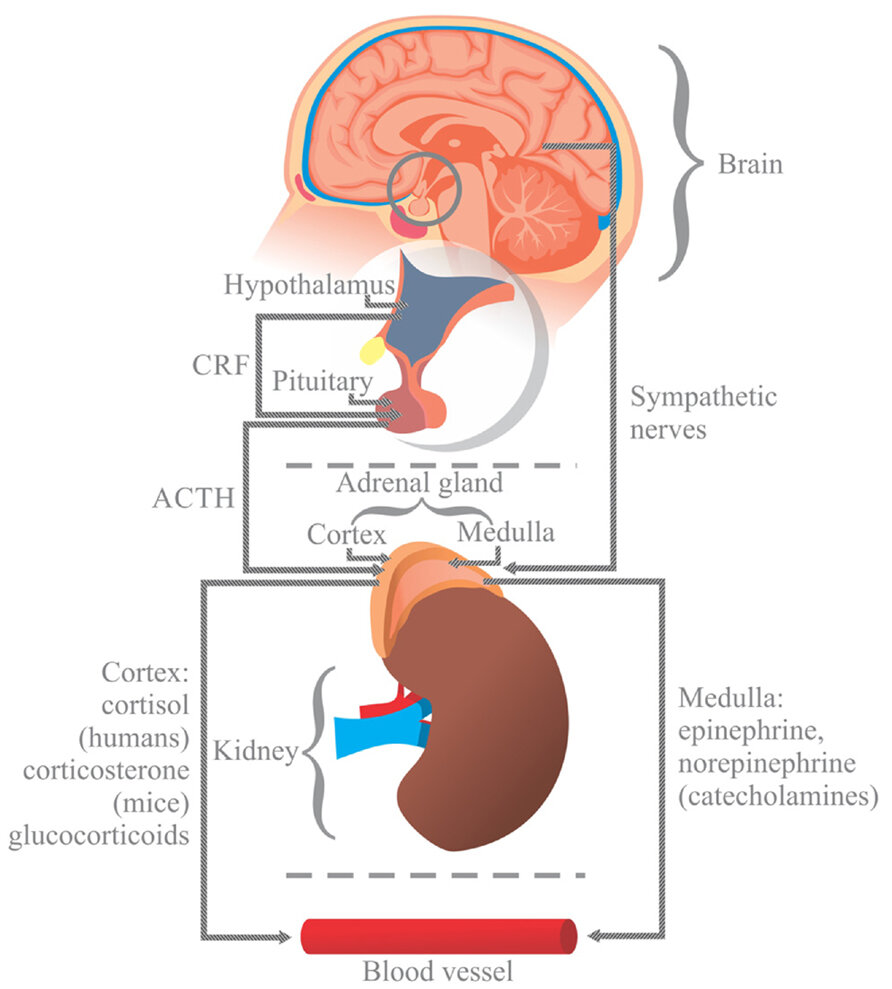
In people with anxiety disorders, this system can be overactive. The brain may perceive threats where there are none, keeping the sympathetic nervous system switched on and the body in a prolonged state of high alert.
The Stories We Tell Ourselves
While biology sets the stage, our thoughts direct the play. Psychological theories help explain why two people might react very differently to the same situation.
The Cognitive-Behavioral Theory suggests that anxiety isn’t caused by events themselves, but by our interpretations of those events. It’s a cycle: a thought leads to a feeling, which triggers a behavior. Imagine you send a text to a friend and don't get an immediate reply. If your thought is, "They must be mad at me," you'll feel anxious. This might lead you to avoid them, reinforcing the initial fear. The theory focuses on how distorted thinking patterns, or "cognitive distortions," fuel the cycle of anxiety.
Example Cycle: You think, "I'm going to fail my presentation." This causes you to feel anxious and panicked. As a result, you avoid preparing for it, making failure more likely.
A newer perspective is the Metacognitive Theory. Metacognition is "thinking about thinking." This theory argues that the problem isn't the anxious thoughts themselves, but our beliefs about those thoughts. People prone to anxiety often hold beliefs like:
- "If I worry, I'll be more prepared." (A positive belief about worry)
- "I can't control my worrying." (A negative belief about worry's uncontrollability)
These metacognitive beliefs keep the person stuck in a loop of worry. They believe they need to worry, but also feel powerless to stop it, creating a persistent state of anxiety.
Let's check your understanding of these foundational ideas.
According to the text, what is the primary distinction between fear and anxiety?
Which part of the autonomic nervous system is responsible for the 'rest-and-digest' response that calms the body after a threat has passed?
By understanding the biological and psychological roots of anxiety, we can begin to see it not as a mysterious force, but as a system of signals and thoughts that we can learn to navigate.