Mastering Angular Momentum Conservation
Angular Momentum Vector Dynamics
Angular Momentum as a Vector
We've seen how torque causes rotation and how inertia resists it. Now, let's formalize angular momentum, not just as a measure of rotational motion, but as a vector with a specific direction. This shift in perspective is key to understanding everything from the stability of a spinning top to the orbits of planets.
For a single point mass, angular momentum () is defined by the of its position vector () from the axis of rotation and its linear momentum vector ().
The cross product means that the resulting angular momentum vector, , is perpendicular to both the position vector and the linear momentum vector . But which way does it point? There are two possible perpendicular directions.
The Right-Hand Rule
To find the specific direction of the angular momentum vector, we use a simple but powerful tool: the right-hand rule. It's a physical mnemonic to determine the orientation of vectors in 3D space.
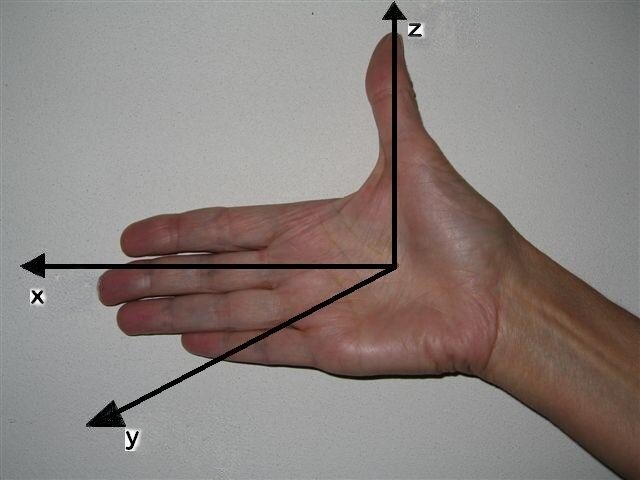
Imagine an axis of rotation. Point the fingers of your right hand in the direction of the position vector, . Then, curl your fingers in the direction of the linear momentum, . Your thumb will now point in the direction of the angular momentum vector, . This vector defines the axis of rotation and its direction (e.g., clockwise or counter-clockwise).
For a spinning wheel, if your fingers curl with the rotation, your thumb points along the axle. This is the direction of the angular momentum vector.
Directional Stability
The vector nature of angular momentum is why spinning objects are so stable. Just as an object in motion wants to stay in motion in a straight line (conservation of linear momentum), a rotating object wants to keep rotating about the same axis. In other words, its angular momentum vector wants to remain pointed in the same direction.
This is the principle behind a gyroscope. Once you get it spinning, its axis remains fixed in space, no matter how you tilt its frame. The same principle, called , keeps a spinning bicycle wheel upright and a quarterback's pass from tumbling end over end.
The law of conservation of angular momentum says that angular momentum will stay constant as a system changes its configuration.
From Points to Bodies
The formula is perfect for a single point mass, like a planet orbiting the sun. But what about a complex, like a spinning bowling ball? A rigid body is just a collection of many, many particles. To find the total angular momentum of the body, we sum up the individual angular momenta of all the particles it's made of.
For a symmetric object rotating about a fixed axis, this complex sum simplifies nicely. The total angular momentum vector aligns with the axis of rotation, and its magnitude is given by , where is the moment of inertia and is the angular velocity. In vector form, this becomes . The direction of the angular velocity vector, , is also found using the right-hand rule.
This vector framework is the foundation for analyzing rotational dynamics in three dimensions. By understanding that angular momentum has a direction that systems seek to preserve, we can predict the behavior of complex rotating objects.
Ready to test your understanding of these vector concepts?
For a single point mass, how is the angular momentum vector, , mathematically defined in terms of the position vector and the linear momentum vector ?
What physical principle explains why a spinning gyroscope remains stable and resists changes to its orientation?
Understanding angular momentum as a vector provides a more complete picture of rotational motion, explaining not just the speed of rotation, but its stability and orientation in space.