Mastering Amazon SageMaker
Introduction to Amazon SageMaker
Your Machine Learning Workshop
Imagine you have a complete workshop dedicated to building machine learning models. It has every tool you need, neatly organized and ready to go. That’s the basic idea behind Amazon SageMaker. It’s a fully managed service from Amazon Web Services (AWS) that brings all the necessary tools for a machine learning project into one place.
Instead of spending time setting up servers, installing software, and managing infrastructure, developers and data scientists can use SageMaker to focus on the actual ML work. It simplifies the entire process, from gathering initial data to deploying a finished model that can make predictions in a real-world application.
SageMaker is designed to remove the heavy lifting from each step of the machine learning process to make it easier to develop high-quality models.
The Three Core Steps
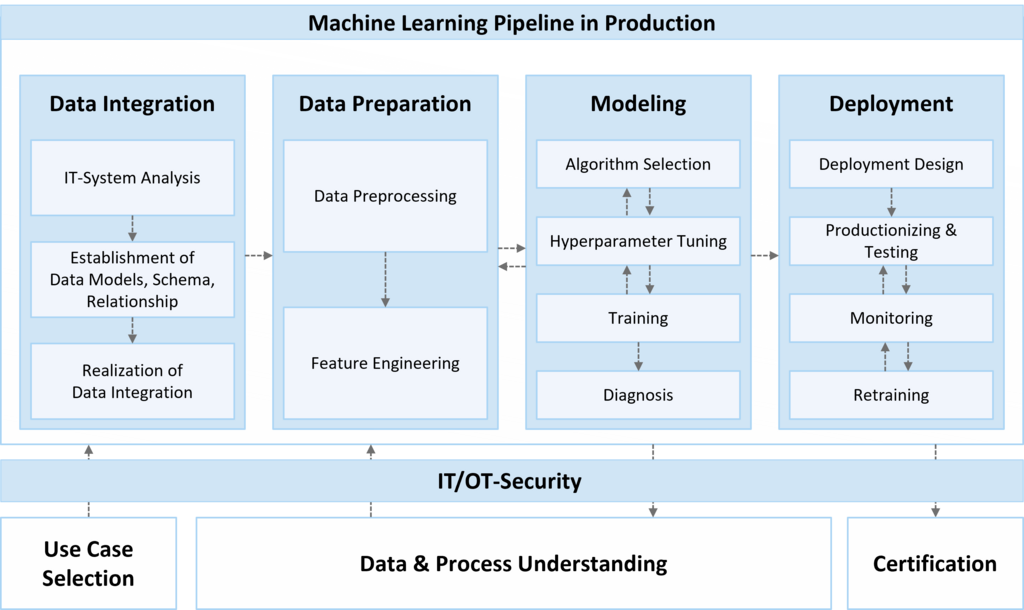
Every machine learning project, whether it's predicting house prices or identifying cats in photos, follows a similar workflow. This workflow has three main stages: preparing the data, training the model, and deploying it for use.
SageMaker provides specific tools to help you with each of these stages, making the entire journey much smoother.
How SageMaker Handles Each Step
Let's break down how SageMaker helps at each point in the workflow.
1. Data Preparation: Models are only as good as the data they learn from. Before you can train anything, you need to collect, clean, and label your data. SageMaker includes tools like SageMaker Ground Truth to help you label large datasets (for example, identifying objects in thousands of images) and SageMaker Data Wrangler to visually explore and clean your data, fixing errors and inconsistencies without writing a lot of code.
This preparation phase is often the most time-consuming part of an ML project, and SageMaker's tools are designed to speed it up significantly.
2. Model Training: This is the learning phase. You feed your prepared data to an algorithm, which learns patterns from it. SageMaker makes this step easier by providing powerful, on-demand computing resources. You don't need to buy or manage your own servers. You can also use built-in algorithms optimized for performance or bring your own. With SageMaker, you can start a training job with just a few clicks or a single API call, and it will handle spinning up the resources, running the training, and shutting everything down when it's done.
3. Model Deployment: Once your model is trained, it's not very useful sitting on a hard drive. You need to put it somewhere that your applications can access it to get predictions. This is called deployment. SageMaker simplifies this by allowing you to deploy your model with another simple API call. It creates a secure endpoint that your app can send data to and get predictions from in real-time. SageMaker also manages the underlying infrastructure, automatically scaling it to handle the amount of traffic you receive.
Plays Well with Others
SageMaker isn't an isolated island; it's a core part of the larger AWS ecosystem. This tight integration is one of its biggest strengths.
For example, you'll almost always store your training data in Amazon S3 (Simple Storage Service), AWS's cloud storage service. SageMaker can pull data directly from S3 for training and then save the resulting trained model back to an S3 bucket.
The computing power for training and deployment comes from Amazon EC2 (Elastic Compute Cloud) instances, but SageMaker manages them for you so you don't have to deal with the details. You can even use AWS Lambda, a serverless computing service, to trigger your SageMaker model for predictions based on events, like a new image being uploaded to S3.
If you master SageMaker, you will rarely need another tool.
By handling the infrastructure and providing a unified environment for the entire ML lifecycle, SageMaker allows teams to move from an idea to a production-ready model much faster.
What is the primary purpose of Amazon SageMaker?
In a typical machine learning project on AWS, what is the role of Amazon S3 in relation to SageMaker?