Mastering All-Mountain Skiing
Advanced Skiing Techniques
From Skidding to Carving
You’ve moved past the wedge and can link turns comfortably. Now, the real fun begins. The biggest leap in skiing is the transition from skidding your turns to carving them. A skidded turn is like drifting a car around a corner — you're pushing snow to slow down and change direction. A carved turn is like a race car on rails. You tip the skis on their edges and let the shape of the ski, its sidecut, pull you through a clean, perfect arc.
This shift requires a new level of trust in your equipment and a finer sense of balance. Instead of pushing your skis away from you, you'll learn to roll your ankles and knees into the turn, engaging the edge and feeling it bite into the snow. The result is more speed, more control, and a feeling of pure connection to the mountain.
The key is to minimize rotation of your upper body and initiate turns with your lower body. Think about your shins pressing into the front of your boots and your knees driving toward the inside of the turn. When you get it right, you'll feel the skis lock into an arc and accelerate you into the next turn.
Fine-Tuning Your Stance
Advanced skiing is an athletic endeavor, and it requires an athletic stance. Your body acts as a suspension system, absorbing variations in the terrain and keeping your skis in contact with the snow. This balanced position is your home base, the platform from which all powerful movements originate.
Keep your feet about hip-width apart, with your ankles and knees flexed. Your hands should be forward, as if you're carrying a tray. This helps keep your weight forward and your center of mass over the middle of your skis. Avoid sitting back; it's a common mistake that puts you on your heels and takes away your ability to steer effectively. A strong core is essential for maintaining this stance and linking your upper and lower body movements.
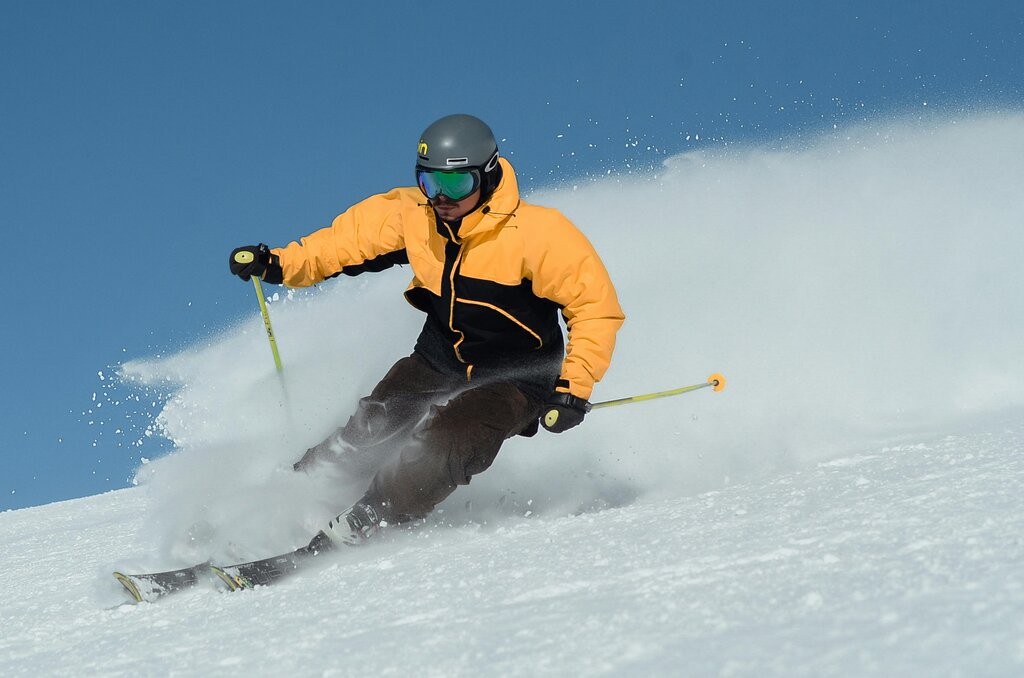
Your shins should always be in contact with the front of your ski boots. This ensures your weight is forward, allowing you to pressure the front of the ski and initiate turns with precision.
Charging the Steeps
Steep terrain is where all these skills—carving, balance, and edge control—come together. The consequences of a mistake are higher, so your technique needs to be precise. On steep slopes, speed control is everything.
You'll use shorter, quicker parallel turns to keep your speed in check. Instead of long, flowing carved arcs, think about making decisive, energetic turns across the fall line. The fall line is the most direct path down the mountain. Your goal is to cross it quickly and get your skis back underneath you for the next turn.
Pole planting becomes critical here. It's not for pushing, but for timing and stability. A firm pole plant just before you initiate a turn gives you a pivot point and helps you commit your weight down the hill. Plant your pole, turn around it, and reach for the next plant. This creates a rhythm that makes skiing steep terrain feel less intimidating and more like a dance.
Simply put, good technique is the ability to put your body in the right positioning to efficiently anticipate the forces you encounter on the slope while staying balanced over your skis.
Remember to always look ahead, planning your line two or three turns in advance. This allows you to anticipate changes in the snow or terrain and adjust your rhythm accordingly. With practice, the steep runs that once looked terrifying will become your favorite playground.
What is the primary difference between a skidded turn and a carved turn?
To initiate a carved turn, you should focus on minimizing the rotation of your upper body.