Mastering Algebraic Factoring
Understanding Factors
What Are Factors?
In mathematics, factors are the numbers you multiply together to get another number. Think of them as the building blocks of a number. If you can divide a number by another number and get a whole number with no remainder, then the number you divided by is a factor.
For example, 2 and 3 are factors of 6 because . You can also divide 6 by 2 to get 3, or divide 6 by 3 to get 2. Both divisions result in a whole number.
Factor
noun
A number that divides another number exactly, leaving no remainder.
Every number greater than 1 has at least two factors: 1 and itself. These are the most basic building blocks. Some numbers, called prime numbers, only have these two factors. Other numbers, called composite numbers, have more than two.
Finding Factors
How do you find all the factors of an integer? A straightforward way is to test numbers starting from 1 up to the number itself. Let's find the factors of 18.
We can start by checking which numbers divide 18 without leaving a remainder. We'll find them in pairs.
- Start with 1. We know . So, 1 and 18 are factors.
- Try 2. Does 18 divide by 2? Yes, . So, 2 and 9 are factors.
- Try 3. Does 18 divide by 3? Yes, . So, 3 and 6 are factors.
- Try 4. Does 18 divide by 4? No, it leaves a remainder.
- Try 5. Does 18 divide by 5? No.
- We've already found 6, so we know we have found all the pairs.
The factors of 18 are 1, 2, 3, 6, 9, and 18. This method of finding pairs helps ensure you don't miss any.
A useful trick: You only need to check numbers up to the square root of the number you are factoring. Once you pass the square root, you'll just be finding the other half of the pairs you've already found.
Another powerful tool for finding factors is prime factorization. This is the process of breaking a number down into its prime number factors. A factor tree can help visualize this.
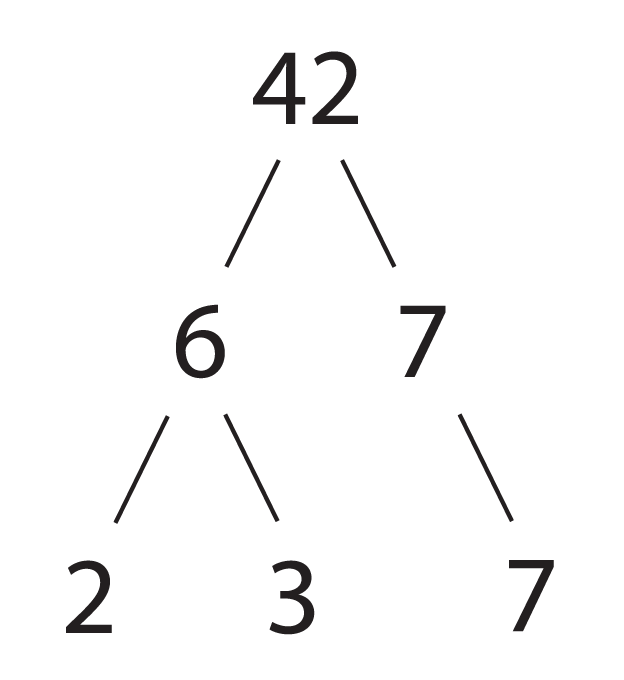
By breaking a number down to its prime factors, you can find all of its other factors by combining these primes in different ways. For 42, the prime factors are 2, 3, and 7. The other factors are created by multiplying these primes: , , and . Don't forget 1 and 42 itself!
Why Factors Matter in Algebra
Understanding factors is not just an arithmetic skill. It's a cornerstone of algebra. In algebra, we don't just work with numbers; we work with expressions that include variables, like .
Just as we can break down the number 6 into its factors (2 and 3), we can break down an algebraic expression into its factors. For the expression above, its factors are and . This is because .
Factoring is a key technique for solving equations, simplifying complex expressions, and understanding the behavior of functions. It turns complicated problems into simpler ones. By mastering the basics of finding factors of integers, you're building the foundation needed to tackle these more advanced algebraic concepts.
Ready to check your understanding?
Which of the following numbers is a factor of 24?
A prime number only has two factors: 1 and itself.