Mastering Algebra II
Functions
What is a Function?
Think of a function as a reliable machine, like a vending machine. You press a button for a specific snack (the input), and the machine gives you that snack (the output). Every time you press that same button, you get the same snack. A function works the same way: for any given input, it produces exactly one output.
In algebra, we write a function using a special notation. You might see something like . Let's break this down:
• is the name of the function. We could also call it or or anything else. • is the input variable. It's a placeholder for any number we want to put into the function. • , read as "f of x," represents the output of the function for a given input .
So, the equation is a rule that says, "Whatever number you give me as input, I will add 5 to it and give you the result as output."
Domain and Range
Every function has a set of possible inputs and a set of possible outputs. These have special names.
Domain
noun
The set of all possible input values for a function.
Range
noun
The set of all possible output values for a function.
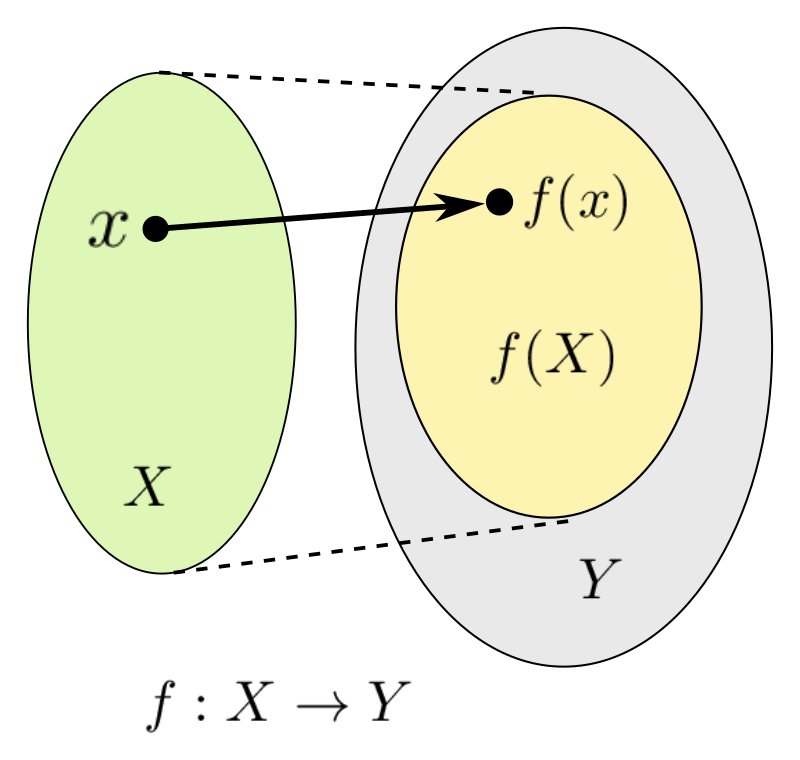
Going back to our vending machine analogy, the domain would be the list of all the button codes that actually work (like A1, B4, C2). The range would be the collection of all the different snacks you could possibly get from the machine.
Working with Functions
To "evaluate" a function means to find the output for a specific input. You simply replace the input variable with the given value and do the math.
Let's use the function . What is the value of ?
We substitute 4 for in the equation:
The input is 4, and the output is 10.
We can represent the relationship between inputs and outputs in a few different ways. A table is one common method. For our function , we could create a table of values.
| Input (x) | Process: 3x - 2 | Output (g(x)) |
|---|---|---|
| -1 | 3(-1) - 2 | -5 |
| 0 | 3(0) - 2 | -2 |
| 1 | 3(1) - 2 | 1 |
| 2 | 3(2) - 2 | 4 |
Each row in the table shows an input-output pair. For example, the input -1 corresponds to the output -5. We can write this pair as a coordinate: .
Graphs of Functions
A graph is a powerful way to visualize a function. It's a picture of all the possible input-output pairs. By plotting the coordinate pairs from our table for and connecting them, we get a straight line.
How can you tell if a graph represents a function? Use the Vertical Line Test. If you can draw a vertical line anywhere on the graph that crosses the curve more than once, it is not a function. This is because a single input (-value) would have more than one output (-value), which violates the definition of a function.
Understanding what makes a function, along with its domain, range, and different representations, is a key building block for algebra. You'll use these concepts again and again.
Which of the following scenarios best describes a function?
If , what is the value of ?