Mastering AI for Practical Use
Introduction to AI
What is Artificial Intelligence?
Artificial Intelligence, or AI, is a field of computer science focused on creating systems that can perform tasks that typically require human intelligence. This includes things like learning from experience, understanding language, recognizing objects in images, and making decisions.
The core idea is to build machines that can reason, learn, and adapt. Instead of following a rigid set of pre-programmed instructions for every possible scenario, an AI system learns patterns from data to figure out how to act.
Think of it this way: you don't teach a child to recognize a dog by describing every possible breed. They learn by seeing examples and eventually grasp the general concept of 'dog'. AI learns in a similar way, but with data.
A Brief History of AI
The dream of intelligent machines is ancient, but the scientific field of AI is relatively new. It officially began at a workshop at Dartmouth College in 1956, where the term "Artificial Intelligence" was coined. Early researchers were optimistic, believing that a machine with human-like intelligence was just a few decades away.
Progress wasn't a straight line. The field experienced periods of rapid advancement followed by "AI winters," when funding and interest dried up due to unmet expectations. But in recent decades, two key ingredients have changed everything: massive amounts of data and powerful computers. These have fueled the incredible breakthroughs we see today.

The Three Types of AI
AI isn't a single thing. It exists along a spectrum of capability, usually broken down into three theoretical stages.
Artificial Narrow Intelligence (ANI), also known as Weak AI, is the only type we have achieved so far. ANI is designed to perform a single specific task, like playing chess, recognizing your voice, or recommending a movie. While it can perform its dedicated task with superhuman ability, it has no awareness or capability outside of that narrow domain.
Artificial General Intelligence (AGI) is the next hypothetical step. This is the type of AI you often see in science fiction—a machine with the ability to understand, learn, and apply knowledge across a wide range of tasks at a human level. An AGI could write a poem, solve a complex scientific problem, and learn to play a new game all on its own. It doesn't exist yet.
Artificial Superintelligence (ASI) is the final, theoretical stage. ASI would be an intellect that is vastly smarter than the brightest human minds in virtually every field, including scientific creativity, general wisdom, and social skills. This is a far-future concept that raises many profound questions.
The Building Blocks of Modern AI
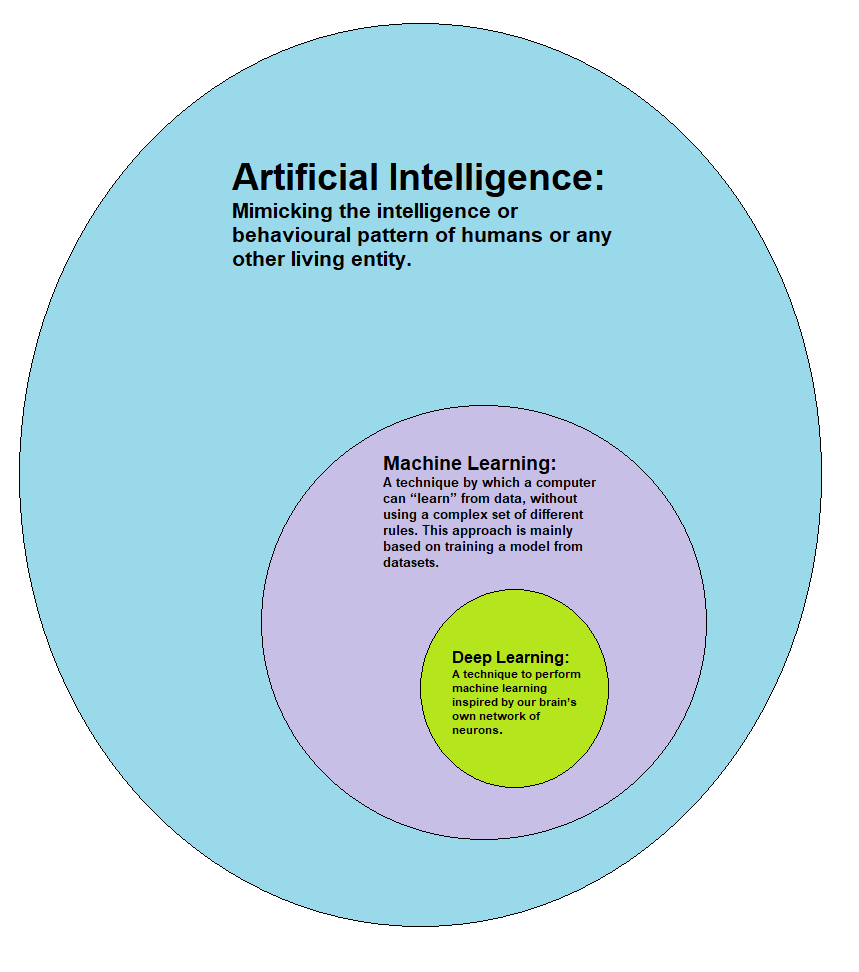
Today's AI is powered by a few key concepts that work together. At the broadest level, we have Artificial Intelligence. A major subfield of AI is Machine Learning.
Machine Learning
noun
A technique that gives computers the ability to learn from data without being explicitly programmed. Instead of writing rules by hand, developers create algorithms that can find patterns in data and use those patterns to make predictions.
To achieve this learning, many modern systems use artificial neural networks.
A Neural Network is a computing system inspired by the biological neural networks that constitute animal brains. It consists of interconnected nodes, or "neurons," that process and transmit information.
When a neural network has many layers of these nodes, it's called a deep neural network. This leads to Deep Learning, a powerful subset of machine learning.
Deep Learning
noun
A type of machine learning that uses deep neural networks with many layers to analyze various factors of data. It excels at finding complex patterns in large datasets, making it ideal for tasks like image and speech recognition.
These concepts are nested. Deep Learning is a type of Machine Learning, which is itself a way to achieve Artificial Intelligence.
Understanding these core ideas is the first step to grasping the power and potential of AI.