Mastering AI Customization and Model Optimization
Strategy Selection
Choosing Your Customization Path
Getting a Large Language Model (LLM) to perform a specific task well is more than just asking a question. It requires a strategy. When a general-purpose model doesn't quite meet your needs, you have three main paths to customize its behavior: Prompt Engineering, Retrieval-Augmented Generation (RAG), and Fine-Tuning.
Think of these three approaches as the LLM Optimization Triad. Each offers a different balance of control, cost, and complexity. Choosing the right one depends entirely on your goal, your resources, and the data you're working with.
Prompt Engineering
Prompt engineering is the art of crafting inputs to guide an LLM toward a desired output. It's the fastest and cheapest way to adjust a model's behavior. Instead of changing the model itself, you change how you ask it for information. This includes providing clear instructions, giving a few examples of the desired output (few-shot prompting), or assigning the model a specific role to play, like 'act as a senior copywriter'.
This approach is ideal for general tasks where you need to steer the model's tone, format, or focus without altering its underlying knowledge. It requires no special hardware and works with any model accessible via an API.
Use prompt engineering when you need to control the output format or style of a general-purpose LLM with minimal effort and cost.
Retrieval-Augmented Generation (RAG)
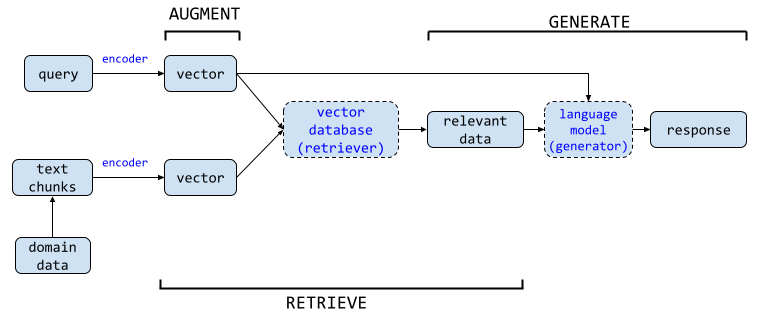
LLMs have a knowledge cut-off date and can invent information, a phenomenon known as hallucination. RAG addresses both problems by connecting the model to an external, up-to-date knowledge base. When you ask a question, the system first retrieves relevant documents from your data source (like a company wiki or a product database). It then passes this information to the LLM as context, instructing it to formulate an answer based only on the provided text.
This method is essential when factual accuracy and current information are critical. RAG doesn't change the model's core training; it just gives it the right facts for the job at hand. This is a powerful way to mitigate hallucinations, as the model's response is grounded in verifiable data. It's also excellent for data privacy, as your proprietary information is used at inference time, not for training a new model.
Fine-Tuning
Fine-tuning is the most intensive approach. It involves taking a pre-trained model and continuing its training on a smaller, domain-specific dataset. This process adjusts the model's internal parameters, or weights, to specialize it for a particular niche. Fine-tuning is what you need when you want the model to learn a new style, master a specific jargon, or adopt a very particular behavior that prompt engineering can't achieve.
For example, if you want an LLM to generate code in a proprietary programming language or write legal documents with a precise structure, fine-tuning is the way to go. It teaches the model how to behave, not just what to say.
However, this power comes with costs. Fine-tuning is computationally expensive and requires significant technical expertise. There's also a risk of 'catastrophic forgetting', where the model becomes so specialized that it loses some of its general capabilities. Data privacy is also a major consideration, as you are sending your data to be used in the training process.
Fine-tuning involves using a Large Language Model as a base and further training it with a domain-based dataset to enhance its performance on specific tasks.
Making the Right Choice
Choosing a strategy means weighing the trade-offs across several key factors. There's no single best answer, only the best fit for your specific use case.
| Factor | Prompt Engineering | RAG (Retrieval-Augmented Generation) | Fine-Tuning |
|---|---|---|---|
| Cost | Lowest | Moderate (vector database fees) | Highest (training compute) |
| Complexity | Low | Moderate (requires data pipeline) | High (requires ML expertise) |
| Data Privacy | High (data sent per query) | High (data stays in your system) | Lower (data used for training) |
| Info Freshness | Static (model's knowledge) | Dynamic (up-to-the-minute data) | Static (new training required) |
| Use Case | Steering tone & format | Factual Q&A, knowledge bots | Learning niche styles & domains |
Often, these strategies aren't mutually exclusive. A sophisticated system might use RAG to fetch the latest data, then use advanced prompt engineering to format the retrieved information into a perfect response. You could even use a fine-tuned model as the generator in a RAG system to get the best of both worlds: a specialized style combined with factual, up-to-date knowledge.
A company wants to build an AI chatbot that can write legal documents using the company's unique, proprietary formatting and style. Which LLM customization strategy is best suited for teaching the model this specific new skill?
What is the primary purpose of using Retrieval-Augmented Generation (RAG)?
The key is to start with the simplest, cheapest method that meets your needs. Begin with prompt engineering. If that's not enough, see if RAG can solve the problem by providing better context. Only turn to fine-tuning when you need to fundamentally change the model's core behavior.