Mastering AI Algorithmic Logic
Advanced Supervised Learning
Boosting Your Predictions
Ensemble methods improve predictive accuracy by combining multiple models. While a method like Random Forests builds many decision trees in parallel and averages their results, Gradient Boosting takes a different approach. It builds trees sequentially, with each new tree dedicated to correcting the errors made by the previous one.
Imagine teaching a student a new skill. You first provide a basic lesson (the first tree). You see where they make mistakes, then you provide a second lesson specifically targeting those weaknesses. This iterative process continues, with each step refining the student's understanding. This is the core idea behind (GBMs). The model doesn't just average a crowd of independent opinions; it builds a team of specialists who learn from each other's failures.
But how does the model know what an “error” is? This is determined by a loss function, a mathematical formula that quantifies the difference between the model's predictions and the actual outcomes. For regression tasks, a common choice is Mean Squared Error (MSE), which heavily penalizes larger errors. For classification, you might use Log-Loss, which penalizes confident but incorrect predictions.
One of the most powerful and popular implementations of gradient boosting is XGBoost (Extreme Gradient Boosting). It's an optimized, scalable library designed for speed and performance. XGBoost includes features like built-in regularization to prevent overfitting and handles missing data automatically, making it a favorite in data science competitions and production environments.
Drawing Lines in High Dimensions
Another powerful supervised learning algorithm is the Support Vector Machine (SVM). Instead of building trees, an SVM's goal is to find the best possible dividing line, or hyperplane, to separate data points into different classes.
The “best” hyperplane isn't just any line that separates the classes. An SVM seeks the hyperplane that has the maximum margin, meaning the largest possible distance to the nearest data point from each class. These closest points are called support vectors, and they are critical because they alone define the position and orientation of the hyperplane. This makes SVMs robust and efficient, as they ignore the other data points.
This works well for data that is linearly separable. But what if the boundary is a curve? SVMs solve this with the This clever technique maps the data into a higher-dimensional space where a linear separation becomes possible. Imagine data points on a flat sheet of paper that can't be separated by a straight line. The kernel trick is like lifting that paper and bending it in a way that, from a new perspective, the points can be cleanly separated by a flat plane.
The Balancing Act
These advanced models force us to confront the bias-variance trade-off. A model with high bias is too simple and underfits the data, missing important patterns. A model with high variance is too complex and overfits, learning the noise in the training data instead of the underlying signal.
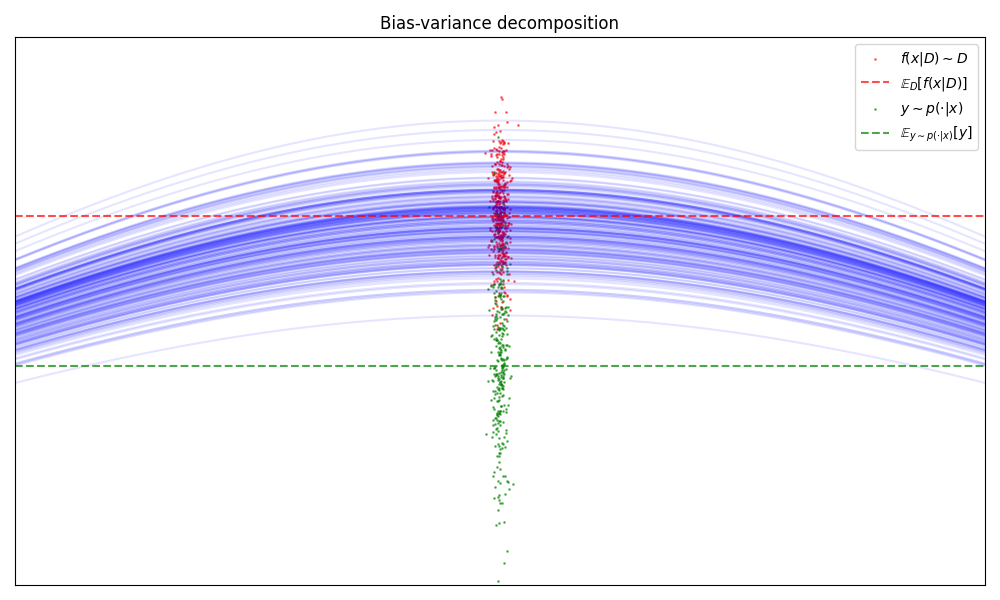
Gradient boosting methods like XGBoost are powerful because they can build very complex models, driving bias very low. However, this power comes at a cost. If not controlled, they can easily overfit the training data, leading to high variance and poor performance on new, unseen data. Regularization techniques are crucial for keeping this in check.
Random Forests, on the other hand, tackle the problem from the other direction. A single decision tree tends to have low bias but high variance. By building many trees on different subsets of the data and averaging their predictions, Random Forests dramatically reduce the overall variance, leading to a robust model that generalizes well.
In essence, XGBoost builds a strong model by sequentially correcting mistakes, while Random Forest builds a strong model by averaging the diverse opinions of many simpler models.
When comparing these in a production environment, XGBoost often yields slightly higher predictive accuracy. However, Random Forests are generally easier and faster to train and tune. They are also arguably more interpretable, as you can examine the feature importances across the entire forest. The choice often comes down to whether you need that last ounce of performance or a model that is more robust and easier to manage.
How does the Gradient Boosting algorithm primarily build its sequence of models?
In the context of Support Vector Machines (SVMs), what problem is the 'kernel trick' used to solve?
Understanding these advanced methods provides a powerful toolkit for tackling complex prediction problems. The key is knowing which tool to use and how to balance its power against the risk of overfitting.