Mastering AI Agents
Introduction to AI Agents
What is an AI Agent?
An AI agent is any system that perceives its environment and takes actions to achieve a specific goal. Think of a simple thermostat. It senses the room's temperature (perception) and turns the furnace on or off (action) to maintain a desired temperature (goal).
At their core, all agents follow a simple loop: Sense, think, act.
This concept scales up from thermostats to much more complex systems, like a robot navigating Mars or a software program booking your travel. What unites them is a set of core characteristics that make them an "agent."
agent
noun
An entity that perceives its environment through sensors and acts upon that environment through actuators.
Key characteristics include:
- Autonomy: Agents can operate on their own without direct human control. They have some level of independence in making decisions.
- Perception: They use sensors to gather information about their environment. For a software agent, this could be data from an API; for a robot, it might be a camera or microphone.
- Action: They can affect their environment using actuators. This could be turning a wheel, displaying a message, or sending an email.
- Goal-orientation: Agents are designed to achieve specific objectives. Their actions are not random but are directed toward fulfilling their goals.
Different Kinds of Agents
Not all agents are created equal. They fall into different categories based on how they decide what to do. The main types are reactive, deliberative, and hybrid.
Reactive agents are the simplest. They work on a simple condition-action rule: if this happens, do that. The thermostat is a perfect reactive agent. It doesn't remember past temperatures or predict future ones. It only knows the current temperature and reacts accordingly.
Deliberative agents are more thoughtful. They maintain an internal model of the world and use it to plan their actions. A GPS navigation app is a deliberative agent. It doesn't just tell you the next turn; it has a map of the entire area, knows your destination, and calculates the best overall route. It thinks ahead.
Hybrid agents combine the best of both worlds. They have a deliberative part for long-term planning and a reactive part for immediate responses. A self-driving car needs to plan a route from home to the office (deliberative), but it also needs to slam on the brakes instantly if a pedestrian steps into the road (reactive). This layered approach allows for both intelligent planning and rapid reflexes.
A Quick History
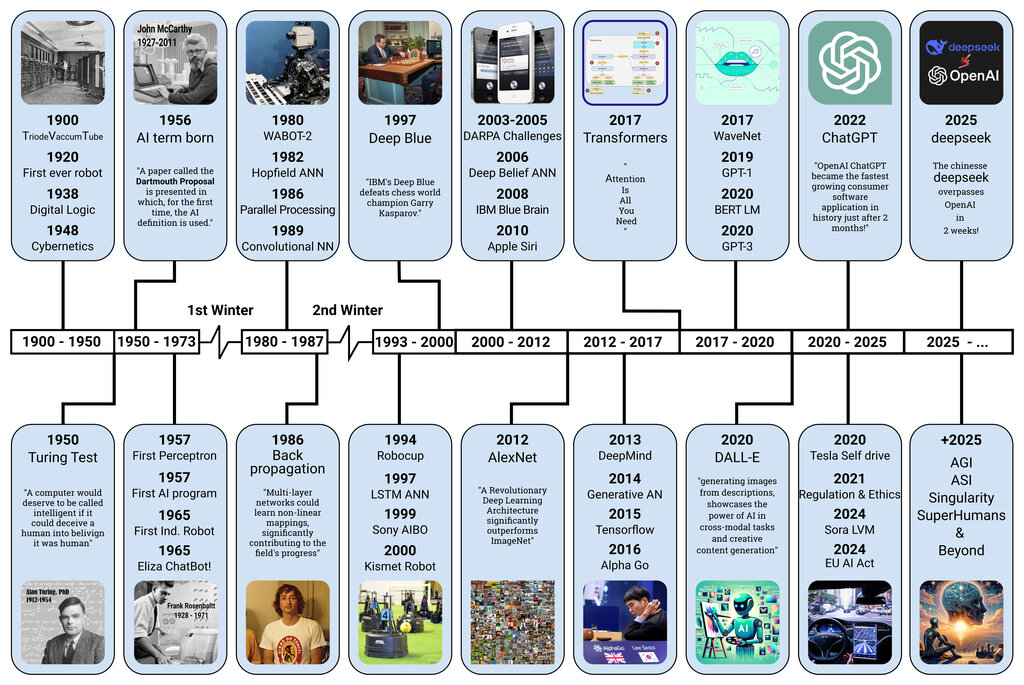
The idea of artificial agents isn't new. It has roots in the earliest days of computer science and artificial intelligence. Early thinkers imagined machines that could reason and act like humans.
Initial attempts in the mid-20th century focused on symbolic AI, where agents operated based on logical rules programmed by humans. Think of early chess programs that evaluated moves based on a complex set of pre-defined rules. They were powerful but brittle; they couldn't handle situations outside their programming.
The big shift came with machine learning. Instead of being explicitly programmed, modern agents learn from vast amounts of data. This allows them to handle uncertainty and adapt to new situations far more effectively. Today, the most advanced agents are powered by large language models (LLMs), giving them sophisticated reasoning and communication abilities that were once the stuff of science fiction.
Understanding these foundational concepts—what an agent is, its different types, and how the idea has evolved—is the first step to grasping the power and potential of modern AI.