Mastering AI Agent Orchestration
Defining AI Agents
From Talker to Doer
A Large Language Model, or LLM, is a powerful tool. Think of it as an incredibly knowledgeable person who has read nearly every book and website in existence. You can ask this person a question, and they can give you a detailed, well-written answer based on everything they've learned.
However, this person is sitting in a silent, empty room. They have no phone, no computer, and no way to interact with the outside world. They can only draw upon the knowledge already in their head. This is the limitation of a standard LLM. It's a brilliant 'talker', but it can't 'do' anything in the real world.
Giving the LLM Hands and Feet
This is where an AI agent comes in. An agent is an LLM that has been given 'limbs' and the ability to act. It's no longer just a brain in a box; it's a system designed to perceive its environment, make decisions, and use tools to accomplish specific goals.
The key difference is agency – the capacity to act independently to achieve an objective. An agent doesn't just answer your question; it takes action based on your request. This process follows a simple but powerful loop: perceive, reason, and act.
Imagine you want to book a holiday. If you ask a standard LLM, it might give you a great list of potential destinations and travel tips. If you ask an AI agent, the process is much different:
- Perceive: The agent receives your request: "Book a relaxing beach holiday for two in Greece for the first week of July, with a budget of $2,000."
- Reason: The LLM brain of the agent breaks this down. It identifies the key constraints: beach holiday, Greece, two people, July, $2,000 budget.
- Act: The agent uses its tools. It might access a flight booking website to check prices, connect to a hotel reservation system to find available rooms, and then check a weather site to confirm the conditions in July. It would then present you with a complete itinerary that fits your criteria.
Agents in the Wild
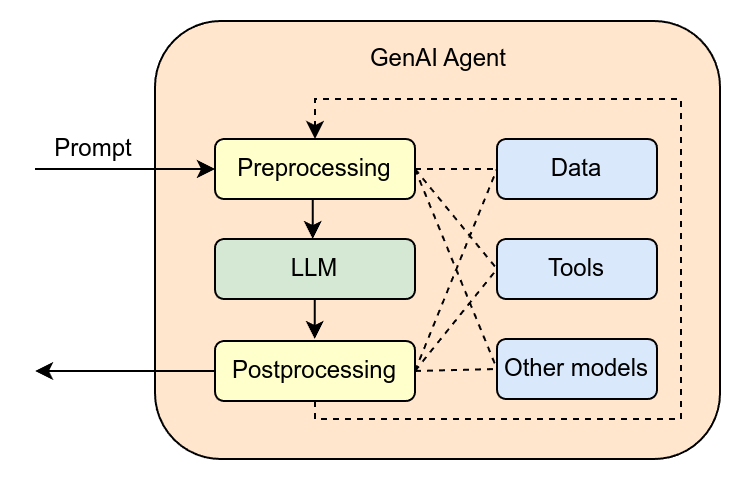
The potential for AI agents goes far beyond booking holidays. They are designed to handle complex, multi-step that would normally require a person to manage several different applications or websites.
Consider an agent designed to manage your email inbox. It could scan incoming messages, summarise the important ones, identify dates for meetings, and automatically add those events to your calendar. The agent isn't just understanding text; it's interacting with other software (your calendar) to perform a useful function. It's a shift from generating information to taking action.
Now, let's check your understanding of these core concepts.
What is the key characteristic that distinguishes an AI agent from a standard LLM?
You ask a system: "Find the top three Italian restaurants near me, book a table for two at the best one for 8 PM tonight, and send a calendar invitation to my partner." Which system is capable of fulfilling this entire request?
Understanding this distinction is the first step. An LLM provides knowledge, but an agent uses that knowledge to get things done.