Mastering Advanced Writing Techniques
Macrostructural Integrity
Beyond the Outline
You already know how to build a basic outline. An introduction, a few body paragraphs, and a conclusion. That structure works for school essays, but professional writing demands a different approach. Your reader—a busy executive, a potential client, a project manager—doesn't have time for a slow buildup. They need the most important information first, delivered with clarity and confidence.
This is where macrostructural integrity comes in. It’s the art of building a document where the high-level organization does the heavy lifting. Instead of just presenting information chronologically, you organize it by hierarchical importance. The goal is to create a logical architecture that guides your reader to your main point immediately, with every subsequent piece of information serving as direct, intentional support.
Substantive Editing (The Big Picture) – Focuses on the document as a whole, not the small details.
The Inverted Pyramid
Journalists mastered this concept over a century ago with a simple, powerful framework: the inverted pyramid. It flips the traditional essay structure on its head. You start with the conclusion, the single most newsworthy piece of information. This is your lead.
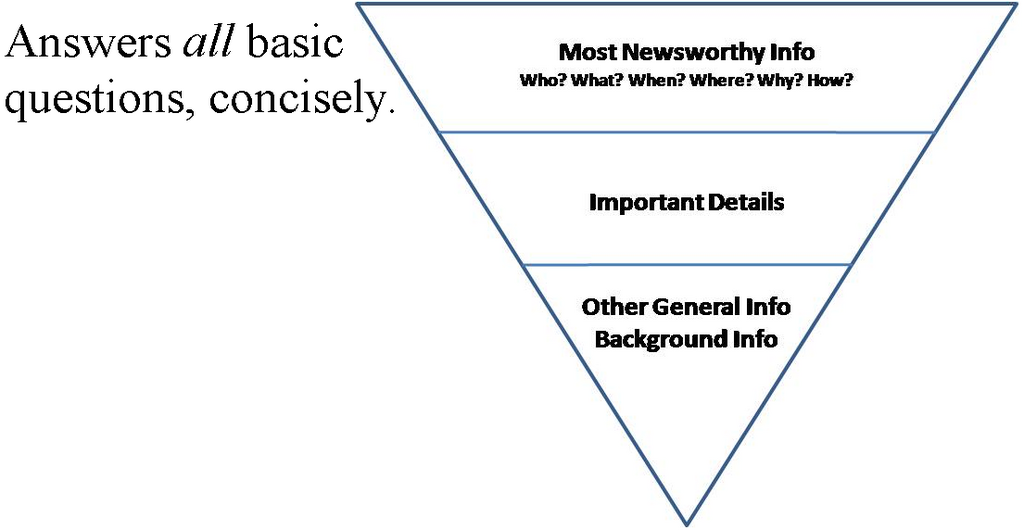
From there, you provide the essential details that support your lead. Who was involved? What happened? Why does it matter? Finally, you offer background information and other general context. If a reader only has 30 seconds, they get the whole story from the first paragraph. If they have more time, they can continue reading for greater depth.
This structure respects the reader’s time. It ensures your core message is delivered even if the reader gets interrupted or loses interest. In a business report or a project proposal, this means starting with your primary recommendation or finding, not with the history of the project.
The Minto Pyramid Principle
For more complex arguments, we can turn to a framework developed by at McKinsey & Company. The Minto Pyramid Principle is a system for structuring arguments so they are crystal clear. Like the inverted pyramid, it starts with the answer first.
The core idea is that ideas in writing should always form a pyramid under a single thought. There are three rules to follow:
- Start with the answer. The top of the pyramid is your main point, recommendation, or thesis.
- Group and summarize supporting arguments. The level directly below your main point should consist of the key arguments or categories that support it. These arguments must be mutually exclusive and collectively exhaustive (MECE).
- Logically order your supporting ideas. Each supporting idea at one level must be a logical summary of the ideas grouped beneath it.
Imagine you're proposing a new marketing strategy. Your main idea (the top of the pyramid) is: "We should launch a new content marketing initiative to increase leads by 25%."
Your supporting arguments on the next level down could be:
- Our target audience is highly active on professional blogs.
- Competitors are successfully using this channel.
- Internal data suggests our current strategy is plateauing.
Each of those points would then be supported by specific data, case studies, and evidence on the level below it. This hierarchical structure ensures that your argument is not just a list of facts, but a framework where every piece of information has a clear purpose.
Mapping Your Logic
Planning your document's structure isn't about creating a simple topic outline. It's about mapping the logical flow of your argument. Before you write a single paragraph, you should be able to sketch out your pyramid. What is your single, governing thought? What are the 2-4 key arguments that directly support it? What evidence proves each of those arguments?
This process forces you to clarify your thinking. If you can't build a clean pyramid, it’s a sign that your argument isn't fully formed. You may have gaps in your logic or evidence that is irrelevant to your main point. Fixing the structure at this stage is far more efficient than trying to edit a poorly organized 20-page document later.
Strong structure forces clear thinking. If the architecture is flawed, the argument will collapse.
By mastering these principles, you move from simply reporting information to strategically communicating it. Your writing becomes more persuasive, more efficient, and far more valuable to your reader.