Mastering Advanced Ultimate Frisbee Handling
Advanced Throwing Techniques
Beyond the Basics
Once you've mastered the standard backhand and forehand, it's time to add throws that can break through tough defenses. Advanced throws like the scoober and hammer use different release points and flight paths to create new passing lanes. They allow you to attack spaces that defenders think are covered, giving your offense a surprising and effective edge.
The Scoober
The scoober is a quick, deceptive, short-range throw. It's essentially an upside-down backhand, released from the forehand side of your body. Its main advantage is getting the disc over a defender's arms when they're marking you closely. The disc flies in a quick arc, starting upside down and flattening out as it reaches the receiver.
To throw a scoober, start by holding the disc with a grip similar to a backhand, but inverted. Place your thumb on the underside of the flight plate, not the rim. Your index finger rests along the inside of the rim, and your other fingers spread across the top for stability.
The motion is a quick, forward push and wrist snap. Keep the disc on a slight outside edge (hyzer) upon release. This angle allows the disc to flip to flat during its flight instead of turning over and crashing into the ground. It's a throw that relies on touch, not power.
The Hammer
The hammer is an overhead throw that is great for attacking deep space, especially over the top of a defender. It uses the same grip as a forehand but is thrown vertically, like a tomahawk chop. The disc flies in a high arc, eventually loses its vertical angle, and then flips over, floating down to the receiver upside down. This unique flight path makes it very difficult to defend.
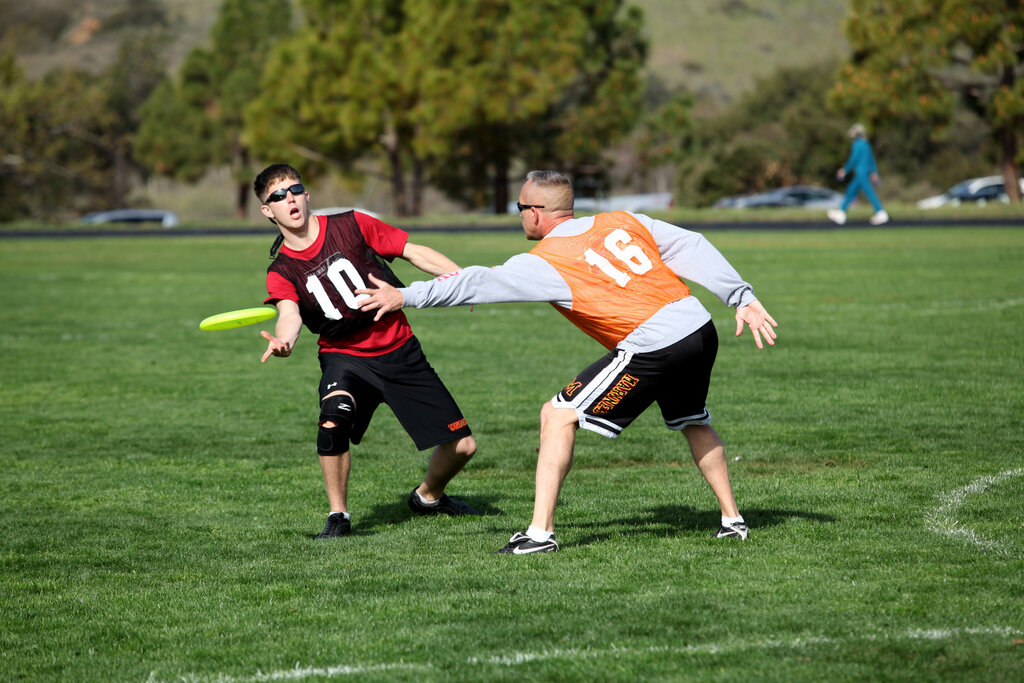
For the execution, grip the disc as you would for a forehand (two fingers underneath, thumb on top). Bring the disc up beside your head, similar to the starting motion for throwing a baseball. Your elbow should be bent at a 90-degree angle. The throwing motion is an upward and forward snap originating from your elbow and wrist.
The release angle is key. You want to release the disc nearly vertical, with a slight tilt away from your body. This tilt determines how quickly the disc will turn over. A more vertical release will result in a longer, straighter flight before it flips, while a more tilted release will cause it to pan out sideways sooner. Experiment with these angles to control where the disc lands.
The Flick from a Stack
While the flick (or forehand) is a fundamental throw, executing it effectively from a static handler position in an offensive stack requires advanced control. In this scenario, you have cutters moving into space, and you need to deliver a flat, accurate throw that leads them perfectly. This isn't about power, but precision and timing.
The goal is to release a perfectly flat flick. Any wobble or unintentional angle (hyzer or anhyzer) will make the disc harder to catch and can ruin a well-timed cut. This requires a smooth, compact motion and an incredibly clean release.
Focus on a crisp wrist snap. The power comes from the snap, not from a large arm movement. A compact motion is easier to control and repeat consistently.
To improve your stack-flick, practice throwing to a stationary target from about 15-20 yards away. Your only goal is to make the disc arrive perfectly flat, with good spin. Don't worry about distance. The spin is what gives the disc its stability and straight flight. Once you can do this consistently, practice leading a moving receiver, timing your throw to hit them in stride. This is the throw that unlocks a high-functioning offense.
What is the primary tactical advantage of throwing a scoober?
Which throw uses the same grip as a forehand (flick) but is released overhead?
Mastering these throws will make you a more versatile and unpredictable handler on the field.