Mastering Advanced Skiing Techniques
Weight Transfer Biomechanics
The Outside Ski Rules
As you move beyond wedged turns, one principle governs everything: the outside ski controls the turn. Think of it as the anchor. While the inside ski helps with balance, the outside ski bears the majority of your weight and does the heavy lifting of steering you through an arc. Shifting your weight onto it is what engages its edge and makes the ski bend into a curved shape, guiding you through the turn.
Your goal is to move your center of mass decisively over this outside ski. When your weight is properly committed, the ski can bite into the snow and carve a clean path. If your weight is split evenly or, worse, on the inside ski, you'll find yourself skidding and struggling for control. All fluid, powerful skiing starts with this commitment to the outside ski.
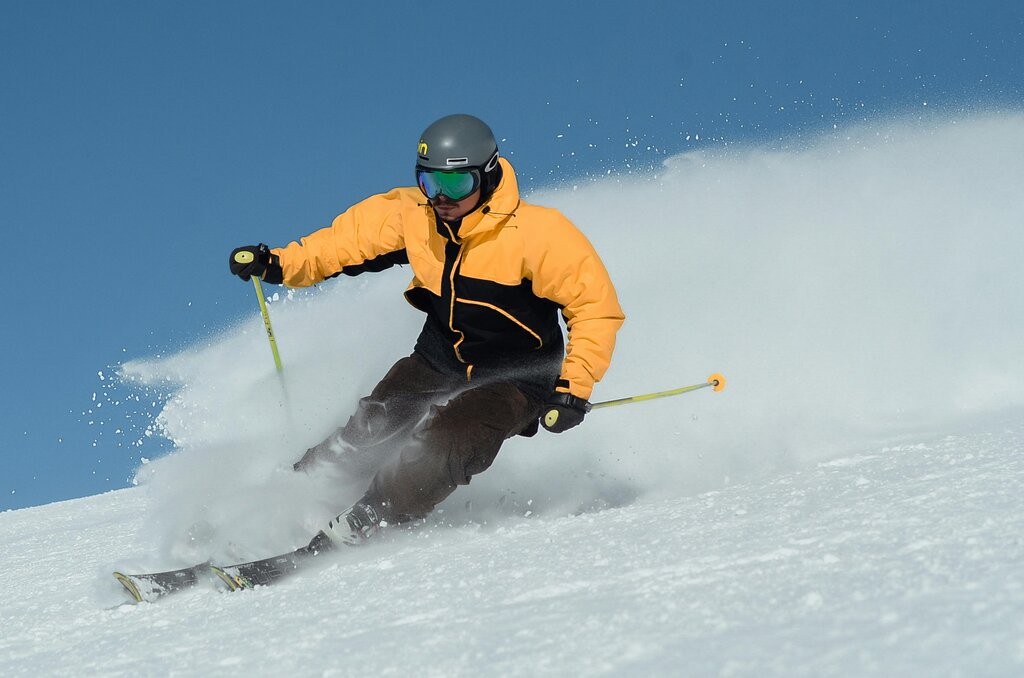
This isn't just about leaning. It's an active, intentional transfer of your body's core weight from one ski to the other at the very beginning of a new turn.
The Athletic Stance
Effective weight transfer is impossible without the right foundation. The athletic stance is your ready position, allowing you to be both stable and mobile. Your feet should be about hip-width apart. Your ankles and knees should be flexed, with your shins pressing firmly into the front of your ski boots. Your hips should be directly over your feet, not behind them. This is the most common mistake, known as being in the "backseat."
Imagine you're a goalie waiting for a shot. You wouldn't stand up straight or lean back on your heels. You'd be low, forward, and ready to move in any direction. That's the feeling you want on skis. Your hands should be in front of you, as if you're holding a tray. This simple cue helps keep your upper body calm and your weight forward.
Initiating the Turn
The magic happens in the transition between turns. A common mistake is to turn the upper body first, forcing the skis to follow. Instead, a clean turn starts from the feet and legs. As you finish one turn, you should already be thinking about the next.
The movement is a gentle but decisive roll. As your current outside ski is finishing its arc, you start to release the edge and simultaneously roll your knees and ankles toward the new turn. This action smoothly transfers your weight onto what will become the new outside ski. This needs to happen before you even point downhill. This early edge engagement is what separates intermediate skidding from advanced carving.
By weighting the new outside ski early, you allow its sidecut to bite into the snow. The ski is designed to turn; your job is simply to get your weight onto it and let it do its work. The result is a much smoother, more controlled, and more efficient turn that conserves your energy and speed.
Initiate turns with your feet and ankles, not your shoulders and hips. Let your lower body lead and your upper body will follow.
Feeling the Pressure
How do you know if you're doing it right? Pay attention to the feedback your boots are giving you. As you commit your weight and angulate into a turn, you should feel consistent, firm pressure from your shin against the tongue of your outside ski boot. This is your primary indicator that your weight is forward and you are driving the ski.
If you feel pressure on your calves, you're in the backseat. If you feel no pressure at all, you're likely standing too tall and aren't flexed enough. Throughout the turn, this pressure should feel like it’s building, reaching its maximum at the apex of the turn, when forces are strongest. Then, as you transition to the next turn, you'll feel that pressure release and start to build on the other leg. Learning to read and manage this pressure is key to dynamic skiing.
Time to see how well you've absorbed these concepts.
In a parallel turn, which ski is primarily responsible for steering and control?
A skier feeling pressure primarily on their calves inside their boots is a key indicator that they are...
Putting these ideas into practice takes time. Focus on one feeling at a time, like the pressure on your shins, and soon these movements will become second nature.