Mastering Advanced Sketching Techniques
Intuitive 3D Construction
Building Beyond the Outline
You've learned to capture the silhouette of an object. Now, let's give it weight, volume, and a place in the world. Constructing believable 3D forms from your imagination isn't about rigid rules or complex math. It's about training your hand and eye to work together to understand space. The first step is to loosen up and find your lines with confidence.
This starts with a technique called Your pen hovers just above the paper, repeating the motion of the line you intend to draw. You're rehearsing the movement, building muscle memory. Your arm, not your wrist, should drive the motion. When you feel the path is right, you lower the pen and execute the stroke in a single, smooth motion. It's less about drawing a line and more about landing it.
Practice ghosting circles and straight lines. Fill a page. Don't worry about perfection; focus on the rhythm and the flow of your arm.
The Box is Everything
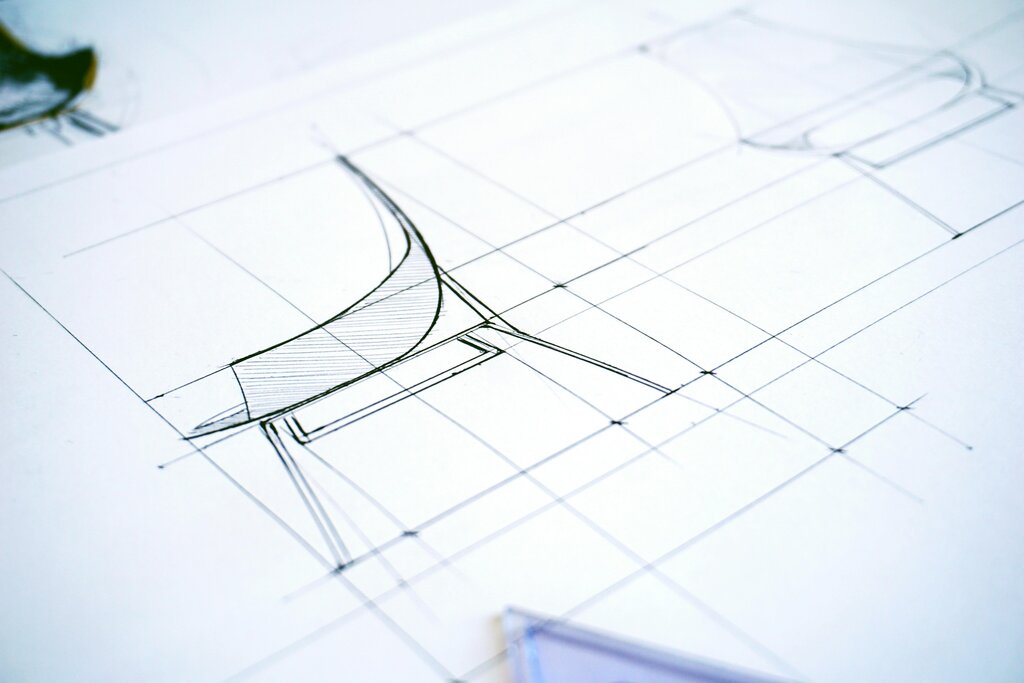
Every object, no matter how organic or complex, can be simplified and contained within a box. A car is a series of connected boxes. A coffee mug is a cylinder that fits inside a box. This is the core of —building complex forms from simple geometric volumes. By learning to draw and rotate a simple cube in space, you gain the power to draw anything from any angle.
Forget about rigid vanishing points for now. Instead, focus on the principle of converging parallels. In the real world, parallel lines appear to get closer together as they recede into the distance. To draw a convincing box, all you need to do is ensure the parallel edges on each face are angled slightly toward each other. The lines that are parallel to each other should feel like they're heading toward the same general area, far off the page.
This box is your stage. Once you can draw it comfortably, you can start modifying it. Want to draw a car? Start with a long, flat box. Then add a smaller box on top for the cabin. Slice off corners, round the edges, and carve out wheel wells. You are sculpting with lines, using the box as your block of marble.
Rotating in Space
The true test of your spatial understanding is rotating an object in your mind. Start with your simple box. Now, try to draw it again, but tilted slightly up. What happens? The top plane becomes more visible, and the front and side planes become more compressed. Now tilt it to the side. The side plane gets wider, and the front plane narrows.
This is an iterative process. Draw a box. Next to it, draw the same box from a slightly different angle. Don't erase; just draw another. This exercise builds a powerful intuitive link between what you imagine and what you can draw. As you practice, you'll feel the object turning in space. The planes—top, front, and side—are your primary guides. Always ask yourself: which planes can I see from this new angle, and how have their shapes changed?
By mastering the box, you're not just learning to draw a cube. You're learning a system for constructing anything, from a simple prop to a complex vehicle, with convincing depth and form, all from your imagination.
What is the primary purpose of the 'ghosting' technique in drawing?
According to the principle of constructive drawing, what is the best starting point for drawing a complex object like a coffee mug from imagination?