Mastering Advanced Molecular Biology
Eukaryotic Gene Regulation
The Cell's Master Switches
Every cell in your body contains the same library of DNA, a complete blueprint for you. Yet, a brain cell is dramatically different from a muscle cell. How? The answer lies in gene regulation. Cells don't use every gene all the time. Instead, they selectively turn genes on and off, expressing only the ones needed for their specific job. This process is like a chef using only certain ingredients from a massive pantry to cook a specific dish.
This control is most critical at the level of transcription, the process of copying a gene's DNA sequence into messenger RNA (mRNA). By controlling which genes are transcribed, a cell dictates which proteins it produces, ultimately defining its function and identity.
Gene regulation ensures that the right proteins are made in the right cells, at the right time, and in the right amounts.
Gatekeepers of Transcription
For transcription to begin, an enzyme called RNA polymerase must bind to a specific region of DNA at the start of a gene, known as the promoter. But RNA polymerase rarely works alone. It needs help from a class of proteins called transcription factors.
Transcription Factor
noun
A protein that controls the rate of transcription of genetic information from DNA to messenger RNA, by binding to a specific DNA sequence.
Think of transcription factors as the gatekeepers of a gene. There are two main types:
-
General Transcription Factors: These are essential for the transcription of nearly all genes. They assemble at the promoter and help position RNA polymerase correctly, forming a base complex that gets the process started. They are like the ground crew preparing a plane for takeoff, ensuring everything is in place.
-
Specific Transcription Factors: These provide a much finer level of control. They bind to specific DNA sequences that can be far from the promoter. Some, called activators, boost a gene's transcription. Others, called repressors, decrease or block it. These are the pilots who decide when and how fast the plane will fly.
Distant Control Centers
Specific transcription factors don't bind at the promoter itself. Instead, they attach to special DNA sequences called control elements. When an activator protein binds to a control element called an enhancer, it dramatically increases the rate of transcription. Conversely, when a repressor protein binds to a control element called a silencer, it shuts transcription down.
But how can a protein binding far away from a gene affect its transcription? The DNA molecule is flexible. It can bend and loop back on itself, bringing the distant enhancer or silencer, along with its bound transcription factor, into direct contact with the transcription machinery at the promoter. This interaction acts like a turbocharger (for enhancers) or a brake (for silencers) on the RNA polymerase.
Unpacking the Blueprint
There's another, more fundamental layer of control: physical access to the DNA itself. In eukaryotic cells, DNA isn't floating freely. It's tightly wrapped around proteins called histones, forming a complex called chromatin. This packaging compacts the vast length of DNA to fit inside the cell's nucleus.
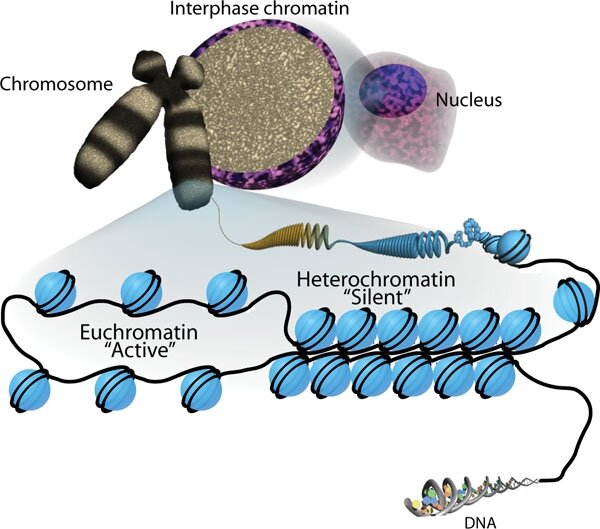
This packaging also serves as a regulatory mechanism. If a gene is located in a region where the chromatin is very tightly condensed, RNA polymerase and transcription factors simply can't reach it. The gene is effectively silenced.
To control gene access, cells use chromatin remodeling. Chemical tags can be added to or removed from the histone proteins. These tags act as signals that tell the chromatin to either open up or condense.
-
Euchromatin is the name for loosely packed chromatin. The DNA is accessible, and the genes within it can be transcribed. It's like an open book, ready to be read.
-
Heterochromatin is the tightly packed form. The DNA is condensed and inaccessible, silencing the genes it contains. It's a book that is closed and locked away.
By modifying chromatin structure, the cell can expose certain genes for transcription while hiding others, providing a powerful mechanism for long-term gene regulation.
So, how is a gene turned on? It's a coordinated effort. First, signals might trigger chromatin remodeling to loosen the chromatin around the gene, making it accessible. Then, general and specific transcription factors bind to the promoter and control elements. If activator proteins bind to enhancers, they help recruit RNA polymerase and kickstart transcription at a high rate. The gene is now 'on', and its protein product will be made.
What is the primary role of general transcription factors?
If a gene is located within a region of heterochromatin, what is the most likely status of its transcription?
These layers of control—from transcription factors to chromatin structure—allow eukaryotic cells to create a stunning diversity of cell types and functions from a single set of genetic instructions.