Mastering Advanced Martial Dynamics
Biomechanical Power Generation
The Secret Engine of Power
You've learned how to throw a punch and a kick. Now, let's learn how to make them powerful. The difference between a novice's slap and a professional's knockout isn't just muscle. It's about using the entire body as a single, coordinated unit.
This is the principle of the —a sequence of movements that transfers energy from the ground, up through your legs and core, and unleashes it at the point of impact. Think of it like cracking a whip. The handle moves a short distance, but the energy travels down the length, multiplying in speed until the tip breaks the sound barrier. Your body works the same way.
Efficient striking isn't about isolating muscles. It's about connecting them in a powerful sequence.
Ground Reaction Force
All power starts from the ground. When you push off the floor to initiate a strike, the ground pushes back with an equal and opposite force. This is Newton's Third Law in action, and it's called ground reaction force. This is the raw energy you'll channel into your opponent.
A solid stance is your connection to this energy source. If your feet are poorly positioned or your balance is off, you leak power before it even starts its journey up your body. You must grip the floor with your feet and use that stability to drive movement.
Rotation and Torque
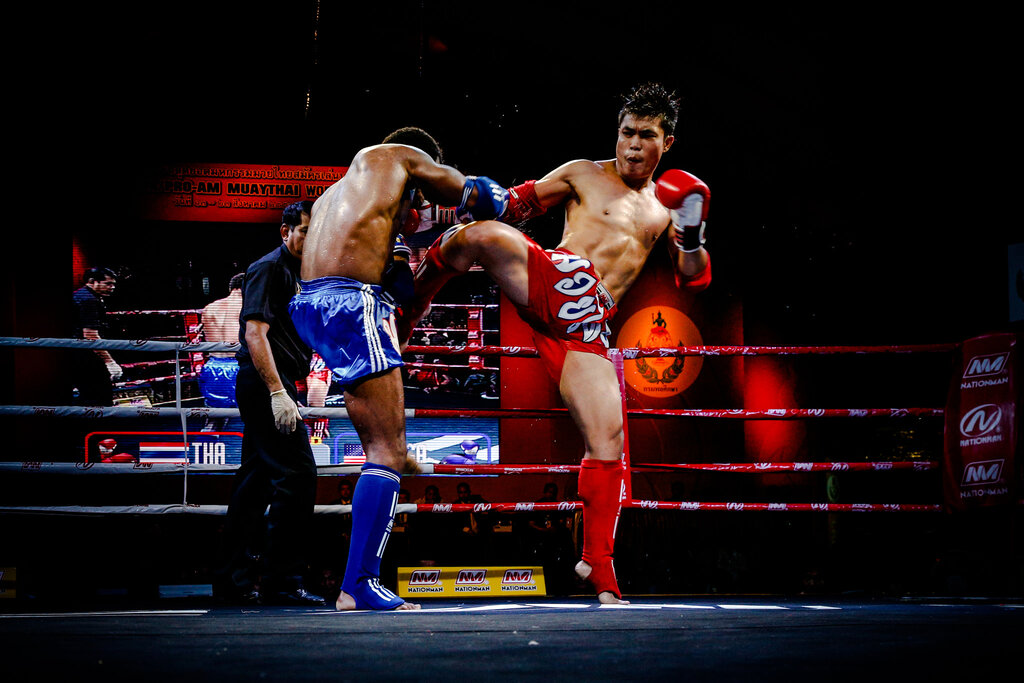
Once you have the energy from the ground, how do you multiply it? The answer is rotation. Your hips and torso are the engine of your power. By rotating them explosively, you generate torque, which is the rotational equivalent of force. This is most obvious in the Muay Thai roundhouse kick.
The fighter pivots on their standing foot, opens their hip, and rotates their entire torso into the kick. The leg itself is almost just along for the ride. The power isn't from the quadriceps alone; it's from the violent, coordinated rotation of the entire core. The same principle applies to a cross-punch. The power doesn't come from the arm, but from the pivot of the back foot and the rotation of the hip and shoulder.
Alignment and Efficiency
The final piece of the puzzle is structural alignment. The energy you've generated must have a solid path to the target. For a punch, this means your wrist, elbow, and shoulder should align at the moment of impact. If your wrist is bent or your elbow is flared out, energy will leak out, weakening the strike and potentially causing injury to your joints.
This is also the key to efficiency, especially when throwing combinations. Proper mechanics allow you to deliver powerful strikes without wasting energy. Each punch or kick flows smoothly into the next because your body is aligned and balanced. You can strike repeatedly without gassing out because you are using your entire body's momentum, not just isolated muscle strength.
The ability to generate maximum power and speed in a strike depends on body mechanics, balance, and the efficient use of kinetic energy.
Now let's test your understanding of how to generate power.
What is the primary role of hip and torso rotation in generating powerful strikes?
The principle that explains how pushing off the floor generates an initial force for a strike is known as the kinetic chain.
Mastering these biomechanics transforms your striking. You move from simply hitting a target to channeling coordinated, full-body power into every movement.