Mastering Advanced Mandala Geometry
Advanced Grid Construction
Beyond the Basics
You've mastered the basics of 4- and 8-fold symmetry. Now we move beyond those familiar structures to create grids with more complex and unusual divisions. This is where the true artistry begins, building intricate skeletons that support highly detailed designs.
The key to this next level is mastering your tools with precision, specifically the 360-degree protractor and the compass. Forget evenly spaced, predictable patterns. We're about to create frameworks with unique rhythms and flows.
Mastering Odd Divisions
Creating 7-fold, 9-fold, or 11-fold symmetry isn't harder, it just requires careful measurement. The logic is simple: a circle has 360 degrees. To find the angle for any number of divisions, you just divide 360 by the number of segments you want. The precision lies in marking these angles accurately with your protractors.
Let's try a 7-fold symmetry. The calculation is . This is where a good protractor is essential. You can't just guess.
Start with your central point and a single vertical line. Align the protractor's baseline with this line, its centre on your central point. Make a tiny, precise mark at . Then, rotate the protractor to align with your new mark and measure another . Repeat this process all the way around the circle. When you're done, draw light pencil lines from the centre through each mark to the edge of your planned mandala. This creates your radial skeleton.
Concentric Rings and Rhythm
With your radial lines in place, the next step is to create the concentric rings that will form the horizontal structure of your grid. The compass is your tool for this, but we're moving beyond uniformly spaced circles. Variable spacing is what gives a mandala visual rhythm and complexity.
Instead of increasing the compass radius by 1 cm each time, try a more organic sequence. You could use a Fibonacci-like progression (e.g., rings at 1 cm, 2 cm, 3 cm, 5 cm, 8 cm from the centre) to create a natural-looking expansion. Or, create clusters of tightly packed rings, followed by a wide open space, then another cluster. This technique guides the viewer's eye and creates distinct zones for different patterns.
Precision is paramount. Ensure your compass lead is sharp and the hinge is tight. A wobbly compass will ruin the accuracy of your entire geometric skeleton.
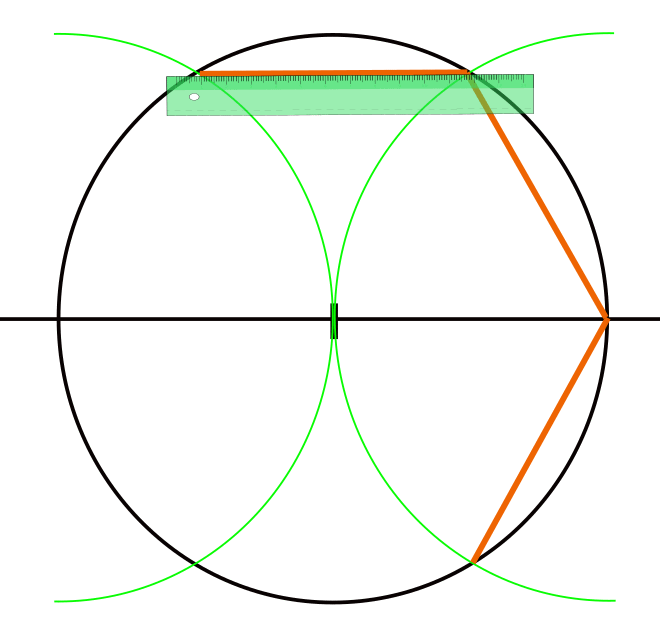
The combination of non-standard radial divisions and variably spaced concentric rings is the key. This process creates a —a precise, mathematical blueprint. It's the unseen foundation that gives the final, decorative mandala its harmony and balance. Don't rush this stage. A perfect skeleton is the prerequisite for a professional-grade mandala. Every line and intersection is a potential anchor point for the patterns you'll layer on top.
Now, let's test your understanding of these advanced grid principles.
To create a mandala grid with 9-fold symmetry, what is the correct angle to measure between each radial line?
What is the primary artistic benefit of using variably spaced concentric rings, such as a Fibonacci sequence, when building a mandala grid?
With these techniques, you can now construct a nearly infinite variety of foundational grids, moving far beyond standard symmetries.