Mastering Advanced Mandala Artistry
Advanced Geometric Grids
Level Up Your Grid
You've mastered the 8-point radial grid, which is the foundation for many beautiful mandalas. But to create designs with professional depth and intricacy, you need a more complex skeleton. Increasing the number of radial divisions allows for denser patterns and more sophisticated symmetries.
Moving from 8 to 16, or even 32, divisions doesn't just add more lines. It fundamentally changes the design possibilities, allowing for delicate, layered details that aren't possible on a simpler grid.
The most straightforward way to create a 16-point grid is to bisect the angles of your 8-point grid. Each 45° segment is split into two 22.5° segments. To get to 32 points, you simply bisect them again, creating narrow 11.25° wedges.
While you can do this with a compass, a protractor is your best friend for precision. Use it to mark your initial 45° and 90° lines, then find the exact midpoint for the 22.5° and 11.25° marks. A sharp pencil and a steady hand are crucial. A small error at the center can become a large, noticeable gap at the edge of your mandala.
The Geometry of Life
Radial lines are just one type of underlying structure. For more organic, flowing patterns, many artists use grids built from overlapping circles. The most well-known of these is the pattern. It's an ancient symbol, but for a mandala artist, it's a practical blueprint packed with useful intersections.
This grid isn't about dividing the circle into wedges. Instead, it creates a hexagonal mesh of curves. The points where the circles intersect become natural anchor points for petals, spirals, and other repeating elements. It’s a fantastic base for designs that feel less rigid and more interconnected.
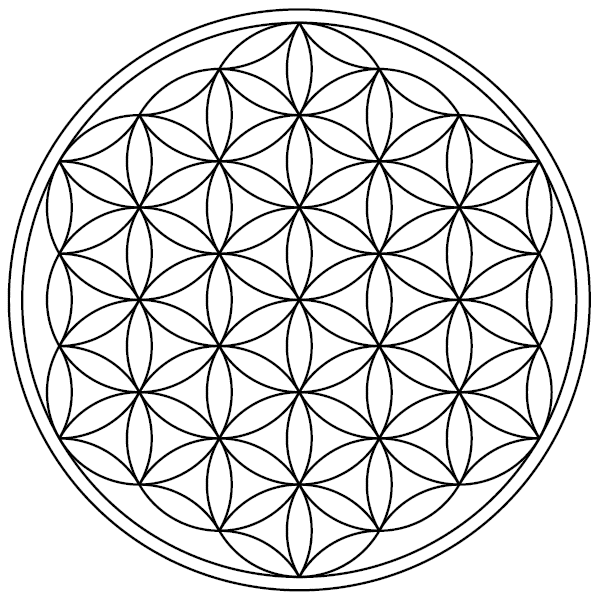
To construct it, you start with a single circle. Then, from a point on its circumference, you draw another circle of the same radius. You continue this process, using the new intersection points as centres for subsequent circles, building outwards until the pattern is complete.
Framing Your Design
Combining linear and radial grids opens another level of complexity. A common technique is the square-in-circle construction. By inscribing a square perfectly inside your main circle, you create four anchor points and straight lines that contrast with the mandala's curves. You can even add a second square, rotated by 45°, to form an eight-pointed star.
This technique is excellent for creating a solid frame or for building asymmetrical patterns inside a perfectly symmetrical border. The contrast between the angular frame and the circular flow inside draws the eye and adds a dynamic tension to the piece.
For truly harmonious proportions, some artists incorporate the into their radial designs. This mathematical principle, often represented by the Greek letter phi (), appears frequently in nature and is considered aesthetically pleasing.
Instead of placing concentric circles at regular intervals, you can space them according to the Golden Ratio. If your first circle has a radius of 1 unit, the next would have a radius of 1.618, the next 2.618, and so on. This creates a natural-looking expansion, similar to the spiral of a nautilus shell. It's a subtle touch that can give your mandala a deep sense of balance and rightness.
By moving beyond simple radial divisions and incorporating these advanced grid techniques, you can build a strong, precise foundation for truly breathtaking mandalas. The more accurate your initial grid, the more freedom you'll have to layer intricate patterns on top of it.