Mastering Advanced Hypothesis Testing
Error Nuance and Power
The Error Balancing Act
In hypothesis testing, we're detectives searching for evidence. We start with a default assumption, the null hypothesis (), and look for strong enough evidence to reject it in favor of an alternative (). But since we're working with samples, not entire populations, we can never be 100% certain. This uncertainty leads to two potential mistakes.
| Decision | is True (No Effect) | is False (Real Effect) |
|---|---|---|
| Reject | Type I Error (False Positive) | Correct Decision (True Positive) |
| Probability = | Probability = Power (1 - ) | |
| Fail to Reject | Correct Decision (True Negative) | Type II Error (False Negative) |
| Probability = 1 - | Probability = |
A Type I error, or false positive, happens when we reject a true null hypothesis. Think of it as a smoke alarm going off when you've only burned toast. The probability of this is our significance level, . A Type II error, a false negative, is failing to reject a false null hypothesis—the smoke alarm stays silent during a real fire. The probability is denoted by .
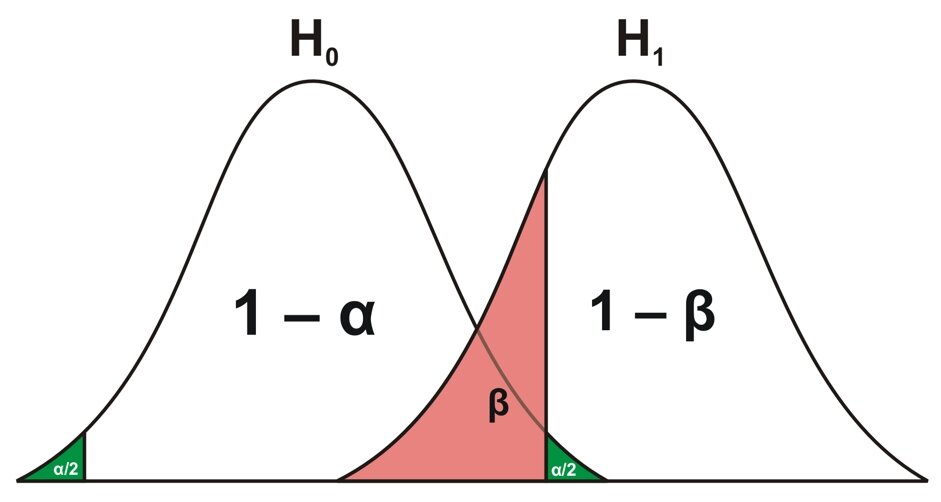
Here's the crucial trade-off: decreasing the chance of one error often increases the chance of the other. If you make your smoke detector extremely sensitive to avoid missing a fire (lowering ), you'll get more false alarms from routine cooking (increasing ). Conversely, making it less sensitive to reduce false alarms (lowering ) raises the risk of missing a real emergency (increasing ). Setting is a judgment call about which error is more costly in a given situation.
The Power of a Test
If is the probability of missing a real effect, then its complement, , must be the probability of detecting one. This is known as —the probability that your test will correctly reject a false null hypothesis. In short, it’s the test’s ability to find what it’s designed to find.
A study with low power is like fishing with a net full of large holes. You might not catch anything, but you can't be sure if it's because there were no fish or because they all swam through the gaps. High power ensures your net is fine enough to catch the fish you're looking for.
Factors Influencing Power
So, how do we get a more powerful test? Three main factors are at play:
- Significance Level (): A more lenient (e.g., 0.10 instead of 0.05) makes it easier to reject the null hypothesis. This increases power but also raises the risk of a Type I error. It's a direct trade-off.
- Sample Size (): More data provides a clearer picture. A larger sample size reduces the standard error of your estimates, making the sampling distributions narrower. This separation reduces the overlap between the null and alternative hypothesis distributions, which in turn shrinks and boosts power. This is often the most direct way to increase power.
- Effect Size: The is the magnitude of the difference or relationship you're investigating. A large, obvious effect (like the height difference between third graders and NBA players) is easy to detect even with a small sample. A small, subtle effect (like a slight improvement in test scores from a new teaching method) requires a much more powerful test, and likely a larger sample, to detect reliably.
Sensitivity and Specificity
In fields like medicine and machine learning, the concepts of power and error rates are often framed as They directly map to what we've been discussing:
- Sensitivity is the ability of a test to correctly identify true positives. It's the same as statistical power. A highly sensitive test catches most of the cases it's supposed to catch.
- Specificity is the ability of a test to correctly identify true negatives. This is the complement of the Type I error rate (). A highly specific test has very few false alarms.
Sensitivity =
Specificity =
Understanding this quartet—Type I errors (), Type II errors (), power (), and effect size—is fundamental to designing experiments that can deliver meaningful and reliable results. It moves us beyond simply running a test to strategically planning a study that has a high chance of success.
In hypothesis testing, what is a Type I error?
If a researcher decides to decrease the significance level () from 0.05 to 0.01, what is the most likely consequence?