Mastering Advanced Flexibility and Mobility
Neuromuscular Physiology
Your Nervous System's Brakes
Your muscles don't operate in isolation. Every stretch, contraction, and explosive movement is governed by a constant conversation between your muscles and your central nervous system. This isn't just about telling a muscle to move; it's about protecting it from tearing itself apart. Your brain sets limits on your range of motion, acting like a protective governor on an engine. To achieve greater flexibility and power, you need to understand how to work with these built-in safety mechanisms, not against them.
The two key players in this system are sensory receptors embedded within your muscles and tendons: muscle spindles and Golgi tendon organs. They provide real-time feedback, allowing your nervous system to make split-second decisions to prevent injury. Think of them as tiny, intelligent sensors.
The Stretch Reflex
Deep within the belly of your skeletal muscles lie specialised sensory receptors called muscle spindles. Their primary job is to detect changes in muscle length and, crucially, the speed of that change. When a muscle is stretched too far or too fast, the muscle spindles fire off a signal.
This signal travels up a sensory neuron to the spinal cord, where it synapses directly with a motor neuron. This motor neuron then sends an immediate command back to the same muscle, telling it to contract. This rapid, involuntary contraction opposes the stretch, acting as a brake to prevent overstretching and potential tearing. This entire circuit is known as the stretch reflex, or myotatic reflex. The classic example is the knee-jerk test at the doctor's office. The tap on the patellar tendon causes a rapid stretch in the quadriceps muscle, triggering the stretch reflex and causing your lower leg to kick out.
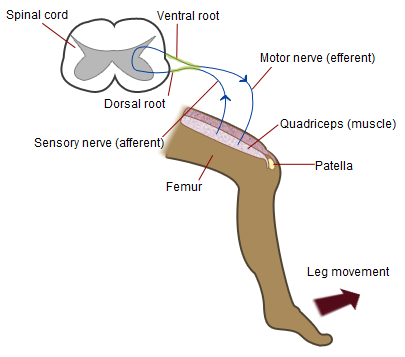
The sensitivity of muscle spindles isn't fixed. It's fine-tuned by gamma motor neurons, which adjust the tension within the spindles themselves. During focused movements or when anticipating a stretch, the nervous system can increase gamma motor neuron activity, making the spindles more sensitive and the reflex response stronger.
The Golgi Tendon Organ
While muscle spindles monitor muscle length, another set of receptors monitors tension. These are the Golgi Tendon Organs (GTOs), and they're strategically located at the junction where muscle fibres connect to tendons. They act as force detectors.
When tension in a muscle increases significantly, whether from a heavy lift or an intense stretch, the GTO is stimulated. Like the muscle spindle, it sends a signal to the spinal cord. But here, the response is the opposite. The GTO's signal excites an inhibitory interneuron in the spinal cord. This interneuron then inhibits the motor neuron that goes back to the contracting muscle. The result? The muscle relaxes. This is a protective override mechanism, called the inverse myotatic reflex, designed to prevent the muscle from generating so much force that it rips its own tendon from the bone.
When a muscle contracts isometrically (generating tension without movement), golgi tendon organs (GTOs) sense the increased tension.
Inhibition and Advanced Stretching
Understanding these two reflexes is the key to unlocking greater flexibility. Advanced stretching techniques are essentially ways to consciously manipulate these neural pathways to convince your nervous system to release its protective brakes. This is achieved through two types of inhibition.
Autogenic Inhibition
noun
The reflex relaxation of a muscle after it undergoes a sustained, strong contraction. This is the GTO in action. By voluntarily creating high tension in a muscle (for example, by pushing against an immovable object), you activate the GTOs, which then send a signal to inhibit that same muscle, causing it to relax more deeply than it would in a simple passive stretch.
The second mechanism is Reciprocal Inhibition. This is a fundamental principle of motor control. To allow for smooth movement, when your central nervous system sends a signal for one muscle (the agonist) to contract, it simultaneously sends an inhibitory signal to the opposing muscle (the antagonist), causing it to relax. You can't effectively flex your bicep if your tricep is also contracting strongly. By contracting the muscle opposing the one you want to stretch, you leverage reciprocal inhibition to achieve a greater release of tension.
| Inhibition Type | Mechanism | Trigger | Result |
|---|---|---|---|
| Autogenic | Golgi Tendon Organ (GTO) activation | High tension from an isometric contraction of the target muscle. | The same muscle (the one being contracted) is inhibited and relaxes. |
| Reciprocal | Agonist-Antagonist relationship | Contraction of the muscle opposing the target muscle. | The target muscle (the antagonist) is inhibited and relaxes. |
Time to check your understanding of these neural mechanisms.
What is the primary function of muscle spindles?
When the stretch reflex (myotatic reflex) is activated, what is the immediate response of the stretched muscle?
By understanding the interplay between muscle spindles, GTOs, and the principles of inhibition, you can move beyond simple static stretching and begin to communicate with your nervous system to safely and effectively enhance your body's range of motion and power.