Mastering Advanced CCNA Networking
Advanced Routing Protocols
Beyond Basic Routing
You've already learned how routing protocols like OSPF and EIGRP share information to build a map of the network. Now, we'll move beyond the default settings. Advanced configuration isn't about just making the network function, it's about making it faster, more efficient, and more resilient. We'll explore how to fine-tune these protocols for complex, real-world environments.
Fine-Tuning OSPF
In a large OSPF network, every router knows about every single link. When a link goes down, this information floods the entire network, forcing every router to recalculate its routes. This can be inefficient and slow down convergence, the process of routers agreeing on the new network topology.
To solve this, OSPF uses a concept of areas. An OSPF network can be divided into smaller, manageable sections. All areas must connect to a central backbone, called Area 0. By creating areas, we can contain routing updates. A change within one area doesn't necessarily flood the entire network, just the routers in that area and the backbone.
A special type of area is a stub area. Routers in a stub area don't need to know all the specific routes outside their area. Instead, the area's border router just gives them a single default route for everything external. This dramatically shrinks their routing tables and reduces the processing they have to do.
Another powerful technique is route summarization. An Area Border Router (ABR) can consolidate multiple specific routes from one area into a single summary route before advertising it to the backbone. For example, instead of advertising 10.1.1.0/24, 10.1.2.0/24, and 10.1.3.0/24 separately, the ABR can advertise a single route: 10.1.0.0/22. This further stabilizes the network by hiding individual link failures within an area from the rest of the network.
Optimizing EIGRP
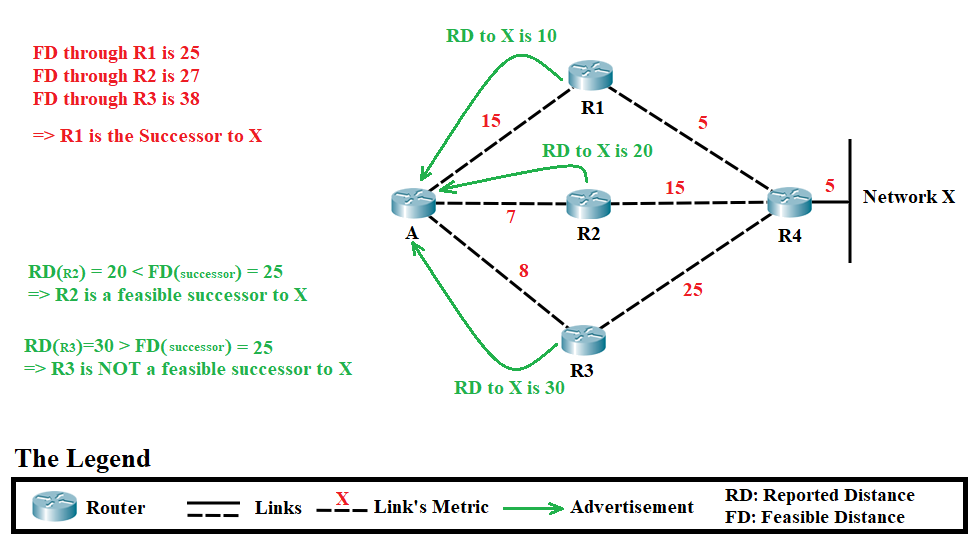
EIGRP has its own set of powerful optimization features. One of its most famous is support for unequal-cost load balancing. Most routing protocols will only use multiple paths to a destination if they have the exact same metric, or cost. EIGRP can be configured to send traffic across multiple paths even if their costs are different, as long as they meet a certain criteria.
This is controlled by the Feasibility Condition. A backup route is considered viable if its Reported Distance (RD) — the cost from the neighboring router to the destination — is less than the current best path's Feasible Distance (FD) — the total cost from the local router to the destination. This simple rule cleverly ensures the backup path is loop-free.
Similar to OSPF stub areas, EIGRP has stub routing. An EIGRP stub router tells its neighbors that it is at the edge of the network. This is a powerful signal. When another router in the network loses a route, it sends out queries to its neighbors to find a new path. It knows not to bother sending a query to a stub router, because a stub router would never have an alternate path to the core network. This limits the scope of EIGRP queries, improving stability and convergence time.
Making Protocols Cooperate
It's common for large organizations to run more than one routing protocol. This might happen during a company merger or when connecting to a partner network. When you have two different routing domains, say one running OSPF and another running EIGRP, you need a way for them to exchange routing information. This process is called route redistribution.
A router sitting at the boundary of both domains is configured to listen to routes from one protocol and advertise them into the other. While powerful, this process is delicate. The two biggest challenges are routing loops and metric translation. Because EIGRP and OSPF calculate their metrics (costs) in completely different ways, you have to define a starting, or "seed," metric when injecting routes from one into the other. Otherwise, the receiving protocol won't know how to evaluate the new paths.
Path selection follows a strict order. First, the router chooses the path with the lowest Administrative Distance (AD). If there's a tie, it then uses the protocol's metric to determine the best path.
Administrative Distance (AD) is a value from 0 to 255 that indicates the trustworthiness of a route source. A lower value is more trustworthy. When a router learns about the same destination network from multiple routing protocols, it uses AD to break the tie.
| Route Source | Default Administrative Distance |
|---|---|
| Connected Interface | 0 |
| Static Route | 1 |
| EIGRP (Internal) | 90 |
| OSPF | 110 |
| RIP | 120 |
| EIGRP (External) | 170 |
According to the table, if a router learns about a path to 192.168.1.0/24 from both OSPF and EIGRP, it will always prefer the EIGRP route because 90 is lower than 110. Network administrators can manually change these default values to influence path selection and execute specific routing policies.
Ready to test your knowledge on these advanced topics? Let's see how well you can apply these concepts.
What is the primary benefit of dividing a large OSPF network into multiple areas?
An Area Border Router (ABR) in an OSPF network is connected to an area containing the networks 10.1.1.0/24, 10.1.2.0/24, and 10.1.3.0/24. Which of the following is the most efficient summary route it can advertise to the backbone area?
Mastering these advanced techniques allows you to build networks that are not only connected but also intelligent, stable, and highly efficient.