Mastering Advanced Calisthenics Progressions
Hollow Body Mastery
Beyond the Brace
You already know how to brace your core for a push-up or pull-up. But to unlock advanced calisthenics skills, you need to move beyond a simple brace and master the hollow body position. Think of your body as a whip. A standard brace is like a slightly floppy whip; some power is lost in the flex. The hollow body turns your body into a rigid, unified lever.
This creates a solid from your hands to your feet. In movements like a planche or front lever, this rigidity is non-negotiable. It eliminates 'power leaks', ensuring that the force you generate is transferred efficiently through your entire body without any weak links breaking the chain.
The Pelvic Tilt
The foundation of the hollow body isn't your abs, it's your pelvis. Specifically, achieving a strong (PPT) is the first step. This movement involves rotating your hips backward, as if you're trying to flatten the small of your back against the floor. Imagine your pelvis is a bowl of water. A PPT is the motion of tipping the water out from the back of the bowl.
This simple adjustment engages your lower abdominals and glutes, eliminating the arch in your lower back. This locks your ribcage and pelvis together, forming the solid centerpiece of your kinetic chain.
Sculpting the Shoulders
With the pelvis locked in, the next step is positioning the shoulder blades, or scapulae. For a hollow body, you need protraction and depression. This is the opposite of the 'chest up, shoulders back' cue you hear in weightlifting, which is scapular retraction.
Protraction means pushing your shoulder blades forward and apart, as if you're trying to wrap them around your rib cage. Depression means pulling them down, away from your ears.
This action engages the serratus anterior, a muscle that helps stabilise your scapula against your rib cage. The combination of protraction and depression creates a slight curve in your upper back and hollows out your chest, completing the 'dish' shape of the position. This provides a stable platform for your arms in movements like push-ups and planches.
Putting It Into Practice
Let's build the position from the ground up. The best way to learn lumbar control and the posterior pelvic tilt is with the dead bug exercise. The goal here is to move your limbs while keeping your lower back firmly pressed into the floor.
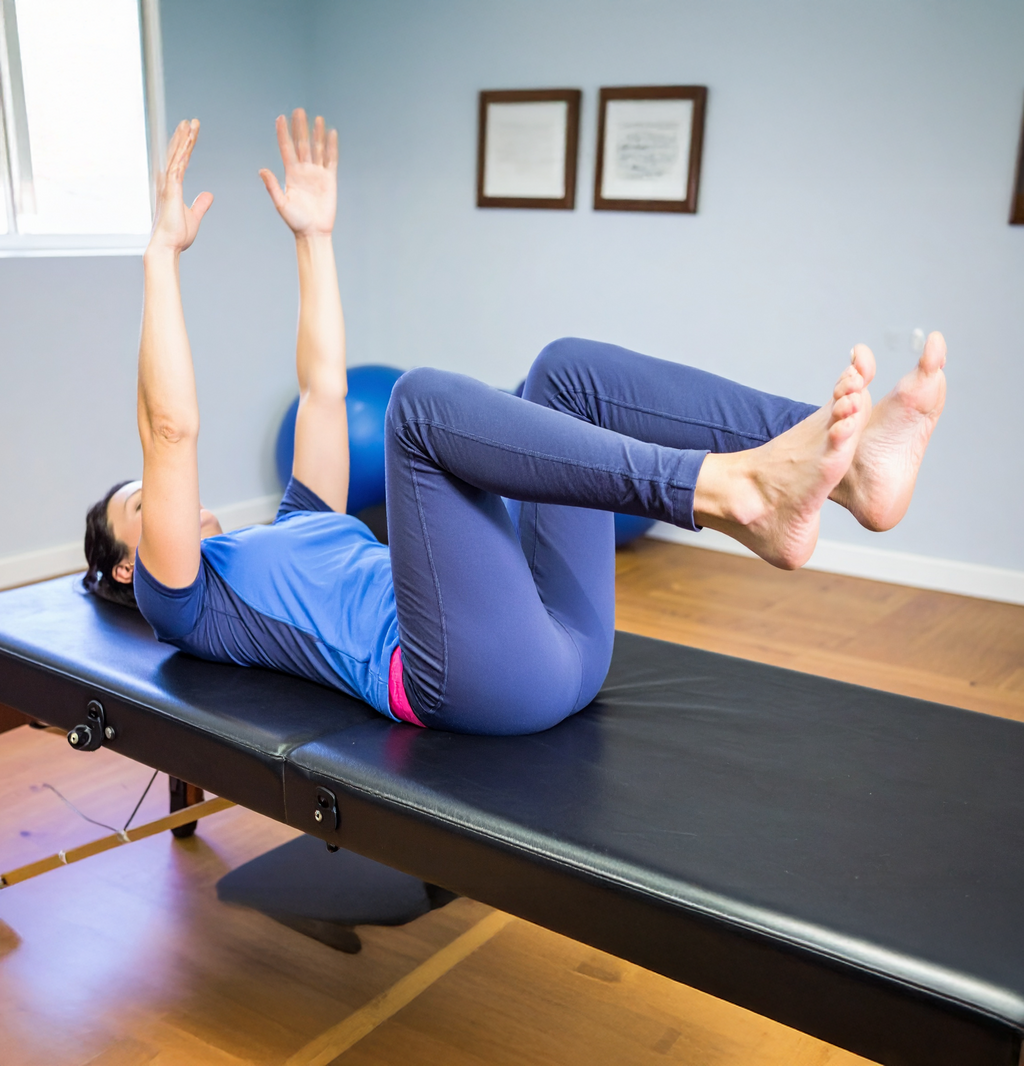
Lie on your back with your arms extended toward the ceiling and your knees bent at 90 degrees over your hips. Actively perform a posterior pelvic tilt to press your lower back into the floor. Slowly lower your opposite arm and leg towards the ground without letting your back arch. If you feel it start to lift, you've gone too far. Return to the start and repeat on the other side.
Once you can maintain your PPT during dead bugs, you can progress to the hollow body hold and hollow body rocks. Start by lying on your back and bringing your knees to your chest. Press your lower back into the floor (PPT). Lift your head and shoulders off the ground, protracting your scapulae. From here, slowly extend your arms and legs. Find a point of extension where you can hold the position without your lower back arching. That is your hollow body hold.
The hollow body rock is the ultimate test. By initiating a gentle rocking motion, you challenge your core to maintain rigidity dynamically. This skill translates directly to creating a stable 'plank in the air' during pull-ups and preventing your hips from sagging in push-ups.
Ready to test your understanding of these core concepts?
What is the primary benefit of the hollow body position in advanced calisthenics?
What is the foundational movement for establishing a hollow body position?
Mastering these mechanics transforms your core from a simple stabiliser into a powerful force generator for all advanced calisthenics.