Mastering Advanced Algebra and Functions
Quadratic Functions and Systems
The Shape of Quadratics
Quadratic functions create a U-shaped curve called a parabola. The way we write the function's equation can tell us a lot about the parabola's position and orientation on a graph. You're likely familiar with the standard form from Algebra 1.
While standard form is useful, another form makes it much easier to spot the parabola's turning point, or vertex. This is called vertex form.
The vertex is the key to optimization problems. It represents the maximum or minimum value the function can achieve.
To convert from vertex form to standard form, you just expand the squared term and combine like terms. For example, let's convert :
- Expand to get .
- Distribute the 2: .
- Add the 5: .
Going the other way, from standard to vertex form, requires a technique called completing the square. It's a powerful algebraic method for rewriting quadratics.
Where Lines and Curves Meet
What happens when a straight line crosses a parabola? They can intersect at two points, one point, or not at all. A system of one linear and one quadratic equation helps us find these exact intersection points.
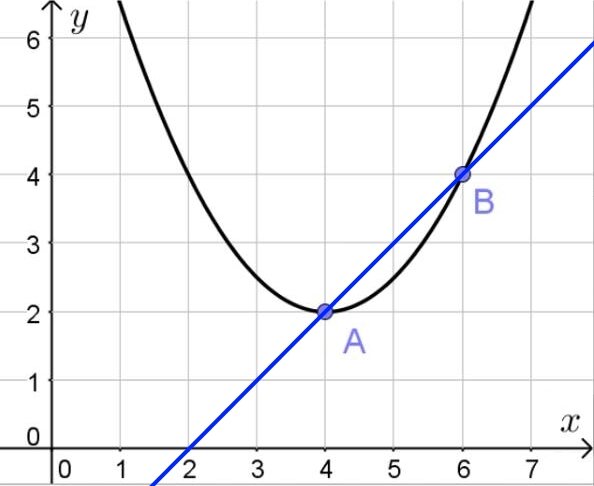
Imagine a system with: (a parabola) (a line)
Since both equations are equal to , we can set them equal to each other to find where they intersect. This is the substitution method.
Now we have a new quadratic equation. To solve it, we first need to set it equal to zero.
This new equation's roots (its solutions for ) are the x-coordinates of the intersection points. We can solve this by factoring: . This gives us and . To find the full coordinate points, we plug these x-values back into the simpler linear equation, .
For , . Intersection point is . For , . Intersection point is .
Modeling Real-World Paths
Quadratic functions are incredibly useful for modeling real-world situations, especially projectile motion. When you throw a ball, its path through the air is a parabola.
Let's say the height (in meters) of a rocket at time (in seconds) is given by the function . The term represents the effect of gravity, the term is its initial upward velocity, and the is its starting height.
Suppose we want to know when the rocket hits the ground. That happens when its height is 0. So we need to solve:
This equation is difficult to factor because of the decimal coefficients. This is a perfect time to use the quadratic formula to find the roots.
In our rocket problem, , , and . Plugging these into the formula gives us two possible values for : about seconds and seconds. Since time can't be negative in this context, we discard the second answer. The rocket hits the ground after approximately 8.21 seconds.
We can also use the vertex to find the rocket's maximum height. The x-coordinate of the vertex is given by the formula .
For our rocket, seconds. This is the time when the rocket reaches its peak.
To find the maximum height, we plug this time back into our height function: meters. The vertex of this parabola is at approximately .
Inequalities and Optimization
Just as we can have linear inequalities, we can have quadratic inequalities. For example, . The solution to this is not a line or a curve, but an entire region on the coordinate plane.
To graph it, you first treat it as an equation () and draw the parabola. Since the inequality is > and not ≥, the parabola should be a dashed line to show that points on the curve itself are not solutions. Then, you test a point not on the parabola, like . Is ? Yes, is true. So, you shade the entire region containing , which is the area inside the parabola.
This idea of finding the best outcome, known as optimization, is a major application of quadratics. The vertex of a parabola represents either a maximum or a minimum value.
Imagine you're building a rectangular garden and you have 80 feet of fencing. You want to maximize the garden's area. Let the length be and the width be . The perimeter is , which simplifies to . The area is .
We can express in terms of : . Now substitute this into the area formula: .
This is a quadratic function that opens downward (because of the ). Its vertex will give us the maximum possible area. Using the vertex formula , we get . If the width is 20 feet, the length is feet. The optimal shape is a 20x20 square, giving a maximum area of 400 square feet.
Ready to test your understanding of these quadratic concepts? Let's see how you do.
Convert the quadratic function from vertex form to standard form.
A system of one linear and one quadratic equation can have, at most, two intersection points.
By understanding the different forms and methods for solving quadratics, you can model and solve a wide range of complex problems.