Mastering Active Components in Electronics
Electricity Basics
The Language of Circuits
The easiest way to understand electricity is to think of it like water flowing through pipes. This isn't just a convenient story—the physics are surprisingly similar. In this analogy, the water itself represents electrical charge, the tiny particles that do all the work.
Imagine a water tower. The height of the water creates pressure. The higher the tower, the more pressure you get at the bottom. In electricity, this pressure is called voltage.
Voltage
noun
The electrical pressure or force that pushes charged electrons through a wire. It represents the potential difference between two points.
Voltage doesn't do anything on its own. It's just potential. You can have a full water tower with the valve shut, and nothing will happen. The same is true for a battery sitting on a table. It has voltage, but no electricity is flowing.
The flow itself is what we call current. In our analogy, current is the volume of water moving through the pipe per second. More current means more water is flowing. In a wire, it means more charge is moving.
Current
noun
The rate at which electric charge flows past a point in a circuit. It is measured in amperes (amps).
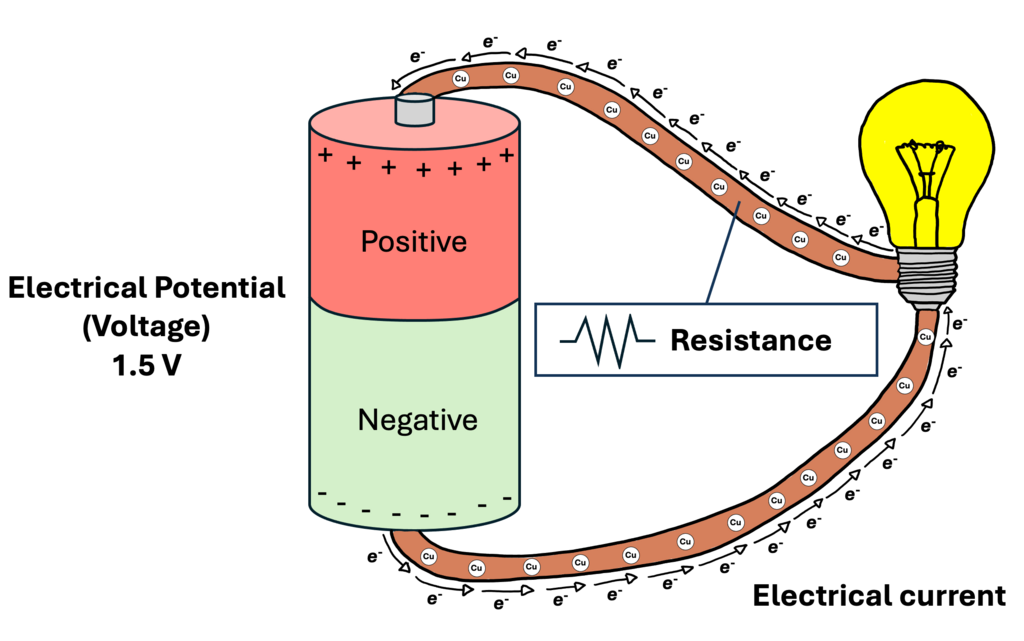
Finally, every pipe has a certain width. A wide pipe lets a lot of water through easily, while a narrow straw resists the flow. In electricity, this is resistance. It’s a measure of how much a material opposes the flow of current. A thick copper wire has very low resistance, while the tiny filament in a light bulb has very high resistance.
A Simple, Unbreakable Rule
These three concepts—voltage, current, and resistance—are linked by a fundamental relationship discovered by in the 1820s. He found a simple, elegant formula that describes how they interact. We now call it and it is the cornerstone of circuit analysis.
The law states that the current flowing through a conductor is directly proportional to the voltage across it, and inversely proportional to the resistance. In simpler terms:
- If you increase the pressure (voltage), more flow (current) will result.
- If you increase the restriction (resistance), less flow (current) will result.
The Closed Loop
There's one final, crucial piece to this puzzle. For electricity to flow, it needs a complete, unbroken path. This is called a closed circuit.
Think about the pipes again. If you have a pump (the voltage source) and a narrow section of pipe (the resistor), water can only flow if the pipe leads back to the pump. You need a complete loop. If there's a break anywhere in that loop, the flow stops instantly everywhere.
A light switch works by creating a break in the circuit. When you flip the switch off, you're opening a gate and breaking the loop. When you flip it on, you're closing the gate and completing the path again.
This is why a battery has two terminals, positive (+) and negative (-). To power something like a light bulb, you must connect a wire from the negative terminal, through the bulb, and back to the positive terminal. This creates the closed loop needed for current to flow and for work to be done.
Understanding this flow is the first step. Next, we'll see how special components can do more than just resist this flow—they can actively control it.
In the common analogy comparing electricity to water in pipes, what does the water pressure represent?
According to Ohm's Law, if you keep the resistance in a circuit constant and increase the voltage, what will happen to the current?