Mastering Acid Base Titration
Introduction to Acid-Base Titrations
Finding the Unknown
Imagine you have a bottle of lemonade, but you don't know how sour it is. You want to find out exactly how much lemon juice is in there. You could add a neutralizing substance, like baking soda, bit by bit until the sourness is completely gone. By measuring how much baking soda you added, you could figure out how much lemon juice was there to begin with.
In chemistry, we do something very similar to find the concentration of an unknown acid or base. This process is called titration.
titration
noun
A laboratory method used to determine the concentration of a substance by reacting it with a solution of a known concentration.
Titration is a precise way of measuring how much of a known substance is needed to completely react with an unknown one. It's a fundamental technique in analytical chemistry, used for everything from quality control in the food industry to medical diagnostics.
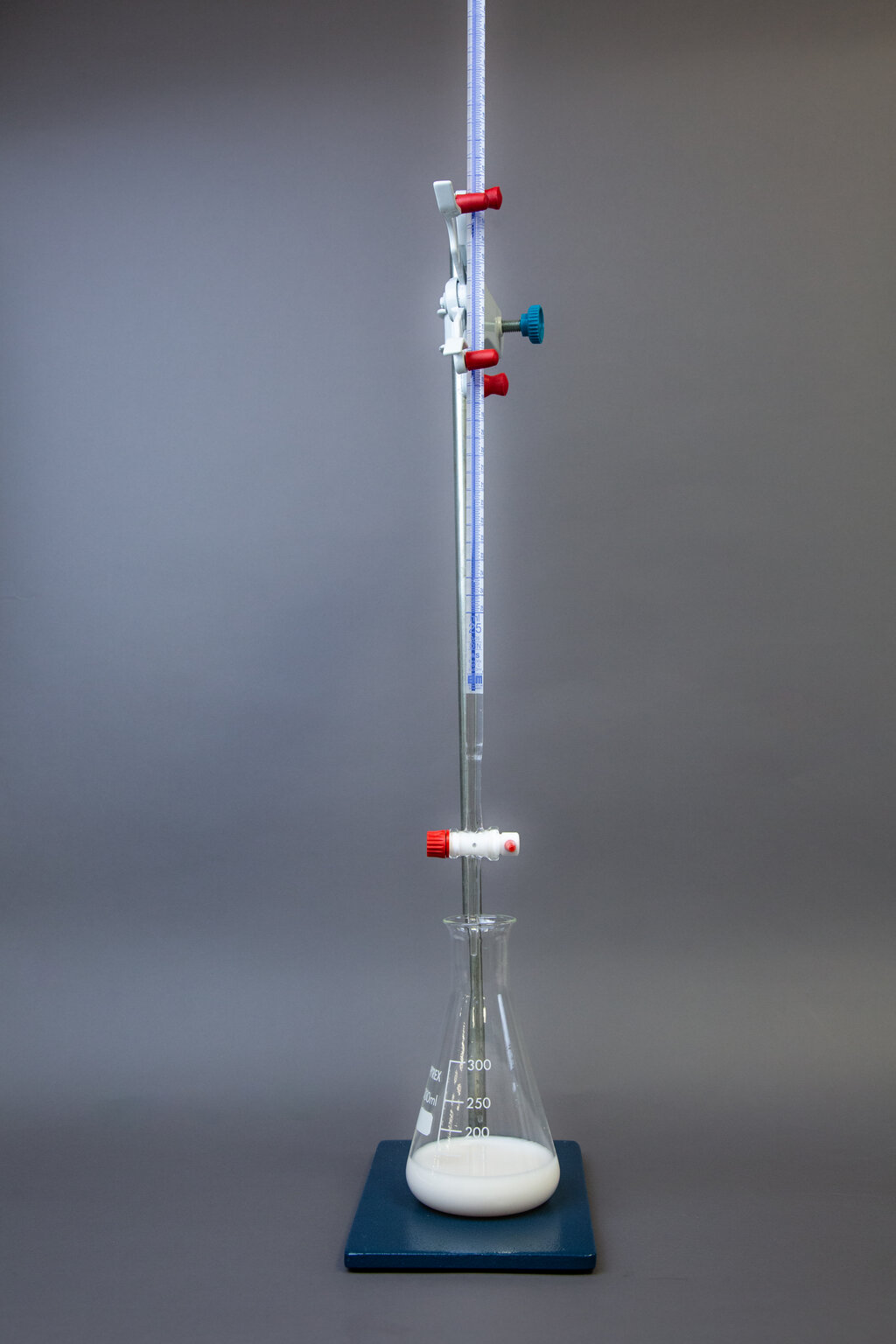
The Key Players
Every titration involves two key solutions: the analyte and the titrant. One has a concentration we know, and the other is the mystery we're trying to solve.
The analyte (or titrand) is the solution with the unknown concentration. It's the lemonade in our example. This is usually the solution in the flask under the burette.
The titrant is the solution with the precisely known concentration. This is our baking soda. It's added carefully from a long, graduated tube called a burette.
| Term | Role | Concentration |
|---|---|---|
| Analyte | The substance being analyzed | Unknown |
| Titrant | The substance added to the analyte | Known |
By measuring the exact volume of titrant needed to react completely with the analyte, we can calculate the analyte's unknown concentration. It's a bit like chemical detective work.
The Core Reaction
Acid-base titrations work because acids and bases neutralize each other in a predictable way. When you mix an acid with a base, they react to form water and a salt. This is called a neutralization reaction.
For example, if we titrate hydrochloric acid (HCl), a strong acid, with sodium hydroxide (NaOH), a strong base, they react to form sodium chloride (NaCl)—table salt—and water (H₂O).
In this specific reaction, one molecule of HCl reacts with exactly one molecule of NaOH. This fixed ratio is crucial. It allows us to use the amount of titrant added to calculate the exact amount of analyte that was originally in the flask.
The predictable, one-to-one neutralization between an acid and a base is the chemical foundation that makes titration a powerful and precise tool.
Now, let's check your understanding of these foundational concepts.
What is the primary purpose of performing a titration in analytical chemistry?
In a titration setup, the solution of a precisely known concentration that is added from a burette is called the titrant.
By understanding the roles of the analyte and titrant and the neutralization reaction that connects them, you have the groundwork for exploring how titrations are performed and analyzed in the lab.