Mastering Academic Article Critique and Framework Development
Understanding Academic Articles
The Anatomy of a Research Paper
Reading an academic article for the first time can feel like trying to understand a conversation in a foreign language. The language is dense, the topics are specific, and the structure is unfamiliar. But once you learn the basic layout, navigating these articles becomes much easier.
Most research papers follow a similar format (IMRAD).
Most papers in the sciences and social sciences follow a structure called IMRAD. It stands for Introduction, Methods, Results, and Discussion. This format tells a logical story, moving from a broad question to a specific answer and back out to the bigger picture.
Think of it as an hourglass. The introduction starts with a broad context and narrows down to a specific research question. The methods and results sections are the narrowest part, focusing on the details of the study. The discussion then widens back out, connecting the findings to the broader field.
Breaking Down IMRAD
Before you dive into the main body, you'll see a few other key elements. The Title gives you the topic in a nutshell. The Authors and their affiliations tell you who did the work and where they're from. And the Abstract is a super-condensed summary of the entire paper. It’s your best friend for quickly deciding if an article is relevant to your research.
Always read the abstract first. It provides the essential information: the problem, the methods, the key findings, and the main conclusion. It’s the movie trailer for the paper.
Now, let's walk through the main sections.
| Section | Purpose | Key Questions Answered |
|---|---|---|
| Introduction | Provides background and context. | Why was this study done? What problem is it addressing? What is the research question or hypothesis? |
| Methods | Explains exactly how the study was conducted. | Who or what was studied? What materials were used? How was data collected and analyzed? |
| Results | Presents the findings of the study, without interpretation. | What did the data show? What were the key findings? |
| And Discussion | Interprets the results and discusses their implications. | What do the findings mean? How do they relate to previous research? What are the limitations? What's next? |
How to Navigate an Article
You don't need to read an academic article from start to finish like a novel. A more strategic approach will save you time and improve your understanding.
Try reading your article out of order! (No one said we have to follow the rules all the time, right?) Start with the abstract, and skim through the Introduction and the Conclusion (Don't see one? Read the Discussion instead.) Note the hypothesis and article findings.
Here’s a common strategy for reading a research paper efficiently:
- Start with the Title and Abstract: Get a high-level overview. Is this paper relevant to your interests?
- Read the Introduction: Understand the background and the specific question the authors are trying to answer.
- Jump to the Discussion/Conclusion: Find out what the authors think their results mean. This gives you the main takeaway of the paper.
- Examine the Results: Look at the figures, tables, and data. Do they support the authors' conclusions? This is where the evidence lives.
- Skim the Methods: Unless you plan to replicate the study or need to understand the technical details, you can often just skim this section to get a general sense of how the work was done.
After the main text, you'll find the References section. This is a list of all the sources the authors cited. It can be a goldmine for finding other important papers on the same topic.
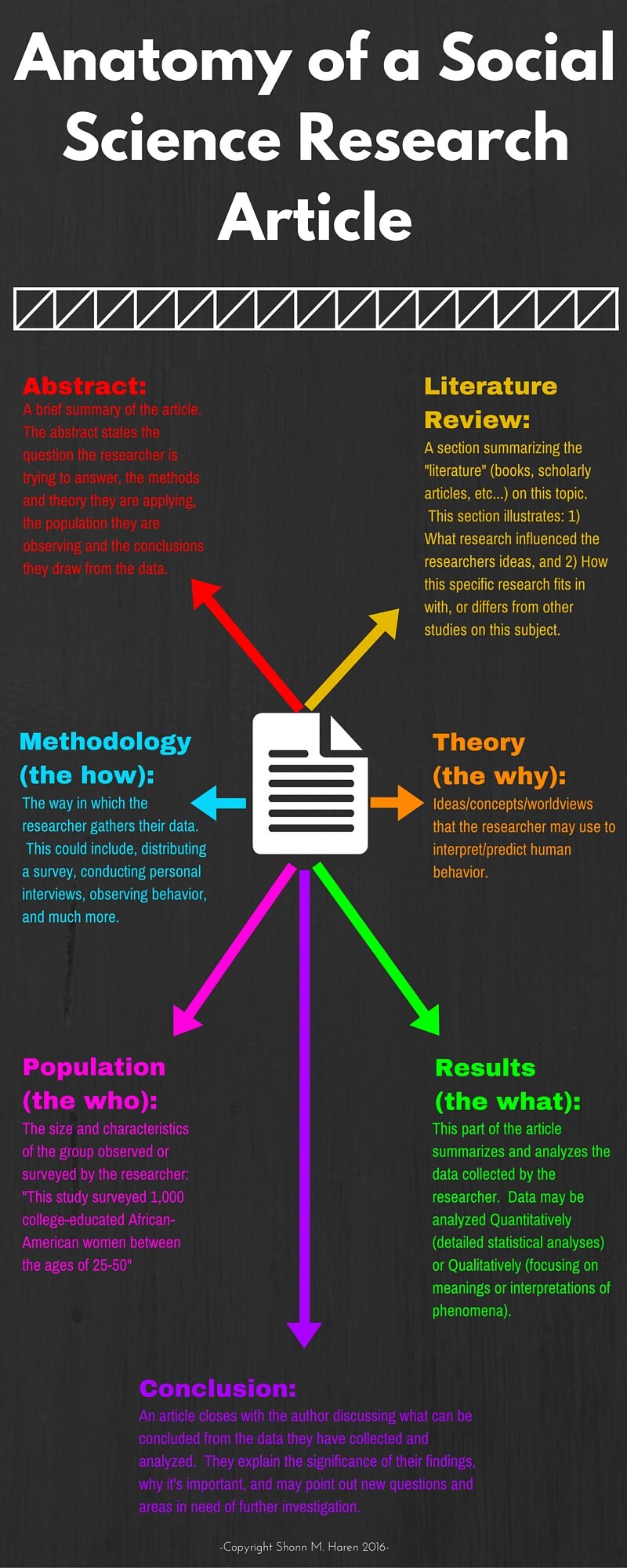
Understanding this structure is the first step toward reading academic literature with confidence. It provides a roadmap, helping you find the information you need quickly and efficiently.
Ready to test your knowledge? Let's see what you've learned about the structure of academic articles.
What does the acronym IMRAD stand for in the context of academic articles?
The structure of many academic papers is often compared to an hourglass. Which parts represent the widest sections of the hourglass?
By recognizing the IMRAD structure, you can move from being a passive reader to an active investigator, piecing together the story the research is telling.