Mastering A-Level Mathematics
Algebra Fundamentals
The Language of Algebra
At its heart, algebra is about using symbols to represent unknown numbers. This lets us write down rules and relationships in a general way. The most basic building blocks are algebraic expressions, which are combinations of numbers, variables (like and ), and operations.
An expression doesn't have an equals sign. It's a phrase, not a full sentence. For example, $3x^2 + 2x - 5$ is an expression.
Working with algebra often means simplifying these expressions. This involves combining 'like terms', which are terms that have the same variable raised to the same power. Think of it as sorting different kinds of fruit. You can combine all the apples and all the bananas, but you can't combine an apple and a banana.
For instance, in the expression , the terms and are like terms. So are and . We can combine them:
Simplifying makes expressions easier to work with before we start solving equations.
Solving Quadratic Equations
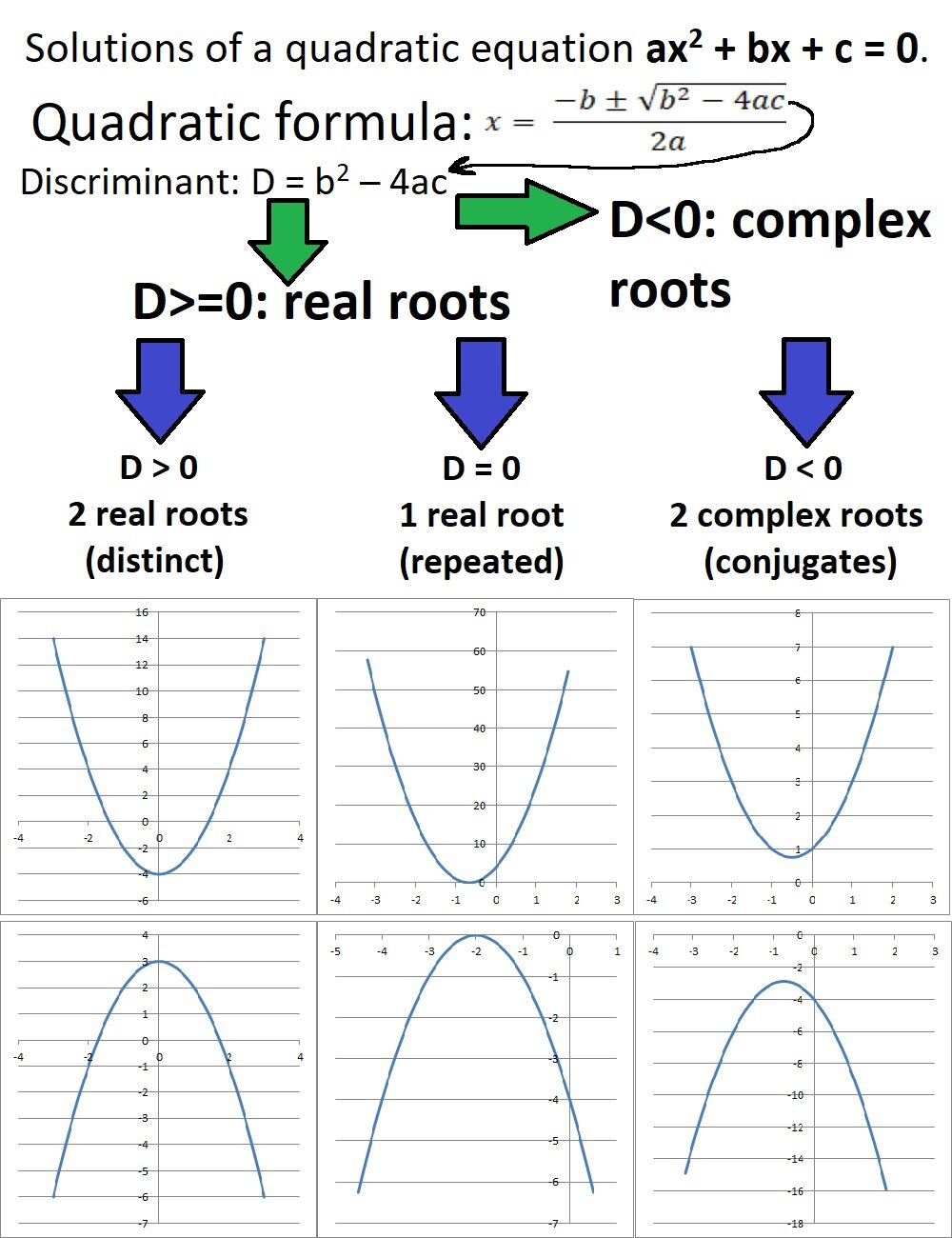
When an expression is set equal to something, we have an equation. One of the most common types you'll face is the quadratic equation, which has the general form:
Here, , , and are known numbers, and is not zero. The highest power of the variable is 2, which is what makes it 'quadratic'. Solving the equation means finding the value (or values) of that make the statement true.
While you can solve these by factoring, there's a powerful tool that works every time: the quadratic formula.
Let's solve . First, identify your coefficients: , , and . Now, substitute these into the formula:
Simplify step by step:
The symbol means we have two possible solutions. We calculate each one separately.
One solution is .
The other is .
So, the solutions are and . These are the points where the graph of the parabola crosses the x-axis.
Working with Inequalities
Inequalities are similar to equations, but instead of an equals sign, they use symbols like (less than), (greater than), (less than or equal to), or (greater than or equal to). Solving an inequality gives a range of values, not just one or two specific answers.
The key rule: if you multiply or divide both sides of an inequality by a negative number, you must flip the inequality sign.
Let's solve the inequality . The goal is to isolate , just like in an equation.
- Subtract 3 from both sides: .
- Divide both sides by -2. Because we're dividing by a negative number, we must flip the sign: .
This means any number greater than or equal to -3 is a valid solution.
Understanding Functions
A function is a rule that takes an input and produces exactly one output. Think of it like a machine: you put something in (the input), it does something to it (the rule), and something else comes out (the output). We often use the notation , which is read as "f of x".
function
noun
A relation between a set of inputs and a set of permissible outputs with the property that each input is related to exactly one output.
For example, consider the function . This rule says to take any input , square it, and then add 4.
If we want to find , we replace every in the rule with 3. .
So, for an input of 3, the output is 13.
What about ? The principle is the same. We substitute everywhere we see an :
We can expand this expression: .
These concepts form the bedrock of more advanced mathematics. Getting comfortable with manipulating expressions, solving equations, and understanding functions is essential for what's to come.
Ready to check your understanding? Let's try a few questions.
Simplify the following algebraic expression:
What are the solutions to the quadratic equation ?